The Short Version
- Performance: Ray Porter is perfectly matched to Robert Kurson's propulsive nonfiction prose, delivering both the historical reconstruction and the modern-day diver sequences with the same controlled urgency.
- What it covers: obsession and the cost of the hunt, Golden Age piracy, the archaeology of character
- Feel: Breathlessly paced and cinematic, alternating between seventeenth-century adventure and contemporary deep-sea tension
- Our call: Kurson and Porter make Pirate Hunters the rare nonfiction audiobook that genuinely competes with adventure fiction for pure listening pleasure.
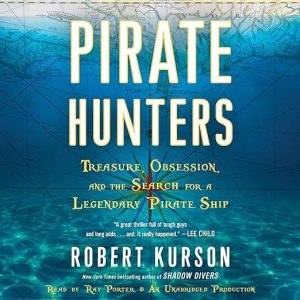
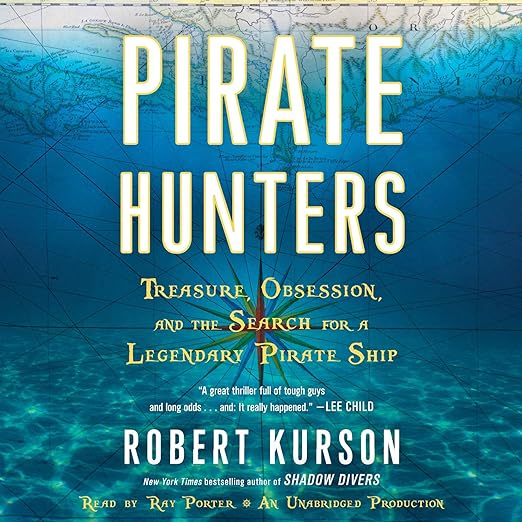
Kurson's Pirate Hunters begins with a puzzle that crosses three centuries: where is the Golden Fleece, the lost ship of the pirate Joseph Bannister, and why has no one found it? Robert Kurson's answer, developed across this riveting audiobook narrated by Ray Porter and running eight and a half hours, is that locating a pirate ship requires something more than technology and determination. It requires learning to think like a pirate. That idea, the pirate and the pirate hunter as mirrors of each other across time, is the animating principle of a book that earns every word of the adventure-nonfiction label applied to it.
The project Kurson chronicles is the search by two experienced divers, John Chatterton and John Mattera, for the Golden Fleece, the ship of Bannister, a seventeenth-century pirate whose exploits were, as Kurson argues, more audacious than Blackbeard's and more daring than Kidd's, but whose story was swallowed by history. If Chatterton and Mattera succeed, it will be only the second time in history that a pirate ship has been positively identified. The odds, and the obstacles, are considerable.
What Robert Kurson Delivers
Kurson's previous book Shadow Divers established a structural template that Pirate Hunters both follows and extends. In both books, a present-day investigation is intercut with historical reconstruction, and the contemporary protagonists are drawn as richly as any fictional character. Chatterton and Mattera carry their own histories, their separate expertise, and an evolving partnership whose tensions and loyalties are as interesting as the diving itself. One reviewer noted that Kurson has found gold, and that praise is precise: the book is not only well-reported but well-structured, with the dual timeline generating dramatic tension rather than merely providing educational variety.
The historical passages on Bannister are where the book's ambition is most visible. Kurson researched archives across multiple countries to reconstruct a life that left fragmentary records. The result is not quite biography, because the evidence will not support biography, but something more like intelligent inference from artifacts: this is who such a man would have to have been, given what the records show. The Wall Street Journal called Chatterton and Mattera real-life Hemingway heroes, and that framing extends to the historical Bannister as well. Kurson is drawn to a particular kind of man who makes his commitments absolute and lives with the consequences.
What Robert Kurson Gets Right
Ray Porter's narration is excellent, and the pairing of Porter with Kurson's material is one of those combinations where the listener senses an instinctive fit. Porter's voice has a natural authority that suits both the historical sequences and the contemporary ones, and he handles the pace shifts between archive-room research and underwater discovery without losing momentum. Publishers Weekly gave the book a starred review partly for the way Kurson's own enthusiasm and eye for detail produce one of the most mind-blowing pirate stories of recent memory, and Porter's performance makes that enthusiasm contagious rather than breathless.
The audiobook structure is particularly effective in the sections where Chatterton and Mattera travel the globe chasing documents and following leads that repeatedly go cold. In print, research montages can lose energy; in Porter's hands they carry the quality of a thriller's midsection, where the accumulation of failed attempts is building toward something. One reviewer noted their delight at discovering this fast-paced adventure story also happened to be true. That reaction, the shock of the true-story landing like fiction, is a Porter specialty.
Where Robert Kurson Loses Some Ground
The most interesting structural choice Kurson makes is refusing to let the historical and modern storylines stay separate. The divers don't just find objects; they find ways of thinking about Bannister that require abandoning the assumptions historians have made. Partway through the book the investigation shifts from locating a ship to understanding why a man made the choice that defined his life, and that shift is when Pirate Hunters becomes something more than excellent adventure journalism. It becomes a meditation on what we owe the past and what the past, correctly understood, can teach the present.
The dangerous rivals who appear in the story are real and their interference is not just a plot complication. The politics of underwater salvage, the competing national and commercial claims on shipwrecks, and the ethical questions around who owns recovered history are threads Kurson does not resolve neatly, because they cannot be. Listeners who want adventure stories without the complications of historical ownership debates may find those passages less gripping than the diving sequences, but they are intellectually necessary to the full argument.
Should You Listen to Pirate Hunters?
Adventure nonfiction readers who responded to Shadow Divers will find this a natural continuation, though it works fully as a standalone. Those drawn to the Golden Age of Piracy as a subject, from academic interest to swashbuckling enthusiasm, will find Kurson's reconstruction of Bannister's world both entertaining and substantive. Listeners who enjoy the cold-case investigation structure, where solving a historical puzzle requires understanding how the past actually functioned rather than how we imagine it did, will find this audiobook unusually satisfying.
Readers who want a rigorous academic treatment of seventeenth-century piracy, or who want the deep-sea diving sequences detailed in the manner of a technical manual, should be aware that this is popular nonfiction aimed at general audiences. The rigor is narrative rather than scholarly, and that is its great strength. What Kurson offers is not less than scholarship, but differently organized: his argument lives in the pacing, the accumulated detail, and the way he connects a man dead three hundred years to two men alive today.