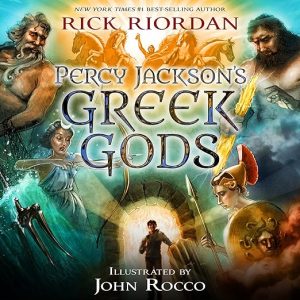
This audiobook has a review headline that looks like a verdict on the recording and turns out to be something else entirely: I always forget that these are narrated and snarky. Read it once and you assume somebody is praising Jesse Bernstein. Read the entry underneath and the word narrated means the book itself, the fact that Rick Riordan wrote a mythology reference in the voice of a sarcastic teenager instead of in the voice of a scholar. It is an accidental pun, and it lands on the single most important thing about this title: the voice is the content, and everything else follows from that decision.
If you want the premise in one sentence, a reader here already supplied it: an unlikely and hilarious reference book of Greek mythology. A publisher in New York asks Percy to write down what he knows about the gods, he asks whether it can be done anonymously because he does not need the Olympians angry again, and then he goes through the whole pantheon from Apollo to Zeus with commentary. The creation of the world, the Olympian Council, Hestia and Hades and Persephone, the titans taking down Ouranos, the gods taking down Kronos, Arachne, and the complete catalog of Zeus's affairs. It is a real survey, not a sampler, and one reader lists the coverage in detail because the coverage is genuinely what impressed them.
Where the conceit earns itself is in the seam between the myth and the joke. One reader makes the point precisely: Percy adds obvious and often ridiculous contributions, gods using modern technology or eating junk food, and those additions stay clearly separable from the material underneath. A child listening learns the actual story and hears the commentary as commentary. Reference books written to be funny usually sacrifice one of the two. This one holds both, which is why it works as a first mythology as well as a joke. The gods come out recognizably themselves and the punchlines sit on top of them. Riordan is not inventing the strangeness either; the source material supplies far more of it than any comic writer could.
Hours of Audio Erase a Ruler-Sized Complaint
The single strongest argument for buying the recording instead of the book comes from the only four-star response here, and it has nothing to do with the writing. That reader bought the hardcover and describes an object almost as tall as a ruler, nine inches across, over three hundred pages, awkward to hold, and responsible for a few near misses to the face while turning pages. Twelve hours and twenty-three minutes of audio makes that entire complaint disappear. The one hesitation anybody records here proves to be a hesitation about an object, not about a book.
A reference structure also suits listening better than it has any right to. The entries are self-contained, so you can stop after a god and resume a week later without losing anything, and the material was composed as speech in the first place: asides, interruptions, a narrator who keeps talking to you. Jesse Bernstein is credited alone, reading a book that is already a monologue, and Listening Library issued it in August 2014. Twelve hours and twenty-three minutes is generous for a reference title, which tells you how much material Riordan decided to cover.
Cannibalism Called a Golden Age
That children's category deserves a closer look before you hand it to anyone. The description itself sets the terms, promising horror shows, blood baths, lying, stealing, backstabbing and cannibalism, and calling all of it a Golden Age. Greek myth is violent, and this version does not sand it down; one reader notes that the harsher stories arrive with humor attached but they do arrive. The listing files it under children's audiobooks with an action and adventure tag, which undersells the content by a fair margin.
What the page cannot tell you is where this belongs in the sequence. A reader here says as much, admitting to no idea why these companion volumes surface where they do in a recommended reading order and wanting to get on to other characters. The listing carries no series name and no number, so a listener buying for a young fan has no guidance on whether to play it before, after or between the novels, or whether it belongs to a numbered set at all. In practice the order barely matters, since nothing here spoils a plot, but a buyer should not have to work that out alone.
Listeners who take to this will immediately want the matching volumes, and the same response names them: Carter Kane's Egyptian Gods and Magnus Chase's Norse Gods. Neither is mentioned anywhere in the description, so the connection exists only in the review column. It is a small failure of merchandising and a useful piece of information at the same time, which sums up what this page offers generally.
The Voice Is Set in Two Minutes
Nothing here requires prior knowledge of the novels, and that is worth stating plainly, because the packaging suggests otherwise. A listener who has never met Percy will follow every entry: the voice is established in the first two minutes and the mythology is explained from creation forward. One reader specifically praises how the teenage perspective makes the material land for younger listeners without talking down to them. That is the hardest register in children's nonfiction and Riordan holds it for the whole runtime.
Two audiences should think twice. Anyone wanting a straight, neutral mythology reference will find the interruptions constant and the tone relentless, since the jokes are not decoration but the delivery system. And anyone who dislikes Riordan's comic register in the novels will dislike twelve concentrated hours of it here, because this is that register with the plot removed.
For everyone else it is close to ideal family listening, provided the adult in the car knows what is coming in the darker stories. The 4.8 average across twelve ratings is unusually high and the written column supports it, with the only dissent aimed at a hardcover's dimensions. Twelve hours also covers a great many car journeys, and the entry-by-entry structure means nobody needs to remember where the last one stopped. Younger listeners get a real education wrapped in a joke they will not notice they are learning from.
- Read by: Jesse Bernstein is credited alone, reading a reference book already written as a teenager's monologue.
- At its heart: Greek mythology retold, comic voice, creation and succession myths, the Olympian pantheon.
- Vibe: Irreverent and chatty.
- Short version: A mythology primer that works better spoken than printed, and the only complaint here is about the hardcover's size.
Frequently Asked Questions
Will this audiobook work for someone who has not read the Percy Jackson novels?
Yes. The book explains the mythology from the creation of the world forward and establishes its narrator within the first few minutes. No plot from the novels is assumed. One reader praises exactly this, noting that the teenage perspective makes the material accessible without becoming condescending toward younger listeners.
Is the content really suitable for children?
Mostly, with a caveat the description supplies itself: it promises horror shows, blood baths, lying, stealing, backstabbing and cannibalism. Greek myth is violent and this retelling does not soften it, though the humor takes the edge off. Preview the darker sections if you are buying for a younger listener.
Does a reference book work as an audiobook?
Better than expected here, because the entries are self-contained and the prose was written as speech. You can stop after one god and pick up a week later with nothing lost. The four-star response also describes a hardcover so large it was awkward to hold, a problem the recording removes entirely.
Where does this fit in the reading order of the series?
The listing gives no series name and no number, and a reader here admits to being confused about where these companion volumes belong. That same entry points toward the companion volumes covering Egyptian and Norse mythology, titles the description never mentions once.