At a Glance
- Narrator: A single credit covers sixteen missions and a galaxy of aliens, so accent choices made in the first hour are choices you live with for four days of listening.
- Subjects: siblings displaced in time, fugitives building forward instead of going back, a galaxy coming apart politically
- Tone: Madcap and fast, with genuine jeopardy under the jokes
- Bottom line: An enormous, cheerfully chaotic space opera to disappear into, sold with almost nothing to check it against.
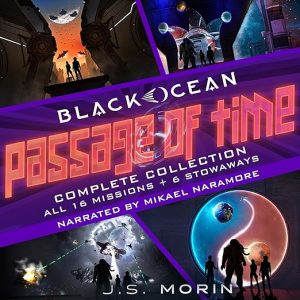
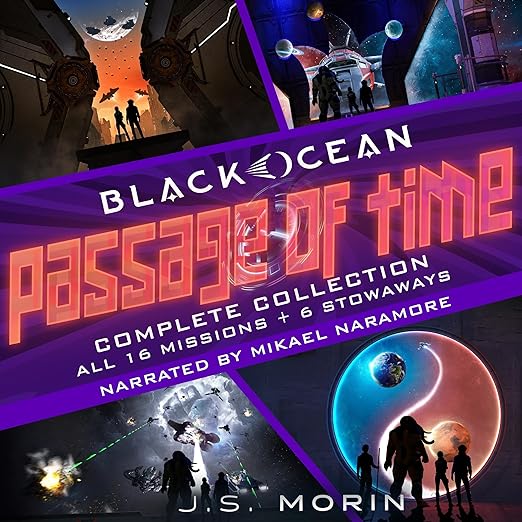
Ninety-three hours and one minute. A time travel prank goes wrong, two siblings land five years inside a future they do not recognize, and by the time they find their bearings one of them is a deserter from Earth Navy and the other has been branded a dark wizard. That is the premise, and the audiobook carrying it is one of the largest single purchases in the genre: sixteen missions gathered into one file, with a counter underneath showing a single rating and no written account of any kind.
Our Take on Passage of Time Complete Collection: Missions 1-16
Series fields sit empty on this record, which is a strange thing to find beneath a title reading Complete Collection: Missions 1-16. The description leaves no ambiguity about the situation. Black Ocean: Passage of Time is called a science fantasy series set in the late twenty-sixth century, and the closing paragraph calls it the latest series in the Black Ocean universe. So a larger universe exists, this is a series inside it, and neither fact reaches a field anyone can search. A buyer hunting for Black Ocean by name will not reach this record through its title, and a buyer who arrives through the title learns nothing about what else connects to it.
Underneath the field problems, the description is refreshingly direct about what it is selling. Jessie and Eric Ramsey, siblings, thrown five years forward by a prank that misfired, on the run through a galaxy whose politics are coming apart. They pick up alien allies and a powerful starship, and they decide against going home, which is the choice that makes a long series possible: carving out a future in the future instead of spending sixteen missions hunting a way back. The description then names its own reference points, asking what Futurama would look like jumping five years instead of a thousand, what happens if Doc and Marty lose the car keys, and what Bonnie and Clyde would be as siblings rather than lovers. Those three comparisons set the tone better than any adjective could.
Why Listen to Passage of Time Complete Collection: Missions 1-16
A complete collection solves the problem serial fiction usually creates. Sixteen missions bought separately means sixteen decisions, sixteen gaps and a standing risk that the run stops before it resolves. Bought together it becomes a single commitment with no cliffhanger you have to wait out and no chance of the next installment vanishing. At ninety-three hours the arithmetic runs heavily in the buyer's favor, close to six hours per mission with the whole arc covered by one price of entry. For anyone who listens while doing something else, a self-contained universe of this size is a genuinely different proposition from a standalone novel, because you stop choosing what to play next for months at a stretch.
Mikael Naramore is credited with all of it, which is an endurance assignment before it is anything else. Ninety-three hours from one voice means every alien, every sibling argument and every ship's officer arrives from the same throat, and what decides whether the collection works is consistency across the whole run rather than brilliance in any given scene. A character introduced in mission two has to sound identical in mission fifteen, recorded who knows how long afterward. Nobody has written a word about whether that holds, because the written column beneath this record is entirely empty. Play a few minutes from a late mission and a few from the first, then compare the two before committing to everything in between.
What to Watch For in Passage of Time Complete Collection: Missions 1-16
One rating stands under a ninety-three-hour purchase. It reads 5.0, which is a legitimate display for a single vote, since one voter can only award whole stars and five is one of them, so nothing about the badge is broken. Everything around it is missing instead. A collection released in August 2025 has had time to gather readers and has gathered one grade and no sentences, which tells a prospective buyer nothing about pacing across sixteen installments, nothing about whether the later missions hold their quality, and nothing about the recording. On a purchase this large, that is the most consequential thing the page fails to supply.
Tone is the other item to weigh carefully. The copy sells madcap and zany, a cast of misfits outsmarting the galaxy just to get by, and in the same breath sells a galaxy falling apart, fugitive status and a political landscape in collapse. Comic science fantasy with real stakes underneath is a difficult balance to hold across one novel and considerably harder across sixteen. The reference points chosen in the description suggest which way the balance tips, given that two of the three are comedies. Anyone who wants their space opera grave should read that list closely before spending anything.
Who Should Listen to Passage of Time Complete Collection: Missions 1-16
Listeners who binge are the obvious audience, particularly anyone who has just finished a long series and wants the next one to be enormous. If you already know the Black Ocean universe, a new series inside it with a fresh cast is the low-risk entry point that long-running universes rarely offer. Sibling stories carry an appeal that crew-romance stories do not, because the relationship is fixed, the friction is permanent and neither party can walk away, and this premise is built directly on that. Anyone who prefers a single reader to a full cast on very long runs will find the arrangement suits them.
Ninety-three hours reads to some buyers as a hostage situation rather than a bargain, and a collection this size only pays off when the first mission convinces you and the remaining fifteen are already bought. The same caution applies if you need reception before spending, since a lone rating leaves the description doing all the persuading. Listeners who want hard science fiction should register the copy's own term, science fantasy, and note that the dark wizard in the second sentence is not a metaphor. Should ninety-three hours inside one universe sound like the best problem you have had all year, this is the record for you.
Does the audiobook work as an entry point to the Black Ocean universe?
The description positions it that way. It calls Passage of Time the latest series in that universe and introduces an entirely new cast of misfits, which suggests a fresh starting line rather than a continuation. No prior volume is named as required reading anywhere in the copy.
How is the audiobook structured across its sixteen missions?
The title identifies missions one through sixteen collected as a complete set, so the natural unit is the mission rather than the chapter. Across ninety-three hours that works out near six hours apiece, which makes each one roughly the length of a short novel and a sensible stopping point.
Is this science fiction or fantasy?
The description settles it with its own label, science fantasy. One sibling is branded a dark wizard while the other deserts Earth Navy, magic and starships operate in the same setting, and the tag on the record reading Science Fiction only tells half the story. Expect both, unapologetically mixed.
Does the story reach a conclusion or stop on a hook?
Not stated. The title advertises a complete collection of missions one through sixteen, which covers the run as it stands, while the copy describes Passage of Time as the latest series in an ongoing universe. Whether the sixteenth mission closes the arc or opens the next one is left unanswered.