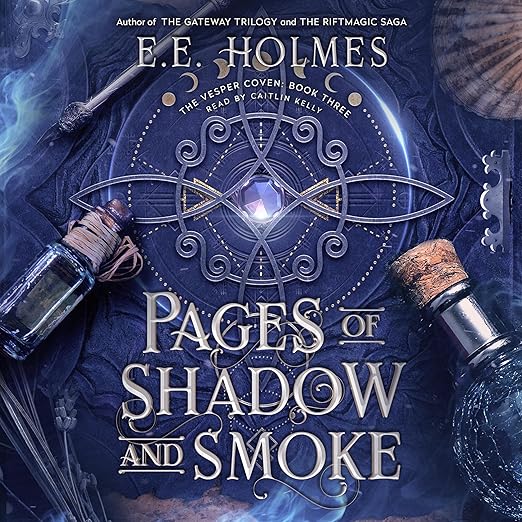
Key Details
- Narration: Caitlin Kelly returns to the Vesper Coven world with the same calibrated warmth she brought to earlier entries, handling the crossover characters from the Gateway series with assured familiarity.
- Themes: Legacy magic and its costs, the origin stories behind established power, grief as a haunting force
- Mood: Atmospheric and increasingly urgent, with the specific texture of All Hallows' Eve horror kept at a measured pitch
- Verdict: The strongest Vesper Coven entry in terms of answers delivered, though the first half tests even invested readers' patience before the crossover elements begin paying off in the second.
I have read enough series fiction to recognize the particular promise and particular danger of the third installment. Volume three is where accumulated worldbuilding has to start returning on its investment, where mysteries established in earlier books must begin resolving rather than simply multiplying, and where a reader's existing affection for characters is asked to carry them through structural work that a new reader would never accept. E.E. Holmes understands this calculus, and Pages of Shadow and Smoke delivers its payoffs, though not without demanding patience in the first half.
The Vesper Coven series follows Wren Vesper, who discovered her connection to a powerful family coven only recently and has been catching up on sixteen years of missed magical education. The setup in this third volume is clever: a mysterious woman named Jess Ballard arrives on Wren's doorstep claiming that Wren's dead grandmother Asteria sent her with a grimoire. The book's sinister past, the silence of spirit guides across the community as All Hallows' Eve approaches, and the thinning of the veil between worlds create a properly atmospheric framework for a mystery whose answer reaches back to the origin story of Sedgwick Cove itself.
The element generating the most reader enthusiasm in this volume is the crossover with Holmes's earlier Gateway Trilogy and Gateway Trackers series. Characters from that universe appear in Sedgwick Cove, and for readers who have spent time in the World of the Gateway, their arrival carries genuine emotional weight. One reviewer described it as the best move of all in the construction of this installment, which is high praise for a craft decision rather than a plot one.
Holmes handles the crossover thoughtfully. Readers who have not encountered the Gateway series are not penalized by their absence; the Sedgwick Cove story functions independently and the crossover characters are introduced with enough context to be comprehensible. But readers who have followed the earlier series will find layers of meaning in how these characters relate to the events of Sedgwick Cove, in what their presence implies about the nature of the deep magic here, and in the specific ways their skills and histories intersect with Wren's situation. It is the kind of interconnected universe building that rewards investment in an author's complete catalog without punishing those who have not made that investment, which is the ideal version of the crossover format. Holmes manages the balance better than many authors who attempt it.
What E.E. Holmes Gets Right
The honest critical note about this volume, acknowledged by a reviewer who describes herself as having read every book in the Gateway series multiple times, is that the first half has stretches of genuine tedium. The mystery elements are established, Jess Ballard is appropriately elusive, and the atmospheric Halloween setting is rendered with care, but the plot machinery turns slowly before the second half accelerates significantly.
This is a structural challenge rather than a character or prose problem. Holmes writes consistently well and the characters in this volume feel continued rather than reset, which is the correct approach for a third installment with an established audience. But the setup for the grimoire mystery and the spirit world silence requires more patience than it immediately earns before the resolution begins to arrive. Listeners who approach the first half as atmosphere-building rather than as plot delivery will have a better experience than those who are impatient for the answers Holmes is carefully withholding. The slow burn is intentional, and it does pay off in the second half with enough specificity to justify the accumulation.
Where E.E. Holmes Loses Some Ground
Kelly narrates this series and related series in the Holmes universe, which gives her a familiarity with the characters and the specific quality of atmospheric tension Holmes writes toward. Her performance is consistent with the earlier Vesper Coven entries: warm where warmth is needed, appropriately tense during the escalating All Hallows' Eve sequences, and confident with the crossover characters whose voices she presumably knows from narrating other Holmes projects.
At eleven hours and fifteen minutes, this is a substantial listen that benefits from Kelly's consistency. The middle sections where plot momentum slows are held together by her narration's sustained atmospheric quality, which is exactly the role a narrator is supposed to play in a series built on world and character as much as on incident. Her performance does not manufacture urgency the text has not yet earned, which is the disciplined choice and the right one for this material. Impatient narration of a patient mystery would undermine both.
Who Should Pick Up Pages of Shadow and Smoke
This free audiobook is not an entry point to the Vesper Coven series. Readers who want to understand what makes Sedgwick Cove's magic interesting, who Wren is and why her family matters, and what the relationship between the Coven and the spirit world means need volumes one and two first. That investment will make what happens in this third volume land with the weight Holmes has been building toward across the series.
For existing readers of both the Vesper Coven and the Gateway series, this is the installment that begins paying out on the promise of connected worlds. The ghost who lingers desperate for promised power, and whose machinations threaten the deep magic itself, is the kind of antagonist whose backstory rewards the patience required to reach it. Holmes is a careful builder, and the view from the third volume justifies the full investment of the series to this point. Reviewers who have read everything she has written confirm they keep coming back, and this installment explains why.