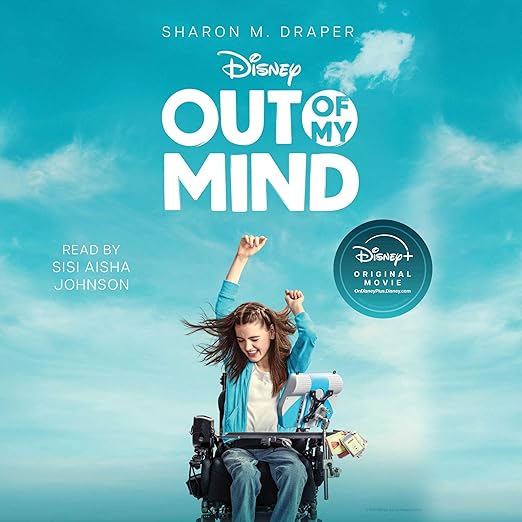
Melody has no voice and the audiobook hands her one. She cannot walk, talk or write, the description says, and she carries a photographic memory that has recorded every detail of everything she has ever experienced, which makes her the smartest child in her school and leaves no one aware of it. Putting that narrator into audio is not a neutral format decision. It is the version of this book where the distance between what Melody thinks and what anybody hears turns literal, for six hours and forty-nine minutes.
Our Take on Out of My Mind
Sharon M. Draper wrote it, Sisi Aisha Johnson reads it, and the credits stop at those two names. The copy supplies the rest of the context: a New York Times bestseller for three years and counting, an original film on Disney+, a starred notice from School Library Journal calling it a gutsy, candid and compelling story that speaks volumes, and a line from KirkusReviews reading unflinching and realistic. The page also positions it for readers of RJ Palacio's Wonder, which is the publisher's comparison and not one I would reach for.
Two of the five visible responses are not written in English, and one of those is not about the book. A five-star entry filed from Brazil runs to a single sentence, and that sentence concerns the order arriving as requested rather than anything inside the story. A five-star entry filed from Japan is a genuine reading response, written in Japanese, dated December 2014, more than a year before this recording was published. Remove those two and three English responses remain, one of them two lines long. That leaves a 4.7 badge, eighteen votes, and three usable opinions.
Draper's premise does the thing most fiction about disability avoids, which is to make the audience complicit in the misjudgment. Most people, her teachers, her doctors, her classmates, dismiss Melody as mentally challenged because she cannot tell them otherwise, and the structure depends entirely on the listener knowing more than every adult in the room. Charis M., a CNA at a facility handling long-term acute care for brain and spinal cord injuries, found a copy left behind in a younger patient's room and has since pressed it on colleagues across healthcare and child care. That is the book working precisely on the audience it was built for.
Why Listen to Out of My Mind
Sisi Aisha Johnson carries the entire recording, and not one response on this page mentions the performance. On most listings that silence would be unremarkable. Here it borders on perverse, because the central fact of the novel is a child who cannot make herself heard, and the product under discussion consists of somebody making her heard for nearly seven hours. Whether Johnson pitches Melody's interior voice as an eleven-year-old or as the intelligence trapped behind an eleven-year-old is the largest interpretive decision in this edition, and the column has nothing whatever to say about it.
Six hours and forty-nine minutes is a comfortable length for middle-grade fiction and a generous one for the classroom use this book keeps attracting. Greg Chisholm read it with a godson for a class. Courtney bought it for a ten-year-old son who needed a book for a book report and chose it because it looked like something he might relate to. Both are describing set-text situations, and both describe them going well, which is not the usual report from that quarter. Chisholm's entry is also the most recent thing on the page, filed in December 2025, and it is the only indication of how lately people are still arriving.
The publisher's comparison deserves to be taken seriously and then set aside. Pointing it at readers of Wonder tells a bookseller which shelf to use and undersells the difference: Melody narrates, and the narration is the entire apparatus. A photographic memory is a device with teeth, since it means nothing is forgotten and no slight goes unrecorded. The copy promises a story that will forever change how we all look at anyone with a disability, which is publisher language, but the mechanism sitting underneath that promise is real and it is doing the work.
What to Watch For in Out of My Mind
Classrooms and family listening are where this lands, and both should know the material is tougher than the category label implies. The listing files it under children's audiobooks with a tag reading Growing Up and Facts of Life, while the content covers an eleven-year-old written off by doctors and teachers, cruelty from classmates, and the daily physical reality of cerebral palsy. Draper does not soften any of it, on the evidence of the starred notice the copy quotes, which reaches for the word unflinching. A child anxious about being misunderstood may find this cathartic or may find it a great deal to sit with. The page cannot help you predict which.
Not one of the five responses appears to concern this edition. The Japanese entry predates the March 2016 recording by well over a year. The Brazilian one addresses a delivery. Charis M. describes a physical copy left behind in a hospital room, Courtney describes buying something for a school report, and Greg Chisholm recommends the film alongside the story. The audio edition, which is the thing actually on sale here, has no direct testimony standing behind it.
Who Should Listen to Out of My Mind
Anybody who works with children who cannot communicate easily should hear this, and the review column argues that better than any description could: a CNA found it in a patient's room and started handing it to coworkers. Families with a listener somewhere between eight and thirteen are the core audience, particularly households where somebody is already being underestimated. Listeners who use audio because print is difficult have a further reason to be here, since a story about a person locked out of ordinary communication reaching them through the format that unlocks reading is not a small coincidence. Adults who arrived through the film and want the original will find a book with more interiority than a screen can carry, since nearly all of it happens where nobody can see it.
Whoever wants a gentle story about difference is served badly here, because the design of this one is to leave you sitting inside a misjudgment and feeling it for hours. Whoever expects the comfortable register the Wonder positioning implies may find this considerably sharper. Teachers most of all, and anybody still reading, get a novel whose central conceit and chosen format point in the same direction. Melody spends the book unable to be heard, and this is the edition where somebody finally reads her out loud.
Before You Press Play
- Narration: Sisi Aisha Johnson gives a speaking voice to a narrator who has none, which is the whole argument for choosing this format.
- Themes: Cerebral palsy and misjudgment, photographic memory, school cruelty, being underestimated.
- Mood: Warm, angry, quietly devastating.
- Verdict: The format this book was waiting for, on a page carrying almost no testimony about the recording.
Questions Listeners Ask
Who reads the Out of My Mind audiobook, and why does that casting matter?
Sisi Aisha Johnson, across six hours and forty-nine minutes. The casting matters more than usual because the narrator cannot speak, walk or write inside the story, so every word a listener hears is interior. How that interior voice is pitched is the biggest interpretive choice in this edition.
Do the listener responses say anything about this audiobook edition?
None of them do. Two are not in English, one of those concerns a delivery, and another predates this recording by more than a year. The remaining entries describe a copy left in a hospital room, a school book report and a film recommendation. No direct testimony about the reading exists.