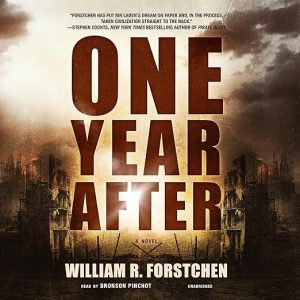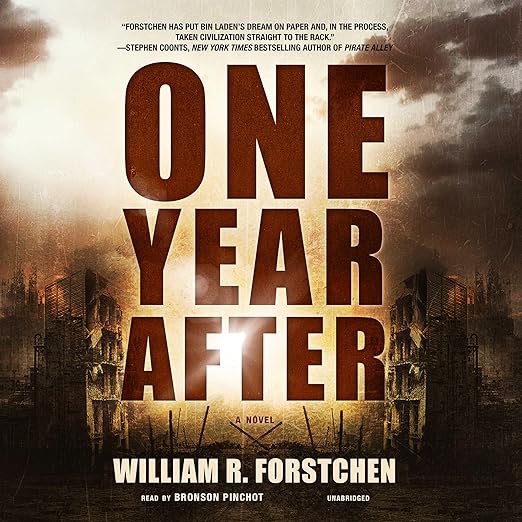
- Voice: Bronson Pinchot brings genuine investment to John Matherson's voice; the narration has the right texture of quiet urgency that suits a story about a man rebuilding order in the aftermath of collapse.
- Big ideas: Community survival after grid collapse, the tension between civilian autonomy and emerging authority, the long aftermath of catastrophe
- Atmosphere: Measured and sobering, with the weight of a world that has not recovered and shows no signs of recovering quickly
- Worth it?: A worthy continuation of the One Second After premise that rewards series readers, though listeners new to Forstchen should start with the first book before committing to this one.
I listened to One Year After on a Sunday afternoon that stretched into evening, parked on the couch during a rainstorm. The weather felt appropriate. Forstchen writes about a world that has lost its infrastructure, and there is something about listening to that particular kind of quiet dread while the lights are still on and the heating is running that gives the experience a specific texture it would not have in better weather.
This is the second book in William R. Forstchen's John Matherson series, the follow-up to One Second After, which was cited from the floor of Congress as a book all Americans should read and discussed in Pentagon corridors as a realistic look at the dangers of electromagnetic pulse weapons. That context is not incidental. Forstchen is not writing pure genre fiction; he is writing a thought experiment with a political thesis, and that thesis has real-world traction in ways that most post-apocalyptic fiction does not.
Is One Year After Worth Your Time?
The setup begins where One Second After ended. The small town of Black Mountain, North Carolina, has survived the EMP attack and the initial catastrophic die-off that followed. John Matherson, a former military historian now serving as the community's central organizing authority, is trying to hold together a functioning society in a landscape that still has no grid, no supply chain, and no external support. The title tells you where the book is set: twelve months after the event, in the difficult middle space between immediate survival and something that might eventually resemble recovery.
What Forstchen does well in this continuation is resist the pull of false optimism. The world of Black Mountain is not healing; it is stabilizing, which is different. The book is concerned with the tensions between a community that has survived by developing its own internal order and the emerging federal authority trying to reassert control over a country that has functionally collapsed. That political tension gives the book more narrative complexity than pure survival fiction, and Forstchen handles it with the even-handedness that comes from having thought carefully about the implications of his premise.
The Best Parts of One Year After
Bronson Pinchot's narration is a consistent strength of the John Matherson series. Pinchot is best known for comedic work, but he brings a quiet authority to Forstchen's material that serves the protagonist's combination of grief, pragmatism, and genuine leadership. The voice is not heroic in the conventional genre sense; it is the voice of a man who is doing what needs to be done without any conviction that it is enough. That texture is difficult to achieve in narration and Pinchot manages it throughout.
The book also benefits from Forstchen's commitment to the specificity of his premise. Unlike post-apocalyptic fiction that uses collapse as backdrop for adventure, One Year After is interested in the granular details of how communities actually function, or fail to function, in the absence of infrastructure. Food production, medicine, governance, the problem of what to do with the people who did not survive the winter: these are treated as substantive questions rather than stage dressing.
Before You Commit to One Year After
This is explicitly a middle book in a series, and it reads like one. The central conflict of the novel does not resolve so much as open into a new set of problems that clearly require a third book. Readers who want a self-contained narrative will be unsatisfied. One reviewer described it as a necessary sequel and a good lead-in to the next book, which is accurate as a description but requires accepting that the book's function is transitional.
The political dimensions of the story will also be more or less engaging depending on the listener's own views. Forstchen's politics are not hidden, and the concerns about government overreach in a post-collapse context reflect a specific ideological position about federalism and local autonomy. Listeners sympathetic to those concerns will find the political narrative compelling; those who are not may find some of the ideological framing more present than they prefer in genre fiction.
Should You Listen to One Year After?
Series readers who finished One Second After and want the continuation are the primary audience, and the book delivers what they are looking for: more time in Black Mountain, more of Matherson's perspective on a world that has not gotten better, and the beginning of a conflict that the third book will need to resolve. New listeners should start with One Second After; the emotional and narrative weight of this volume depends on prior investment in both the setting and the protagonist. Listeners interested in the EMP threat as a genuine geopolitical concern rather than just a premise will find Forstchen's research and his engagement with the subject more substantive than most fiction of this type.
A Few Questions About One Year After
Can One Year After be read without having first listened to One Second After?
It is possible to follow the narrative without prior context, but not recommended. The emotional weight of the second book depends on investment in Black Mountain and John Matherson built over the first novel. Starting with Book 2 is technically manageable but loses much of what makes the series compelling.
How does Bronson Pinchot's narration suit the material, given that he is primarily known for comedic roles?
Pinchot proves an effective choice here. He brings a quiet, measured quality to Matherson's voice that fits the character's combination of grief, pragmatism, and exhausted authority. Reviewers of the series have not flagged his narration as a problem, and the performance holds up across the full runtime.
How plausible is the EMP threat that underpins the series, and does Forstchen's treatment of it hold up?
The EMP threat is real enough to have been discussed in congressional hearings and Pentagon briefings, which is part of why the first book achieved the reception it did. Forstchen's treatment is informed rather than speculative, and the series has been cited by policy audiences as a credible popularization of a genuine national security vulnerability.