Before You Press Play
- Performance: Susan Peirce Thompson narrates her own material with the warmth and steady authority of someone who has lived every word, making the daily devotional format feel like a personal check-in rather than a lecture.
- What it covers: Food addiction recovery, daily mindfulness, sustained behavioral change
- Feel: Steady and encouraging, grounded in clinical experience
- Our call: A genuinely useful daily companion for anyone working through the Bright Line Eating framework, best absorbed in the morning in small doses.
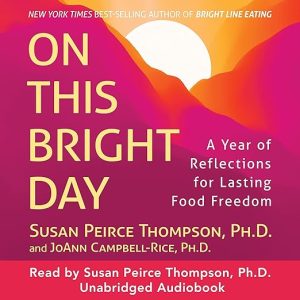
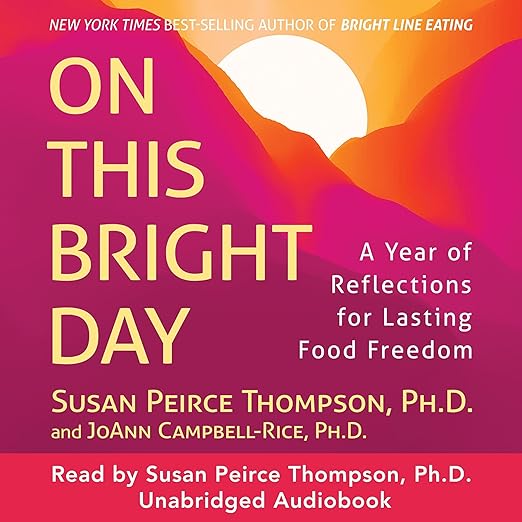
Few audiobooks are designed to be consumed one page at a time, in silence, before the rest of the day gets loud. On This Bright Day by Susan Peirce Thompson PhD is precisely that kind of audiobook, and the distinction matters enormously when you sit down to evaluate it. This is not a listen-straight-through experience. It is a 365-entry devotional built for people who are somewhere in the middle of recovery from food addiction, working the Bright Line Eating system that Thompson laid out in her New York Times bestselling book of the same name. At 12 hours and 51 minutes in total, each daily entry runs just a few minutes, and that brevity is a feature, not a compromise. The format mirrors the actual texture of recovery: not a dramatic arc but a daily practice, modest and repetitive and quietly necessary.
Thompson herself narrates, which shapes the entire character of the listening experience. Her voice has the unhurried cadence of a therapist who has sat across from this specific fear many times before. She does not perform reassurance; she offers it plainly. That distinction is subtle but felt across hundreds of short entries, and it is the reason listeners return to this audiobook morning after morning rather than finishing it in one session.
What Thompson has constructed here is a support structure for people who already know the Bright Line Eating approach and need ongoing reinforcement rather than instruction. The year-long format means the audiobook mirrors the actual passage of time in recovery, which is not linear, clean, or dramatic. It is repetitive and quiet and hard in small ways on ordinary days. That is exactly the gap this product fills. One reviewer described it as the daily devotional she had been searching for for years, and the specificity of that reaction tells you something about the audience finding their way here. They are not casual listeners. They arrive with something at stake.
The content across the 365 entries weaves through interconnected themes: healing the body alongside healing the mind, the role of purpose and meaning in sustaining recovery beyond food and weight, and the particular challenge of maintaining forward momentum when progress is invisible from day to day. Thompson approaches each of these themes with the directness of someone who has conducted this conversation hundreds of times with actual clients and knows which framings land and which ones slide past without purchase. The entries feel tested rather than composed in the abstract.
The supporting PDF that accompanies the audio is worth noting. Thompson supplements the spoken entries with written material, which signals that she understands her listeners are processing information across multiple channels. For anyone managing a recovery practice with journaling or written tracking, that pairing is genuinely useful rather than a marketing add-on.
Thompson's Own Voice Argues for Audio Here
The argument for choosing the audio version over reading the book in print is Thompson herself. Her delivery carries a quality that printed text cannot fully replicate: the sense of being spoken to directly by someone who built the system and has watched it work and fail and work again across thousands of people. When she says that your future is indeed Bright, it does not read as a slogan. In audio it lands as a considered statement from someone who has earned the right to make it.
The daily structure also trains a particular kind of listening discipline. You play one entry and sit with it. Then you close the app. There is something countercultural about that in an era of binge consumption, and for listeners whose food patterns have historically involved compulsive behavior, the built-in stopping point may have genuine therapeutic relevance beyond the content itself. The entries weave through themes of body healing, mental clarity, purpose, and the meaning of food in a broader life. Thompson does not pretend the work is easy. She acknowledges struggle with consistency and without sentimentality, which earns listener trust across the long arc of a year.
Built Only for Those Who Know Bright Lines
This audiobook has an unusually narrow effective audience. If you have not read Bright Line Eating or engaged with Thompson's framework elsewhere, the daily entries will feel like fragments without context. The book assumes familiarity with concepts like Bright Lines, susceptibility, and the food plan, and it does not pause to explain them. Listeners without that foundation will find the entries cryptic rather than reinforcing. That is not a flaw in the product; it is a design constraint worth naming clearly before purchase.
The rating of 4.9 from nearly 500 listeners is striking given that framing, because it suggests the people finding this audiobook are overwhelmingly the right audience for it. The responses are consistent: listeners describe using it as part of a morning routine, playing a single entry before the day begins. That is exactly the use pattern Thompson seems to have designed for. If your listening habits run more toward immersive, chapter-driven narrative, this will feel foreign. The format asks something different of you, and the payoff is proportional to your willingness to meet it on its own terms.
Prior Exposure to Bright Line Eating Helps Most
The ideal listener is someone already working the Bright Line Eating program who wants a daily spoken anchor for their practice. People in early recovery who struggle with the silence between meals, who find written devotionals easy to skip, and who respond well to a consistent voice will get the most from Thompson's narration. This also works well for anyone who has lapsed and is re-entering the practice, since the year structure allows you to pick up anywhere without needing to start over from the beginning.
Who should skip it: anyone approaching this without prior exposure to the Bright Line Eating system, anyone looking for a comprehensive introduction to food addiction science, and anyone who prefers longer-form analytical content over brief daily affirmations. For those listeners, Thompson's original Bright Line Eating book or her podcast would serve better as a first entry point. This one is a maintenance tool, and it works best once the foundation is already in place.
Questions Listeners Ask
Do I need to have read Bright Line Eating before listening to this audiobook?
Yes, strongly recommended. On This Bright Day assumes familiarity with the Bright Line Eating framework, including its core concepts and food plan. Without that context, the daily entries will feel incomplete. Read or listen to Thompson's original Bright Line Eating book first.
Is the accompanying PDF essential, or does the audiobook stand on its own?
The audio entries are self-contained, but Thompson designed the PDF as a supplement. For listeners who journal or track their practice in writing, the PDF adds value. If you are purely an audio listener, you will not miss critical content by skipping it.