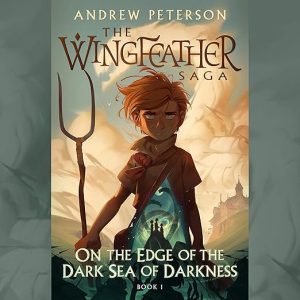
- Voice: Andrew Peterson performs the book as its author, which settles how a page full of invented names is meant to sound.
- Big ideas: Siblings, a hidden inheritance, occupation and resistance, family loyalty
- Atmosphere: Warm, funny, gently perilous
- Worth it?: A strong family listen, provided somebody opens the supplementary map file before the drive starts.
An asterisk at the bottom of the description carries the only sentence written with a listener in mind: "This audiobook includes a PDF of maps, illustrations, and more." Everything above it belongs to the printed book, including an invitation for families to read the story aloud. Listening Library issued the recording in January 2021, Andrew Peterson is credited both as author and as narrator, and the recording lasts eight hours and nineteen minutes.
Gifted as All Children Are, the Book Says
Janner Igiby lives in a cottage above the cliffs with his brother Tink, their disabled sister Leeli, a dog named Nugget, a noble mother and a grandfather who used to be a pirate. The Fangs of Dang have crossed the water to rule the land with malice, and the Igibys turn out to hold a secret about the lost legend and jewels of good King Wingfeather of the Shining Isle of Anniera. It is a classic shape, executed with more warmth than the plot summary suggests, and the family is drawn well before the danger arrives. The description makes a small, characteristic move early on, calling the three children gifted as all children are, which tells you the register the book means to work in long before any Fang appears in the story.
Zoe's Mom gives the most persuasive account of what the book does to a reader. That entry describes borrowing a copy from a library on a trip out of town, laughing out loud from the opening pages, stopping to share a few lines with curious companions, then buying a copy on returning home "to place on the shelf right alongside the classics, such as C.S. Lewis's Narnia tales." Another response reaches for the same comparison in its title, calling the book a new Narnia for a new generation. Two readers, nine years apart, landed on the same shelf.
Silly names are the entry barrier, and the column addresses it directly. One reviewer opens by warning readers not to be dissuaded by the odd names given to creatures and people here, insisting that this is not a silly book. That is fair advice. The invented vocabulary is dense in the early chapters, and the ear takes longer than the eye to absorb unfamiliar proper nouns, which is a real consideration when you cannot glance back up the page to check a spelling.
Peterson Chose the Names He's Now Pronouncing
Andrew Peterson reads it, which changes the calculation on a book like this one. The publisher copy says outright that families can read the story aloud, and a self-narrated recording is the closest a purchased file gets to that arrangement: the person who chose every one of those strange names is the one pronouncing them. Where a hired reader would be guessing at intended emphasis, the author is simply reporting it. That advantage matters more on invented-world children's fiction than on almost any other category.
Eight hours and nineteen minutes is a comfortable length for a family serial, roughly two weeks of bedtimes or a long car journey with room to spare. The description casts a wide net, promising a tale children of all ages will cherish, a text families can read aloud, and enough layers of meaning for reading groups to discuss. Those are three separate audiences in one paragraph, and the responses suggest the copy is not overselling: one reviewer reports lending the book to an eighty-two-year-old parent who then bought the rest of the series.
Kiki, writing from Germany in late 2025, reviews something else entirely, reporting that the household loved the book so much they also watched the cartoon on an app. That is a useful signal in its own right, since it tells you this story now exists in more than one medium and that families move between them. It is not, however, a comment on the recording, making this the second of five responses that never touches the text.
One Review Is Actually About the Cartoon
Maps and illustrations arriving as a separate PDF is standard practice and worth planning for. A children's fantasy with an invented geography leans on its map, and here the map lives in a file rather than in front of you. If the intended listener is a child in a car, someone will need to have opened that document in advance on a device within reach, or the geography stays abstract for eight hours.
Two of the five responses in this column have nothing to do with the story. One reports a fast delivery and a friend's satisfaction with a gift. The other is about an animated adaptation. Of the three that engage with the book, all describe a printed object being borrowed, lent, shelved, or handed around, which leaves this recording without a single word of assessment anywhere on its own listing.
Action and Adventure is the tag, and it undersells what the book is doing. The adventure is real, but the material that reviewers single out is the family: three siblings, one of them disabled, a mother holding the household together, a grandfather with a past. Buyers steering by tag alone may expect something more propulsive and less domestic than what arrives, and parents scanning for reading level should note the description places this with middle readers while the column insists adults enjoy it equally.
Sample First if Invented Nouns Bother You
Parents looking for a shared listen with children roughly eight and up have an unusually strong candidate here, particularly households that already work through fantasy series together. The comparison two separate reviewers reach for is not a small one, and the recording arrives in the author's own voice, which is the best available answer to the question of how these names are supposed to sound. Reading groups get an explicit invitation from the publisher as well, and the layered-meaning claim is the sort of promise that usually collapses under inspection but appears to have held across nine years of responses here.
Anyone allergic to whimsical invented nouns should sample before buying, because the density of them in the opening chapter is the single most common complaint these reviewers bother to preempt. Families already reading aloud at bedtime may simply find that the recording does that work for them.
Frequently Asked Questions
What comes with the audiobook besides the recording?
A PDF of maps, illustrations and additional material, flagged by an asterisk at the end of the description. For an invented world this matters, since the geography is otherwise carried entirely by the prose. Open the file before you set off, because the map is not part of the audio.
How old should a listener be for this one?
The description aims at middle readers while promising something for children of all ages and for reading groups. Reviewers push the range further, with one lending the book to a parent in their eighties. Eight and up is a reasonable floor for following the plot without help.
Does the author narrate the Wingfeather Saga audiobook?
Yes. Andrew Peterson holds both the author and narrator credits, so the whole recording comes from the person who invented every name in it. On a book the publisher copy explicitly recommends reading aloud, that is a meaningful production choice, well beyond a cost saving.
Do the reviews describe this recording or the printed book?
The printed book, without exception. Three responses discuss borrowing, lending and shelving a physical copy, one covers a delivery, and one is about an animated adaptation watched on an app. Nothing in the column addresses the narration, so the credit is the only guidance available.