Quick Take
- Narration: James Fouhey voices both Kieren and Esten with enough distinction to keep the dual perspective clear, and brings genuine comedic timing to the book’s lighter moments – a good match for the story’s mix of action and warmth.
- Themes: Found trust between rivals, institutional corruption, the cost of inherited power
- Mood: Brisk and fun with genuine menace underneath – think adventure story with emotional intelligence
- Verdict: A confident debut fantasy with a slow-burn MM romance, an intriguing alternative-historical setting, and a magic system whose revelations divide readers sharply – worth the listen if you enjoy watching an unlikely partnership form under pressure.
I started this one on a Saturday morning with coffee and no particular expectations. I had been working through a batch of heavier literary fiction and wanted something that moved, that had momentum, that did not require me to hold an architecture of symbols in my head while also tracking a plot. Kit Vincent’s Of Feathers and Thorns gave me exactly that for about the first two-thirds, and then gave me something I was less prepared for in the final act – a magic reveal that, depending on your tolerance for a specific kind of fantasy trope, will either feel satisfying or deeply frustrating.
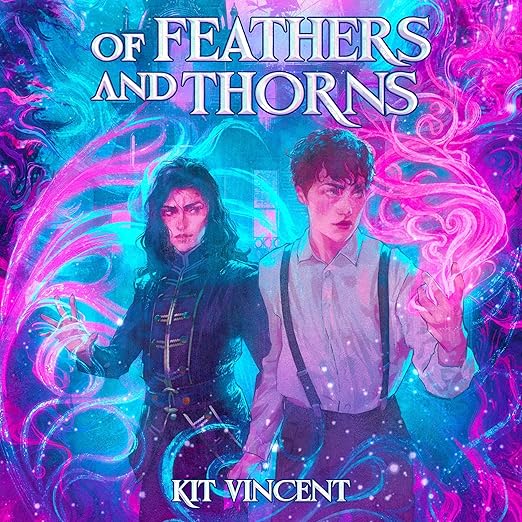
More on that later. First, the book itself. Set in an alternative early 1900s America where magic exists as an institutional force managed by the Magic Service, the novel follows Kieren Belltower, a young man whose unruly thorned magic has nearly destroyed his hometown and earned him a summons to apprenticeship. When he arrives, his assigned mentor is absent and he is stuck with Esten, the senior apprentice who is haughty and annoyingly handsome in equal measure, and who clearly would rather be doing literally anything else. Their teacher has vanished. Instructions have been left to trust no one. The investigation into illegal magic use and the mysterious phenomenon called the sludge begins more or less immediately.
Our Take on Of Feathers and Thorns
What Vincent does well is the partnership dynamic. Kieren and Esten are a genuinely engaging pair – not because they are complete opposites but because they are both people who have learned to manage themselves carefully around others, for different reasons. Watching that caution erode under pressure and shared danger is the book’s real subject, and the romance that develops from it is appropriately slow and respectful rather than rushed to a dramatic conclusion. Reviewer Sunny CA described it as a very mild romance with an HFN ending, and called the secondary characters strong. The ghost character known as spirit Oi brought enough comedy to earn mention from multiple reviewers.
The alternative historical setting – roughly equivalent to 1900s America with a bureaucratic magic infrastructure – is one of the more distinctive choices in recent self-published fantasy. Vincent does not exhaustively world-build in the way that can slow a debut novel to a crawl. The setting is established through texture and implication rather than information dumps, which is exactly the right approach for a nine-hour audiobook that is fundamentally interested in two people learning to trust each other under duress.
Why Listen to Of Feathers and Thorns
James Fouhey’s narration makes a significant difference to the book’s comedic register. The humor in Vincent’s writing is dry and character-based rather than situational, and Fouhey has the timing to deliver it without telegraphing the punchline. He also manages the dual-perspective structure – Kieren and Esten each have their own voice in the narrative – with enough differentiation that you never lose track of whose interiority you are inside. For an LGBTQ+ fantasy debut aimed at fans of Carry On and A Marvelous Light, the audio format particularly rewards the emotional subtlety of how these two characters circle each other.
The pacing is brisk almost throughout. The book takes place across approximately one week of story time, which reviewer Sunny CA noted creates a density of incident that keeps the plot moving even in its quieter interpersonal moments. Vincent trusts the reader to keep up without excessive recapping, which is a choice I appreciate more than I used to.
What to Watch For in Of Feathers and Thorns
Two structural issues surface in the reviews and are worth flagging. The first is the magic origin reveal in the final act. One reviewer, who gave the book three stars specifically because of this twist, described it as a common trope that undercut the originality of the world she had been so invested in. Another reviewer gave five stars without mentioning it as an issue. This is genuinely subjective territory – the reveal connects magic to something outside the book’s established world in a way that will feel either earned or deflating depending on your genre expectations. I will not name it, but if you are someone who reads a lot of fantasy and has strong feelings about specific recurring tropes, it is worth knowing the twist exists.
The second issue is structural ambiguity: the book ends in a way that feels like either a series opener with loose threads intentionally left open, or a standalone with an HFN ending that could go either way. This seems to be an ongoing uncertainty for readers. If you need a fully resolved story, that ambiguity may sit uneasily with you.
Who Should Listen to Of Feathers and Thorns
Readers who enjoy MM fantasy with slow-burn romance, competent protagonists learning to rely on each other, and alternative historical settings with institutional magic systems will find this a very satisfying nine hours. Fans of T. Kingfisher’s pacing, Rainbow Rowell’s emotional intelligence, or early R. J. Ford will find points of contact here. Those who need their fantasy worlds to be fully fleshed out over hundreds of pages may find the setting underdeveloped. And listeners who have strong feelings about the specific trope the magic reveal employs should probably look up what it involves before committing. But for the right reader, this is a debut that makes a genuine case for its author’s talent.
Frequently Asked Questions
Is Of Feathers and Thorns a standalone novel or the beginning of a series, and does it end on a cliffhanger?
This is one of the book’s genuine ambiguities. The story resolves its central investigation and the two protagonists reach a meaningful point in their relationship, giving it an HFN feel. But several plot threads remain open in ways that suggest either a planned sequel or an intentionally inconclusive ending. The author has not definitively clarified the series status, which has frustrated some readers who need clearer resolution.
How explicit is the romance between Kieren and Esten, and is the MM relationship central to the plot or a subplot?
The romance is very mild – more tension and growing emotional intimacy than explicit content. It develops gradually over the course of the story and is central to the emotional arc but does not drive the main plot, which is the investigation into the illegal use of magic and the phenomenon called the sludge. Listeners looking for explicit MM content will find this restrained; those who prefer slow-burn and emotional complexity will find it well-executed.
Does James Fouhey handle the alternating perspectives between Kieren and Esten clearly in the audiobook?
Yes, Fouhey differentiates the two voices enough to keep the perspective shifts clear. Kieren’s narration has a slightly more open, reactive quality; Esten’s is more guarded and controlled. The distinction is subtle rather than theatrical, which suits the material.
What is the alternative historical setting actually like – how much does the 1900s America backdrop matter to the story?
The period setting is more textural than historically detailed. Vincent uses it to establish a specific institutional feel for the Magic Service – bureaucratic, hierarchical, embedded in social class – without committing to the kind of period-accurate world-building that would require extensive historical research. The setting functions more as atmosphere than as a historically rigorous alternate history. Listeners expecting detailed Edwardian-America authenticity should calibrate expectations accordingly.