What does a counter reading one rating mean when five people have written full paragraphs beneath it? That is the first question this audiobook puts to a buyer, before a single obelisk lands anywhere. The star line says 4.5. The rating count says one. Five signed responses of real length, spread over thirteen months, sit directly underneath. Whatever produced that display, it was not one person voting, and a display broken this plainly is worth naming ahead of everything else, since the number is what most buyers glance at and believe.
Two columns on this page are describing two different rooms. The counter claims a single rating. The written column holds five people who read closely enough to argue about a character's military rank, to explain how the equipment market is set up, and to notice what the system pointedly refuses to do for anybody. A rating costs one click. A paragraph costs the book. So the counter is either missing most of its population or it is tallying a different edition, and the 4.5 printed above it was computed from a group this page declines to show you. The paragraphs are the part worth reading.
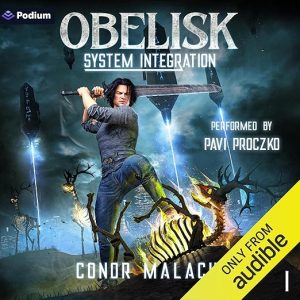
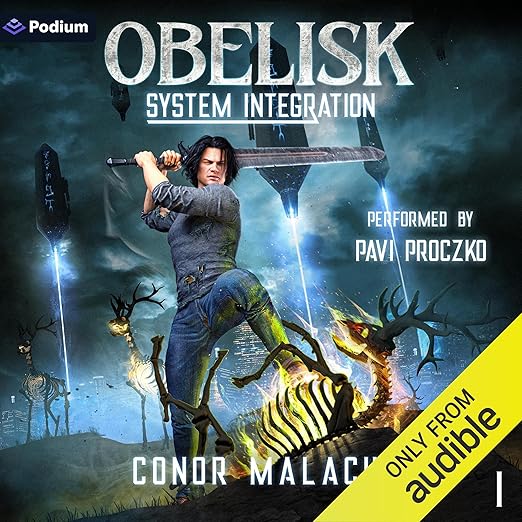
Underneath the broken display sits an unusually pointed premise. The obelisks arrive with a single message: join the games and give humanity a fighting chance, or roll over and die. Warren signs up. He has cancer, two friends, one of whom is his dog Buck, and a very short list of things left to lose. The copy puts the reasoning in his own voice, preferring to bleed out with a sword in hand over a hospital bed, then immediately conceding that hospital beds are not looking so bad after all. That reversal is the book's real tone.
The Best Parts of Obelisk: System Integration: A LitRPG Adventure
An entry filed in August 2024, six months ahead of the release date on this record, identifies exactly what makes the setting worth the time. Everyone who receives the system in this world has something wrong with them: mostly old, some terminally ill. The system fixes none of it. In most books of this shape, integration doubles as a cure and a power fantasy. Here humanity reaches the games already compromised, and the protagonist can function most of the time but not always, which is a far more demanding constraint to write around than any level cap.
An August 2025 response describes the arc that grows out of that: not the typical save-the-world story, a man who is not popular and has been dealt a bad hand, who ends up leading a band of misfits into something lethal. Fifteen hours and twenty minutes gives that development room to earn itself. Pavi Proczko inherits the job every reader in this genre faces, which is turning system text into speech: notifications, stat blocks and figures written to be seen inside boxes. Sample a stretch where the system itself is talking rather than a conversation, because that is where the format either works for you or grates.
Before You Commit to Obelisk: System Integration: A LitRPG Adventure
Somebody grading it four stars in September 2025 filed under a headline advising a little research, and the objection is precise: a US Space Force character named General Merrick is described as a five-star general, and that response counts only nine officers ever holding that American rank, all of them from the WWII era, setting a few special cases aside. Its conclusion is the useful part, that little details accumulate into whether a story holds. If you are the sort of listener who snags on that kind of thing, one confirmed snag inside an alien invasion novel is worth knowing about beforehand.
Then a format question the copy raises without intending to. The description censors its own profanity, writing a dollar sign into one word and reducing another to a single letter, which is a page convention with no audio equivalent. Either the narrator says it or he does not, and nothing on the listing indicates which. Expect the register the copy is winking at: crude, jokey, violent, cheerfully unserious about its own stakes right up until somebody dies. A June 2025 response calls the whole thing brutal and clearly means it as praise.
Be careful in the written column as well. A May 2025 five-star gives away a late reveal in its second sentence, naming a traitor at the end of the book and hoping for consequences later in the series. That is the standing risk of reading responses on a first volume. The series field marks this as book one of a sequence whose name simply repeats the title, and the copy advertises academy politics, player-versus-player conflict and tower ascension across the arc, so plenty of what gets set up here goes unpaid inside these fifteen hours.
Should You Listen to Obelisk: System Integration: A LitRPG Adventure?
The LitRPG shelf is the right address for this one. The copy names Defiance of the Fall, Life in Exile and Apocalypse: Generic System as its neighbors, and if two of those three landed for you, the target here is clear enough. It suits anyone wanting a system apocalypse with a genuine constraint at the center, where the power fantasy has to run through a body failing on its own schedule. It suits you especially if a first-person voice joking through its own catastrophe sounds like company rather than like noise.
Skip this one if numbers read out loud wear you down, or if you want your alien invasion sober rather than profane. Skip it too if you need military and technical detail to hold up under scrutiny, because this is a book that prioritizes momentum over verification at nearly every turn. And if untreated illness is a subject you would rather not sit beside for fifteen hours, know that it runs the length of the book instead of occupying a single chapter.