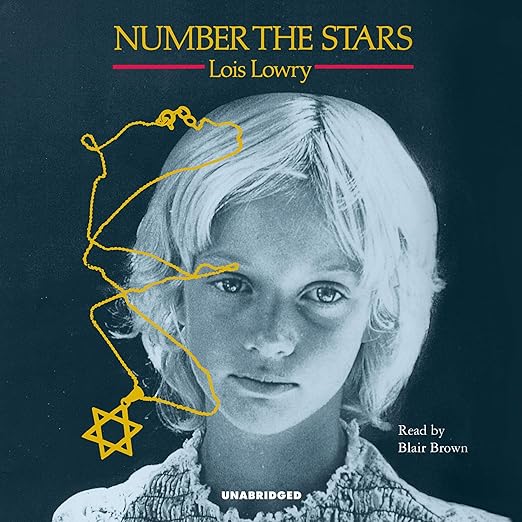
Key Details
- Narrator: Blair Brown's narration brings quiet gravity to Lois Lowry's prose, understated and clear, which is exactly right for a story that depends on the weight of ordinary people doing extraordinary things.
- Subjects: Courage in occupation, friendship as moral commitment, the ethics of ordinary life in extraordinary circumstances
- Tone: Restrained, emotionally precise, quietly devastating
- Bottom line: A Newbery Medal winner that earns the distinction, the audiobook adds a layer of intimacy to Annemarie's story that makes its emotional core land hard.
Annemarie Johansen is ten years old, her best friend Ellen Rosen is Jewish, it is 1943 in Copenhagen, and the Nazis are coming. Number the Stars, Lois Lowry's Newbery Medal-winning novel narrated by Blair Brown in this two-hour-and-forty-five-minute audiobook, is one of the most carefully constructed pieces of children's historical fiction in the English-language canon. It is also, as a collection of adult readers who have returned to it years later can attest, a book that does not lose its capacity to affect even when you already know exactly what is coming.
First, the Big Picture
What Lowry understood when she wrote this novel in 1989 was that the Danish rescue of its Jewish population during the Nazi occupation, one of the most remarkable acts of collective moral courage in World War II, was best told not through the perspective of those making the large decisions but through the eyes of a child who is asked to carry out one specific, dangerous task without fully understanding the stakes. Annemarie is not aware of the full scope of what her family is doing. She knows that Ellen is pretending to be her sister. She knows that her family is moving people to somewhere safe. When she is finally asked to make a solo journey to her uncle's boat in the dark, carrying a package whose contents she does not understand, she carries it without knowing what would happen if she were caught. Lowry's structural decision to keep Annemarie's knowledge partial is the novel's central moral move: it puts the reader in the position of knowing more than the protagonist and watching her act with courage that is all the more moving for being uninformed. The epilogue, which provides the historical context for the small packet Annemarie delivers, the science behind the packet that made the Jewish refugees undetectable to the German dogs, arrives as a quiet revelation that reframes everything that came before it. One reviewer who taught this novel to adult English language learners described a student's written response as producing a moment of genuine collective emotional impact in the classroom. That kind of transportability across age and cultural distance is the mark of a novel that has done something right at the structural level.
What Makes Number the Stars Worth Hearing
Blair Brown's narration is a near-perfect match for Lowry's prose. Number the Stars is written with deliberate restraint: Lowry does not editorialize, does not pause to explain the horror of the historical moment, and does not use Annemarie's perspective to deliver lessons. She trusts the reader to understand what is at stake and lets the story carry the weight. Brown honors that restraint. Her voice is clear and measured, and she reads Annemarie's perspective with the specific quality that the character requires: a child who is afraid but who acts anyway, not because she has fully processed the moral enormity of what she is participating in, but because the person she loves needs her to. The audiobook format serves this novel well. The short runtime, just under three hours, makes it practical as a family listen, but the intimacy of Brown's narration also makes it a strong solo experience for older children and adults. The historical distance of the setting, occupied Copenhagen, 1943, becomes more immediate when heard rather than read, perhaps because the voice collapses the sense of temporal remove that the page can create. For teachers or families using this book as an introduction to Holocaust history and the moral questions it raises, the audio version offers something the print version cannot: a listening experience that can be shared communally in a car, in a classroom, or at home.
A Few Reservations
The novel's brevity is worth noting in context. At two hours and forty-five minutes, this is a short audiobook, appropriate to its original format as a children's novel of roughly 160 pages. Listeners expecting the scope of a longer historical narrative will need to calibrate expectations. What Lowry achieves in that space is not comprehensive history but a precisely focused emotional argument: that ordinary courage in occupation is not the property of the historically significant but of people like Annemarie's family, who were ordinary in every respect except the circumstances they were given. The historical note at the end of the novel, which Lowry includes to explain the real packet Annemarie carried and to provide context for the Danish rescue operation, is essential, do not turn the audiobook off before it finishes. It reframes the entire story and is not optional. The review record for this audiobook includes multiple adult readers who came to the novel through teaching or rereading rather than childhood encounter, which is a useful signal: this is not a novel that only works for children, and it is not condescending to the adults who listen to it. Its emotional precision is designed for a reader at any age who is willing to sit with the specific moral weight it carries.
Who Should Listen to Number the Stars
This audiobook belongs in the library of any family with children ages eight and up who are ready to engage with World War II history through a narrative that neither sanitizes the danger nor overwhelms young readers with graphic detail. It is also a strong choice for adults who read it as children and want to return to it, or who want to experience it for the first time. Teachers looking for a classroom-compatible audiobook on occupation, resistance, and the ethics of ordinary courage will find Brown's narration a genuine asset for shared listening. Listeners seeking historical fiction with the scope and complexity of longer adult historical novels will want to look elsewhere, but those looking for precision and emotional honesty will find both here.
Is this audiobook appropriate for young children, or is the World War II content too heavy?
The novel is designed for readers approximately eight years and older. Lowry does not include graphic violence or adult content, but the threat of the Nazi occupation is real and present throughout the story, and children should be at an age where they can engage with that historical reality without being overwhelmed. The emotional weight is significant even within those careful limits.
How does the audiobook format improve the experience of Number the Stars compared to reading it in print?
Blair Brown's narration collapses some of the temporal remove that the page can create, making occupied Copenhagen feel more immediate. The short runtime also makes this a practical shared-listen for families or classrooms, and the communal dimension of an audiobook suits a story that is fundamentally about collective courage and community responsibility.
Is the historical note at the end included in the audiobook recording?
Lowry's historical note, which explains the real science behind the packet Annemarie carries and provides context for the Danish rescue operation, is part of the text and is included in the audio recording. Do not stop the audiobook before it finishes, that note reframes the entire story and is essential to the full experience.
Does this audiobook work well for classroom use with middle school students?
Yes, and multiple reviewers specifically cite classroom use as a context in which the book resonates powerfully. The two-hour-and-forty-five-minute runtime is manageable for school listening sessions, and Blair Brown's clear, restrained narration suits a classroom environment. The historical note also provides a natural anchor for post-listening discussion about the real events behind the story.