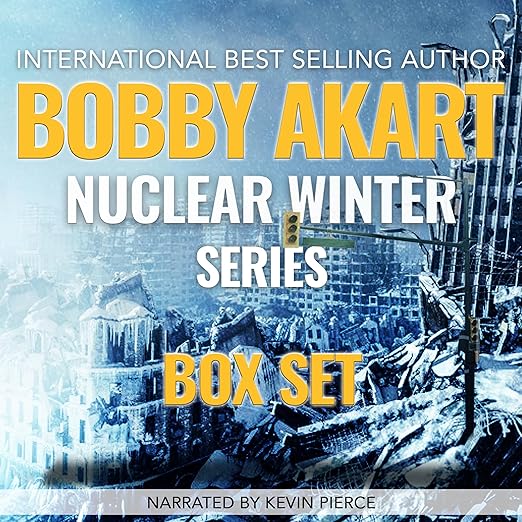
I tend to listen to post-apocalyptic fiction in the mornings, which probably says something unflattering about my psychology. There's something about working through a survival scenario before the day begins that I find clarifying rather than depressing. Bobby Akart's Nuclear Winter Series Box Set, narrated by Kevin Pierce, is exactly the kind of fiction I reach for in those early hours, specific, researched, and structured around ordinary people making decisions that feel real rather than heroic in the cinematic sense.
The box set collects all five books in Akart's Nuclear Winter series: First Strike, Armageddon, Whiteout, Devil Storm, and Desolation. At thirty hours and thirty-one minutes, this is a substantial commitment, but the series is designed to be read consecutively, and at least one reviewer confirmed they found the box set format superior to encountering the books individually. There's a cumulative logic to the five-book arc that benefits from being experienced without gaps.
Akart's particular strength as a disaster writer is his commitment to the aftermath rather than the event. The nuclear exchange itself, what the synopsis calls the moment when "this is how the world ends", occupies relatively little page time. What Akart is interested in is nuclear winter: the temperature drop, the crop failure, the collapse of supply chains, the way communities calcify into territorial units and turn against outsiders. That's a harder thing to write compellingly than the fireball, and Akart handles it with the procedural seriousness that the subject deserves.
The Albright family, rooted in the Florida Keys, provides the human anchor for what would otherwise be an overwhelming scale of catastrophe. Akart's decision to center the series on a family whose "roots stretch back to the early settlement" of a specific place is smart structuring, it gives the reader a fixed point from which to measure the collapse of everything around it. The relationship between place-identity and survival instinct runs through all five books, and it deepens with each volume.
What Works
Kevin Pierce is doing real work here. The "undisputed voice of the apocalypse" billing in Akart's own synopsis is self-promotional, but it's not inaccurate, Pierce has narrated enough of this genre to have developed a genuine feel for it. He understands that Akart's fiction lives and dies by its procedural texture: the descriptions of radiation dispersal patterns, the physics of temperature collapse, the mechanics of food preservation under extreme conditions. Pierce reads these passages with the same investment he brings to character moments, which is the only approach that works. A narrator who signals boredom during technical exposition will kill this kind of book; Pierce never does.
The research that underpins the series is extensive. Reviewers consistently note Akart's meticulous preparation, and one who loved the series still flagged that the detail density occasionally tips into slog. That's a legitimate critique, and it's worth naming: Akart is a writer who would rather give you more than you needed than leave a technical question unanswered. For listeners who want their disaster fiction to function as something close to a survival reference, this is a virtue. For listeners who prefer character-driven momentum, it can slow things down.
Things to Know Before Starting Nuclear Winter Series Box Set
The pacing is uneven across the five books. First Strike and Desolation are the tightest; Whiteout and Devil Storm, covering the middle phases of the nuclear winter itself, are where Akart's information density most strains forward momentum. One reviewer with a love-hate relationship with Akart's work noted this box set was their favorite of his output, suggesting the Florida Keys setting and the Albright family characterization give this series more emotional traction than some of his other work. That assessment tracks: the series is better when you're invested in specific people trying to survive, and slightly more difficult when Akart zooms out to the systemic level.
Listeners who are new to Akart should know that his books are explicitly ripped from real scenarios. The geopolitical setup of First Strike is contemporary enough to feel uncomfortably plausible, and at least one reviewer noted this kept them up at night, not in a horror fiction way, but in a genuinely unsettled way. That's not a warning so much as a description of the experience the book is designed to produce.
Who It's For
This is for readers who have worked through other disaster preparedness fiction, Parable of the Sower, One Second After, William Forstchen's EMP series, and want something that takes the science of nuclear winter as seriously as it takes the human drama. The box set format makes the most sense if you've been curious about the series and want to commit to the full arc at once rather than sampling. Listeners who prefer their post-apocalyptic fiction character-light and action-heavy may find Akart's research density more hindrance than help. For everyone else: thirty hours of Kevin Pierce narrating nuclear winter is exactly as good as it sounds.
Quick Take
- Read by: Kevin Pierce, billed in the synopsis itself as 'the undisputed voice of the apocalypse,' brings exactly the gravitas and pacing that Akart's survival fiction demands, this is a narrator who has done enough of the genre to know when to slow down and when to push.
- At its heart: Nuclear war survival, societal collapse, family loyalty under existential pressure
- Vibe: Bleak and propulsive, with enough procedural detail to feel uncomfortably plausible
- Short version: Thirty hours of meticulously researched post-nuclear survival fiction that rewards listeners who want their disaster fiction grounded in actual science, Akart and Pierce are a proven pairing for the genre.
Questions Listeners Ask
Is the Nuclear Winter Series Box Set appropriate for readers new to Bobby Akart, or should I start with a shorter standalone first?
The box set is actually a reasonable entry point if the nuclear winter premise is what draws you, since it represents Akart's work in what reviewers describe as stronger-than-average form for his output. If the thirty-hour commitment feels daunting, First Strike alone is available separately and serves as a satisfying introduction to his style before you commit to the full series.
Is Kevin Pierce's narration consistent across all five books in the box set?
Yes, Pierce narrated the entire series, and the box set format preserves that continuity seamlessly. His performance across the five books has a consistency that helps the listener maintain investment across the tonal shifts between volumes. The second and third books in the series, which cover the bleakest phases of the nuclear winter, are where his pacing choices are most important, and he handles them with the right deliberateness.
The box set is thirty hours long, does the story sustain that length, or does it feel padded?
It sustains it, though not without effort. The first and fifth books are the tightest; the middle volumes, particularly Whiteout and Devil Storm, are where Akart's tendency toward detailed research exposition most tests patience. Reviewers who love the genre consider the detail a feature; reviewers who want character-driven momentum consider it a tax. Know which category you fall into before committing to the full thirty hours.