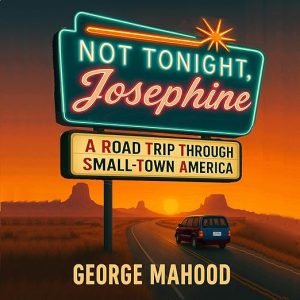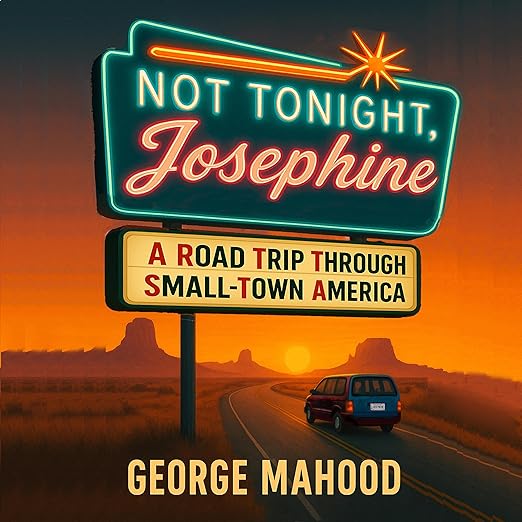
Josephine is a car, and by the description's own account the worst car in the world, which is exactly the right engine for a book like this. Two Brits leave New York City with insufficient money, no plan worth the name, and a vehicle that will betray them repeatedly on the way to the California they are aiming for. The audiobook runs just under nine hours, and George Mahood's method is to let the disasters pile up until they turn into the itinerary.
Picaresque is the shape here, not plot. George and Mark drive, something goes wrong, somebody local rescues them or arrests them, and the next chapter starts over in a different county. Run-ins with the police accumulate. The finances dwindle from thin to comic. Back in England, Rachel waits, which supplies the one thread of real consequence the road cannot provide, because the description asks outright whether leaving for the United States without her turned out to be the stupidest decision he ever made. That question is the closest thing here to a plot.
A five-star account from January 2026 describes the appeal as a social one: knowing before you open one of these books that the next few hours will be spent in good company, on the road with George and Mark and eventually Rachel. That same account credits the book with teaching an American reader about places in their own country they will probably never visit in person, which is a serious compliment to a travel writer working a foreign road with a broken car and no research budget.
Nathaniel Priestley reads it rather than the author, a decision worth registering on a first-person comic memoir. Self-narrated travel humor arrives with the writer's own timing built in, while a separate reader has to reconstruct that timing from the page. The humor the responses describe is the accumulating kind rather than the joke-by-joke kind, which puts more weight on pacing than a plotted novel would ask for, and makes the sample more informative here than on most books of this length.
What Works
Dating the trip is the single most useful thing anybody has written about this book. Five stars in May 2025 point out that although the publication date is 2016, the trip itself happened in late 2000 and the first half of 2001, so what you are hearing is the just-pre-9/11 United States rather than the current one. Nothing on the listing tells you that, and the fact changes the category the book belongs to, from road guide to period document.
Once you know it, the whole thing reads differently and better. Run-ins with police that end in anecdotes rather than consequences, strangers who take two broke foreigners at face value, a route improvised from whatever the road offered next: the texture belongs to a season that closed a few months after they got home. Travel writing usually ages badly. This one aged into something else entirely, and the long delay between the journey and the writing turns out to be an accidental asset.
Humor of this kind also survives interruption, which suits the format better than most memoirs manage. Each catastrophe is self-contained, so stopping after twenty minutes costs you nothing, and the momentum comes from accumulation rather than from a question you need answered before bed. An episodic book in that mode goes faster than plotted fiction of the same length, because nothing is held in suspension across the gaps and no thread unravels while you are away from it.
Before You Commit to Not Tonight, Josephine
The three-star verdict here, filed in December 2016, measures the book against the two Americans everybody measures road books against: William Least Heat Moon's Blue Highways and Steinbeck's Travels with Charley. Judged on that scale, it says, this one does not come close to stirring the same yearning for travel off the beaten path. The comparison is unfair and useful at the same time, because Mahood is not writing in that tradition at all, and a listener who expects him to be is buying the wrong book.
Nobody here has described the reading. Five of the seven ratings arrived with words attached, an unusually high proportion, and not one of those five mentions the reader, the pace or the accents, so anybody choosing the audio edition over the paperback is working without evidence. The oldest of the five predates the June 2019 recording by two and a half years, which means part of that 4.3 average belongs to the printed book rather than to this production.
A four-star response from September 2021 lands the specific complaint that will settle this for some listeners. It enjoyed the coast-to-coast romp and laughed out loud at the encounters with what it calls myopic Americans, then observed that a young traveler with a hollow leg keeps food permanently top of mind, and that it did not need to know what he ate each day. If that kind of inventory grates on the page, it will grate harder when somebody is reading it aloud to you.
Who It's For
Listeners who want company rather than a destination are the audience here, and specifically the ones who enjoy watching capable people fail cheerfully in front of strangers. Writing in July 2025, one reader graded it five and described the effect precisely: warm and funny, the sort of book that makes you want to meet the author for a beer even if you do not drink beer, with a few of the stops marked down for a trip of your own later.
Travel purists after lyric landscape writing should pass, and so should anyone hoping for insight into American politics or culture beyond what two broke visitors run into by accident. Listeners who need a plot will also struggle, since the only forward question the book carries is whether the car and the relationship both survive the crossing, and neither is treated with much suspense along the way.
Comedy travelogues age in one of two directions, into embarrassment or into a record, and this one went the second way without intending to. The disasters are funny, the company is good, and the accidental time capsule is the part that stays with you afterward. Go in knowing that the road you are hearing about closed a long time ago, and that what is on offer is company rather than discovery.
The Short Version
- Narration: Nathaniel Priestley reads a British comic memoir set on American back roads, and since the author is not the reader, the delivery is an interpretation rather than the writer's own timing.
- Themes: an American road trip taken by outsiders, breakdowns as plot structure, cheerful incompetence, a country recorded just before it changed
- Mood: warm, shambolic, funny by accumulation
- Verdict: Buy it for the company and the accidental period detail, not for landscape writing or for anywhere in particular to arrive.
Before You Listen
Does the audiobook work if I have not read George Mahood's other books?
Yes. The description introduces George, Mark and Rachel from scratch and the journey is entirely self-contained, so no earlier title is required. Familiarity buys you nothing except advance knowledge of the author's manner, which is the kind of thing a three-minute sample settles more efficiently than any recommendation could.
Is the humor clean enough for a family listen?
The listing carries no content advisory in either direction. The comedy described in the copy runs on breakdowns, police encounters and running out of money rather than on shock value, but nothing on the page guarantees the language, so anyone planning a shared car listen should sample a chapter before committing to it.
How much of the audiobook is actually about the car?
Josephine supplies the running gag and the structure, but the car is a device rather than a subject. What the failures produce is contact: the people who tow, ticket, fix or feed two stranded foreigners. Expect a book about Americans encountered at their most improvised rather than a book about a vehicle.
Is nine hours a long time to spend on a trip with no destination?
The structure is episodic, so it survives being taken in pieces far better than a plotted novel would. The risk is not boredom but sameness: breakdown, rescue, next state. Listeners who feel that pattern setting in early should treat the feeling as a signal rather than push through.