Quick Take
- Narration: Dara Rosenberg delivers Ward’s academic prose with clarity and measured authority, keeping dense theoretical passages accessible without softening their intellectual edge.
- Themes: Sexual identity vs. behavior, heterosexual privilege, race and masculinity
- Mood: Intellectually probing and occasionally provocative, academic in register but readable
- Verdict: A rigorous academic study that reframes how we understand straight male sexual practice, rewarding for readers comfortable with scholarly language, frustrating for those expecting accessible pop sociology.
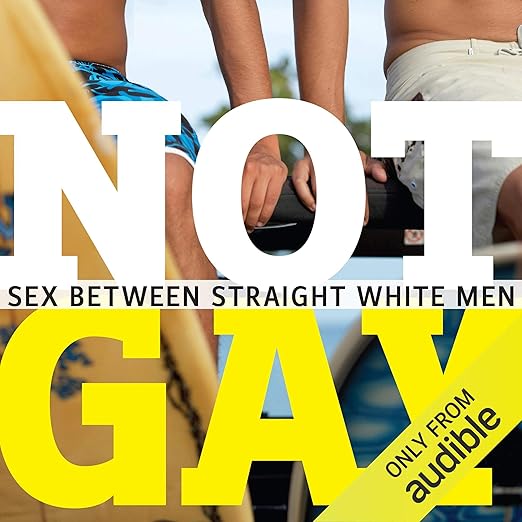
I picked up Not Gay on a Tuesday evening when I was midway through a pile of cultural theory I had been meaning to get to for months. Jane Ward’s title alone was enough to make me stop scrolling. By the time Dara Rosenberg was twenty minutes in, I had paused twice to take notes, something I rarely do outside of a formal review session. This is the kind of academic work that genuinely unsettles comfortable assumptions, and it does so with a precision that I found both admirable and, at moments, exhausting in the best possible way.
Ward’s central argument is deceptively simple: straight white men engage in same-sex sexual activity in contexts ranging from fraternity hazing to public restroom encounters, and rather than destabilizing their heterosexual identity, these acts actually reinforce it. The mechanisms by which that reinforcement operates, whiteness, masculinity, the performance of compulsory heterosexuality, is where Ward’s analysis gets genuinely interesting. She is not writing a titillating expose. She is mapping a social phenomenon that most cultural commentary has either ignored or misread.
Our Take on Not Gay
Ward’s argument lands hardest when she draws the distinction between sexual behavior and sexual identity. For decades, both popular culture and academic discourse have treated same-sex behavior as evidence of a hidden gay identity. Ward dismantles that assumption with methodological care, drawing on personal ads, hazing rituals, and sociological literature to show that context and meaning, not the act itself, are what determine how sexuality is understood and performed. That is a genuinely important contribution. Whether one agrees with all of her conclusions, the framework she offers is durable and thought-provoking.
Where the book generates friction, and some reviewers have flagged this honestly, is in its academic register. The jargon is real. Phrases like disidentification and epistemological frameworks appear regularly, and Ward does not always pause to define them for a general audience. One listener described the experience as encountering dark interstices of didactic epistemology where plain speech would have served better. I do not think the prose is impenetrable, but listeners accustomed to narrative nonfiction will need to adjust their expectations.
Why Listen to Not Gay
The audiobook format actually suits this material reasonably well. Rosenberg’s narration is steady and authoritative without becoming robotic. She handles the more provocative passages, descriptions of hazing rituals and public cruising spaces, without either sensationalizing them or deflating their analytical significance. For a subject that carries enormous cultural charge, that tonal steadiness is valuable. Some reviewers confessed they picked up the book expecting something closer to a how-to guide and were surprised by its scholarly seriousness. That mismatch is worth naming upfront: this is cultural theory with a sharp thesis, not journalism.
Ward’s framing of race is one of the book’s most underappreciated contributions. Several listeners noted that the focus on whiteness, how straightness and racial identity become mutually reinforcing categories, opens up questions well beyond sexuality. That is accurate. Ward is really writing about how dominant social identities are constructed and maintained through behavior that appears to contradict them. The sexuality is the entry point; the broader argument is about power and privilege as they operate at the level of the body.
What to Watch For in Not Gay
The passages drawn from online personal ads are among the book’s most vivid and analytically productive. Ward treats these texts with sociological rigor rather than prurient interest, reading them as cultural documents that reveal how straight-identified men construct narratives around same-sex desire. Those sections move at a brisk pace and are easier to follow than some of the more theoretical chapters. The military and fraternity hazing material is harder going, not because it is graphic but because Ward’s analysis there is more layered and depends on readers already comfortable with concepts from queer theory and gender studies.
First-time listeners to academic audiobooks should know that Ward’s argument builds cumulatively. Skipping chapters will leave gaps. This is not a title where you can dip in and out; the thesis requires the full arc to land properly.
Who Should Listen to Not Gay
Listeners with a background in gender studies, queer theory, or sociology will find this essential and bracing. Those curious about the gap between sexual behavior and sexual identity, and willing to sit with academic prose for eight hours, will come away with a genuinely new framework. Listeners expecting a narrative-driven or journalistic take on the subject should look elsewhere. And anyone who needs every term defined as it appears will find Rosenberg’s steady delivery can only do so much to compensate for Ward’s assumption of theoretical literacy in her reader.
Frequently Asked Questions
Is Not Gay a journalistic expose or an academic study?
It is firmly academic in approach. Ward draws on sociological fieldwork, cultural analysis, and queer theory rather than on-the-ground reporting. Listeners expecting narrative nonfiction will find it more theoretical than anticipated.
Does Dara Rosenberg’s narration handle the explicit material professionally?
Yes. Rosenberg maintains a composed, analytical tone throughout, including during the passages about hazing rituals and cruising. She does not sensationalize or sanitize the material, which suits Ward’s scholarly framing.
Do you need a background in queer theory to follow Ward’s argument?
Some familiarity helps significantly. Ward uses terms like disidentification and heteronormativity without always defining them. The core argument is followable without specialist knowledge, but the finer analytical moves will land better with some background.
Does the book address sexual identity beyond straight white men?
The focus stays deliberately narrow. Ward’s argument depends on the specific dynamics of whiteness and heterosexual masculinity, so the book does not offer an equivalent analysis of women or men of color, though her framework has implications well beyond its immediate subject.