Quick Take
- Narration: Trei Taylor handles a dual-protagonist sapphic space opera with range and commitment, the battle sequences and the quieter emotional moments both land.
- Themes: Political identity versus personal freedom, survival as a foundation for love, imperial power and the cost of inheritance
- Mood: Cinematic and emotionally expansive
- Verdict: Virginia Black’s debut delivers the kind of space opera that makes you forget to check the time, Trei Taylor’s narration is a key part of why it works so well in audio.
I started this on a Sunday night thinking I would listen for an hour before switching to something lighter. I was still awake at two in the morning, unwilling to stop at anything that even resembled a chapter break. This is the kind of audiobook that happens to you rather than one you simply consume, and the experience left me genuinely annoyed that I could not look up a sequel the next morning.
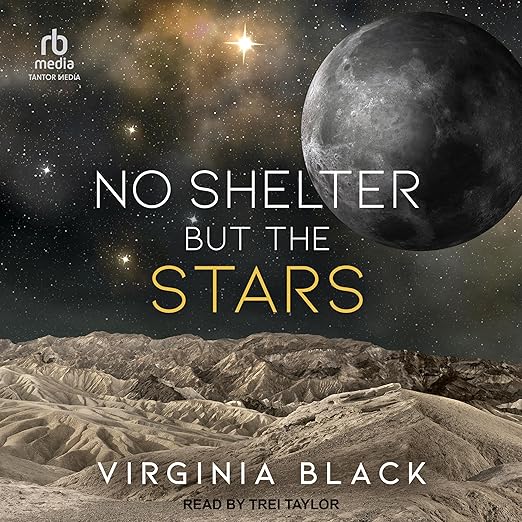
Virginia Black’s No Shelter But the Stars is a sapphic space opera structured around two women on opposite sides of a galactic war who find themselves, through the kind of circumstances only fiction can arrange with a straight face, stranded together on a barren moon with no one else in sight. Kyran Loyal is the last heir to a destroyed throne, the figurehead of a people still fleeing the empire that destroyed them. Davia Sifane is the illegitimate daughter of the despot responsible. Their survival, and everything that follows from it, requires trusting the one person they have every reason not to.
Our Take on No Shelter But the Stars
The setup is classical enemies-to-lovers, and Black does not pretend otherwise. What she does with it, though, goes considerably further than the genre’s usual parameters. The stranded-on-a-moon section that opens the book is where Black earns the credibility for everything that follows. The desperation feels real, not romanticized survival but the actual grinding problem of food, shelter, and bodies that are breaking down in an environment that was not built for humans. Kyran and Davia’s mutual suspicion does not evaporate conveniently; it erodes through shared experience in ways that feel psychologically earned rather than narratively convenient.
One reviewer described this as playing out in their head like a full-budget TV series, cinematic, dramatic, sweeping camera angles over war-torn planets. That is an accurate description of the book’s ambition and largely of its execution. Black writes space with visual precision; the worldbuilding has spatial logic and visual scale that make both the political universe and its specific locations coherent across the full runtime. Multiple reviewers who described themselves as first-time science fiction readers noted that the book converted them. That is a meaningful data point about accessibility: this is a space opera that does not require prior genre fluency.
Why Listen to No Shelter But the Stars
Trei Taylor’s narration is exceptional. The dual-protagonist structure requires a narrator who can carry two distinct voices without making the transitions feel like a performance exercise, and Taylor manages this throughout. Kyran and Davia are differentiated not just in vocal quality but in cadence and emotional register, the way each woman moves through fear, grief, and desire sounds different, which matters considerably across a ten-hour listen. The battle sequences have genuine momentum; the slower emotional passages do not drag. This is exactly the kind of performance that makes audio the better format for a book like this rather than merely an alternative to print.
At ten hours and forty-three minutes, the pacing never becomes an endurance test. Black structures the narrative efficiently: the stranded section, the separation, and the larger galactic stakes that emerge in the second half each receive enough room without overstaying their welcome.
What to Watch For in No Shelter But the Stars
The book’s political structure, the mechanics of Kyran’s lost kingdom, the internal dynamics of Davia’s imperial family, the factions and alliances, is handled well but moves quickly. Listeners who want to fully inhabit the worldbuilding will find that some of this passes fast; Black trusts her readers to keep up rather than over-explaining. This is generally the right call in a space opera, but it means the early chapters require active attention. The political backstory for both protagonists is distributed through the narrative rather than front-loaded, so some listeners may feel slightly behind the first few chapters before the context firms up.
The ending is also worth noting: several reviewers mention wanting more, which is a kind of praise but also a genuine observation. The book resolves its central story with satisfaction while leaving the larger world open. Whether that reads as a complete ending or an implicit invitation to a sequel depends somewhat on what you want from space opera structure.
Who Should Listen to No Shelter But the Stars
This audiobook is ideal for readers who want a sapphic romance with genuine narrative stakes beyond the relationship itself, space opera fans who want strong character interiority alongside the politics and action, and LGBTQ+ readers who are tired of romance plotlines that treat queerness as the central conflict rather than simply the nature of the protagonists. First-time science fiction listeners will find the book accessible, several reviewers with no prior SF background describe it as a revelation. Listeners who need comprehensive worldbuilding front-loaded before character work begins may find the first chapters slightly disorienting, but the patience pays off quickly.
Frequently Asked Questions
Is No Shelter But the Stars a standalone novel or the first in a series?
It is written as a standalone, though the ending leaves the world open. As of this writing, no sequel has been announced, though the strong reader response has generated significant demand for one.
How explicit is the sapphic romance in terms of content?
Reviewers describe the romance as the emotional core of the book with significant intensity, but it is generally categorized as adult romance rather than explicitly graphic. It is in the tradition of space opera romantic subplot rather than erotica.
Does Trei Taylor narrate both Kyran and Davia with distinct voices, and does the dual-POV structure work in audio?
Yes, multiple reviewers specifically praise Taylor’s ability to differentiate the two protagonists. The dual-POV structure is one of the book’s strengths, and the audio narration supports it effectively rather than flattening the distinction.
Is prior science fiction reading necessary to follow the worldbuilding in No Shelter But the Stars?
No, several reviewers explicitly note this was their first science fiction book and found it highly accessible. Black explains her world’s conventions as needed without over-explaining, making the book usable as a genre entry point.