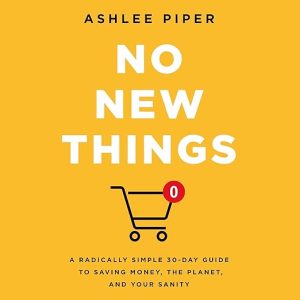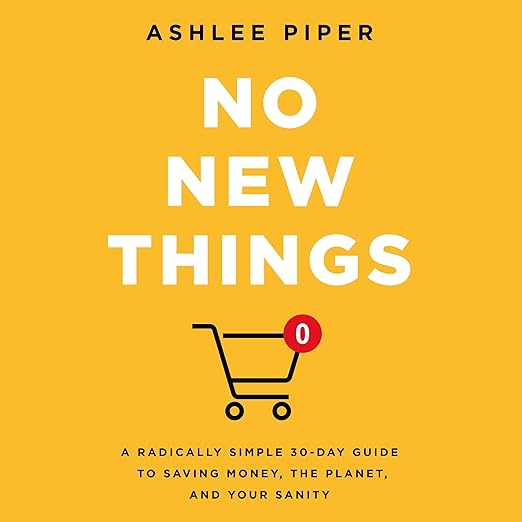
I started No New Things on a Saturday morning while reorganizing a closet that had gotten away from me. That felt like an appropriate context. Ashlee Piper spent nearly two years buying nothing new and documented what that did to her debt, her clutter, her goals, and her mental health. I was surrounded by the evidence of my own unchecked purchasing decisions. The timing was useful.
Piper is an award-winning sustainability expert and the book is framed around what she calls a revolutionarily simple challenge: for thirty days, buy nothing new. Not nothing at all, secondhand purchases, digital goods, consumables like food are generally permitted depending on how strict a version you adopt, but nothing manufactured new. She has run this challenge with global participants for a decade, which gives the framework an empirical grounding that distinguishes it from purely aspirational sustainability literature. This is not a book about what we should ideally be doing. It is a book about what one specific challenge produced for specific people over a documented period.
Conditioned Consumerism, Engineered by Design
The historical section on what Piper calls conditioned consumerism is the book's most substantive intellectual contribution, and multiple reviewers mention their jaw dropping during it. The account of how modern consumer culture was deliberately engineered, how planned obsolescence, advertising psychology, and the architecture of retail spaces were designed to create the spending patterns most of us experience as natural, is not new information for readers already engaged with sustainability, anti-consumption, or behavioral economics. But Piper synthesizes it accessibly and with genuine energy, and for listeners encountering these ideas for the first time, it has the quality of a revelation.
One reviewer noted that the book is most interesting for readers who have not dabbled in sustainability or anti-consumption thinking before, and that is an accurate characterization. The framework itself is well-known within those circles. Piper's contribution is the thirty-day challenge structure and its documented outcomes, plus the personal narrative of her own debt elimination and goal achievement. For readers already deep in minimalism or sustainable living communities, some of this will be familiar territory repackaged.
Piper's Own Narration Keeps the Daily Challenge Honest
Piper narrating her own work is clearly the right call. The wit that reviewers consistently identify, the humor that keeps the sustainability message from becoming sanctimonious, is in the writing, but it lands differently when delivered by the author herself. There is a conversational quality to her narration that makes the daily action items feel like advice from a person rather than instructions from a manual. For a book structured around behavior change, that warmth is not a cosmetic feature. It is part of how the challenge becomes achievable rather than theoretical.
The customizable nature of the thirty-day challenge means that the audio format serves a practical function beyond entertainment. Listeners who are running the challenge while listening to the book will find the daily action items more immediately useful than they would in print, where the temptation to read ahead or skim is stronger. The audio format enforces a pace that matches the challenge's daily structure.
Professionally Produced, Yet Deliberately Light on Rigor
The book is produced by Macmillan Audio through Celadon Books, which means the production quality is professional and consistent. Piper's narration is warm and energetic throughout the seven and a half hours, but listeners who prefer denser analytical content over practical self-help frameworks should be aware that the book prioritizes accessibility over depth. It is not trying to be a rigorous academic account of consumer psychology, it is trying to get you to try the challenge.
Several reviewers who came to the book already practicing minimalism or sustainable living found it valuable as reinforcement and motivation rather than as new information. That is a legitimate use of a book in this category, but it is worth calibrating expectations accordingly.
Thirty Days of Structure for Overwhelmed Shoppers
Listeners who are curious about buying less but have not found a concrete framework that makes it feel achievable will get the most out of this. Those who have felt overwhelmed by their own stuff and spending patterns without knowing where to start will find the thirty-day structure a genuinely useful scaffold. Skip it if you are already practicing intentional consumption at a sophisticated level and are looking for new theoretical frameworks, or if you want a deeply researched academic account of consumer culture rather than a practical guide to opting out of it.
Key Details
- Narrator: Ashlee Piper narrating her own book brings the wit and directness reviewers attribute to her in person, this is a conversational, warm listen that benefits significantly from the author's own voice.
- Subjects: conditioned consumerism and its origins, the thirty-day no-new-things challenge, financial and psychological decluttering
- Tone: Energizing and practical, with a thread of genuine humor that keeps the sustainability message from becoming preachy
- Bottom line: A well-constructed guide to buying less that earns its optimism through a documented personal experiment, most valuable for listeners new to anti-consumerism thinking.