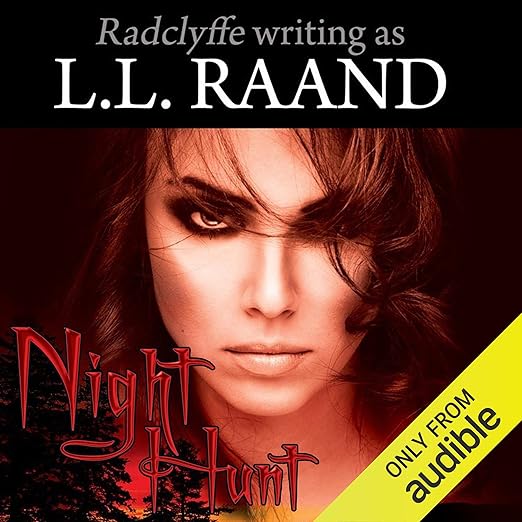
Quick Take
- Narration: Maxine Mitchell delivers a commanding performance that handles both the pack’s primal urgency and the quieter emotional beats of Niki and Sophia’s forbidden connection with equal conviction.
- Themes: Forbidden desire, political coalition-building, identity within community
- Mood: Propulsive and emotionally charged, with underlying tension that rarely lets up
- Verdict: Readers invested in the Midnight Hunters world will find this installment richer in political scope and more emotionally satisfying than its predecessor.
I listened to Night Hunt across two late evenings, the kind of sessions where you tell yourself you’ll stop at the next chapter break and then don’t. By the time Niki Kroff’s situation had fully crystallized, stripped from Sylvan’s guard, assigned to protect a newly turned Vampire she desires but cannot have, I had forgotten entirely that I’d picked this up as Book 3 in an ongoing series. The story pulls you back in.
L.L. Raand, the pen name under which Radclyffe writes paranormal fiction, has built the Midnight Hunters world as something considerably more intricate than a shapeshifter romance backdrop. The Praetern coalition, Were, Vampire, human allies, reads like a political thriller grafted onto urban fantasy, and in this third entry that scaffolding becomes load-bearing in ways the earlier books only gestured at. Sylvan Mir is now pregnant and more dangerous than ever, which changes the group dynamic in ways I found genuinely interesting rather than just dramatically convenient.
Our Take on Night Hunt
What makes this entry stand out within the series is how Raand manages to run two entirely different kinds of tension simultaneously. On one track, you have the external war: extremists, radical factions, and fractures within the coalition itself threatening Praetern autonomy. On the other, Niki’s internal struggle with her desire for Sophia, a Were whose complicated past Raand takes time to actually excavate, creates an intimacy that grounds the broader conflict. One reviewer quoted directly from the text: “What are we, any of us, except what we believe and how we behave? We are more than what is inside our cells. We are what lives in our heart.” That line captures something real about what this series is doing. It wants to be a romance, yes, but it also wants to say something about belonging and identity that goes beyond genre convention.
The political layer is dense enough that readers jumping in here without the first two books will likely struggle. The coalition dynamics, the Vampire hierarchy, the significance of Lara’s transformation, none of it is re-explained with particular patience. That’s a structural choice I respect more than I resent, but it bears noting.
Why Listen to Night Hunt
Maxine Mitchell is doing careful work here. The Midnight Hunters world demands range: Alpha posturing, Vampire menace, the charged vulnerability of desire that can’t be acknowledged. Mitchell keeps Niki’s voice distinct from Sylvan’s without making either feel like a performance. The pack scenes carry physical weight, you feel the hierarchy operating in the room, while the quieter moments between Niki and Sophia have a different register entirely, slower and more uncertain. For an LGBTQ+ paranormal romance in audiobook form, casting and vocal chemistry matter enormously. Mitchell earns the emotional payoff that readers had been anticipating since Book 1.
Audible Studios produced the recording cleanly, which is worth noting for a 12-hour title. Nothing about the audio experience gets in the way of the material.
What to Watch For in Night Hunt
A few things are worth flagging for listeners considering this entry. The political plotting accelerates sharply, and Francesca’s scheming, which one reviewer noted with evident feeling, hoping she “suffers the true death”, can feel like it’s pulling focus from the relationship arc that drew most readers to the series. Raand’s instinct is to keep all the plates spinning, which means neither the romance nor the conspiracy ever gets the single-minded attention it might deserve. The pacing is propulsive rather than measured.
There’s also the recurring issue noted by at least one reader about the explanatory passages around powers and abilities. In a series this deep, Raand sometimes recaps mechanics in ways that feel redundant to established fans. As an audiobook listener, I found this less disruptive than I might have on the page, Mitchell’s delivery keeps the momentum, but it’s present.
Who Should Listen to Night Hunt
If you’ve read or listened to the first two Midnight Hunters books and liked them, this is the entry where the emotional and political threads start genuinely converging. Niki and Sophia’s relationship was seeded in Book 1, and watching it finally reach a reckoning here delivers on that early investment. Listeners who came to the series primarily for the romance will find this chapter satisfying. Those who never connected with the worldbuilding complexity may find Book 3 more of the same.
New listeners should start at the beginning. This is not an entry point, and Raand makes no apologies for that. For established fans of sapphic paranormal romance with real political stakes, Night Hunt is the installment where the series finds its footing most convincingly.
Frequently Asked Questions
Do I need to have read the first two Midnight Hunters books before listening to Night Hunt?
Yes, very much so. The Praetern coalition politics, the specific relationships between Niki, Sylvan, and Lara, and the significance of Sylvan’s pregnancy all depend heavily on what was established in the earlier entries. Raand doesn’t pause to re-explain for newcomers.
Is Niki and Sophia’s relationship the central focus of Book 3, or does the political plot dominate?
Both threads run simultaneously and Raand keeps them roughly balanced, though some readers feel the war arc occasionally pulls focus from the romance. Niki’s emotional arc, stripped from the guard, drawn to a forbidden Were, provides the book’s emotional core even as Sylvan’s coalition battles take up significant page time.
How does Maxine Mitchell’s narration compare to what LGBTQ+ paranormal romance listeners typically expect from Audible Studios productions?
Mitchell handles the series’ vocal demands well. She differentiates between pack hierarchy and intimate scenes effectively, and the chemistry between Niki and Sophia lands in audio in a way that feels earned rather than performative. The production quality is clean across the full 12-hour runtime.
The synopsis mentions Sylvan becoming ‘more powerful and more deadly than any Alpha Were in centuries’, does that change her role in the story significantly?
Yes. Sylvan’s pregnancy-amplified power shifts the group dynamic in this installment. She moves from protagonist to something closer to a force of nature, and the story adjusts around her, which gives Niki’s arc more room to breathe than it had in earlier entries.