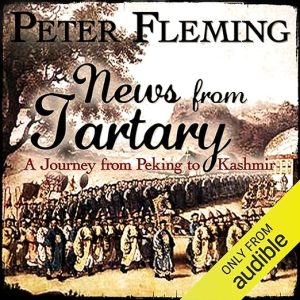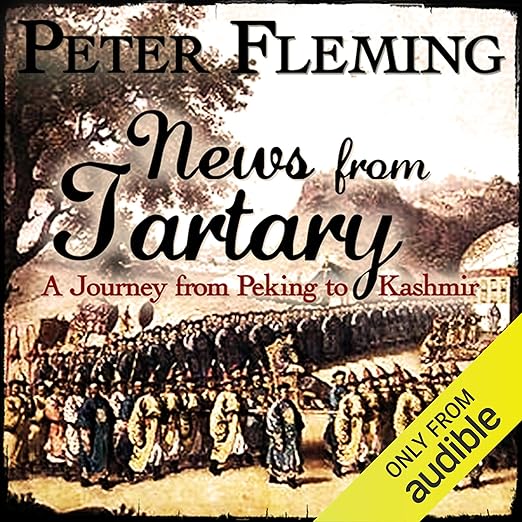
Peter Fleming's 1935 journey from Peking to Kashmir along a stretch of the old Silk Road is the kind of travel writing that makes you aware of how small the genre has become. News from Tartary covers 3,500 miles across deserts and mountain ranges, through ice and sand, into territory that was genuinely unmapped at the time, and yet Fleming writes about it with a studied casualness that is itself a form of mastery. Richard Mitchley narrates the audiobook with precisely the right register: measured, dry, never theatrical, allowing the sheer scale of the journey to speak without editorial amplification.
The journey took seven months. Fleming and his companion, the Swiss journalist and adventurer Ella Maillart, traveled through Sinkiang at a moment when the region was convulsed by warlord conflict, Soviet influence, and the dying tremors of imperial Chinese authority. That geopolitical context shadows the narrative without dominating it. Fleming was a journalist by training and a traveler by temperament, and his account is as interested in the texture of daily existence on the road as in the political forces swirling around the route. That balance is what makes the book last.
The Strengths
Reviewer R. R. Wilkins makes a point worth dwelling on: Fleming was Ian Fleming's brother, and he led a life of genuine adventure that his younger brother channeled into fiction. Reading News from Tartary with that context in mind is quietly illuminating. The composure, the irony, the refusal to dramatize the genuinely dangerous as anything other than a practical problem to be solved: these are qualities that migrated into James Bond's creator from a man who actually walked the Silk Road in temperatures cold enough to kill a horse.
Reviewer erisgeenhoop raises the format limitation that any audio listener needs to know about: the original text includes photographs and a map, both of which are absent from the audiobook. The map matters because Fleming's route is not a straight line and the geography is unfamiliar to most Western listeners. Mitchley cannot substitute for cartography. Listeners who want to follow along will need a separate map open, something easily done with an online search for historical Sinkiang or the Karakoram range. The photographs, frequently referenced in the text, are a more significant loss, but they do not derail the listening so much as add a layer of incompleteness that attentive listeners will notice.
Mitchley's narration is one of the genuine strengths of this edition. Fleming's prose style is famously terse: he tends toward understatement at moments when other travel writers would reach for superlatives. A bad narrator could make that style seem flat. Mitchley understands that the dryness is the point. When Fleming describes a near-miss with a hostile patrol or an ascent over a mountain pass with no surviving pack animals as a mild inconvenience to be worked around, Mitchley delivers it with exactly the tone Fleming intended, and the effect is genuinely funny and quietly awe-inspiring at the same time.
The relationship between Fleming and Maillart is one of the book's subtler pleasures. They are not romantically involved, though the journey is intimate enough that a lesser writer would have forced that narrative. Instead they are two people with complementary skill sets who respect each other sufficiently to share the impractical project of crossing one of the world's most hostile landscapes together. Mitchley handles the dynamic with quiet attention, and listeners who know Maillart's own account of the journey, published as Forbidden Journey, will find the comparison instructive about how two very different narrators can cover the same events with radically different emphasis.
Before You Commit to News from Tartary
The book belongs unmistakably to its era. Fleming writes about the Chinese, Mongol, and Indian peoples he encounters with the framing assumptions of a 1930s British journalist, which means the perspective is almost entirely that of an outsider observing from a position of assumed cultural authority. This is not unusual for the genre, but listeners who approach travel writing primarily through contemporary authors like Pico Iyer or Rory Stewart will feel the distance between their expectations and Fleming's sensibility more acutely than those already familiar with Evelyn Waugh, Robert Byron, or Eric Newby.
The reviewer who invokes Chatwin, Theroux, and Newby as analogues is calibrating accurately. Fleming predates all of them and in some ways made them possible. The laconic Englishman abroad, underprepared by design, finding the journey more interesting than the destination: that is a literary type Fleming helped establish. The comparisons are flattering but also instructive about what this kind of travel writing does and does not attempt to do. It is not confessional; it is not primarily interested in the author's inner transformation. It is a record of what happened, told with wit and precision, and that is enough.
At nearly twelve hours the audiobook requires a certain commitment, but it does not feel long because the journey itself is genuinely eventful. Fleming rarely lingers; he moves his narrative forward with the same practical efficiency with which he moved his body across the plateau. Mitchley paces the narration to match, which makes the eleven hours and forty-six minutes pass more quickly than the runtime suggests.
Recommended For
This audiobook is essential listening for anyone who reads classic British travel writing, and it is an excellent gateway for listeners approaching the genre for the first time through audio. The combination of Fleming's prose and Mitchley's narration is the best case for what the audiobook format can do with a canonical text: it activates the rhythm and humor of the writing in ways that silent reading sometimes misses.
Listeners who need visual geography and frequent map reference will want to listen with a browser handy to fill in what the audio cannot provide. Those who can sit comfortably with an approximate sense of where the journey goes, trusting that the prose will do the work, will find no obstacle. News from Tartary is one of the best travel audiobooks available in English, and Mitchley's performance is a primary reason why.
At a Glance
- Voice: Richard Mitchley brings Fleming's laconic wit and wry understatement to life with controlled precision; the dry British cadence suits the material perfectly.
- Big ideas: colonial-era exploration, endurance across extreme terrain, cross-cultural encounter
- Atmosphere: Dry, adventurous, and quietly magnificent
- Worth it?: Readers who love the golden age of travel writing will find this audiobook a sustained pleasure, one of the finest examples of the form available in audio.
Does the audiobook version of News from Tartary include Fleming's original photographs or maps?
No. The audio edition does not include the maps or photographs from the print version, both of which Fleming references in the text. Listeners who want geographic orientation should keep a map of the Sinkiang region available separately.
How does Richard Mitchley handle Fleming's famously dry and understated prose style in the audiobook?
Exceptionally well. Mitchley understands that the understatement is the source of both the humor and the drama, and his controlled, measured delivery captures the tone without turning it into a performance. It is one of the better-matched narrator-text combinations in the genre.
How does this audiobook compare to other classic travel writing available in audio format?
It stands with the best of them. Reviewers have compared Fleming's style to Chatwin, Theroux, and Newby, and the audiobook format brings out the rhythmic quality of his prose in a way that justifies the comparison. At nearly twelve hours it is a substantial listen but never a laborious one.