Quick Take
- Narration: Tom Taylorson delivers a performance that matches the series’ complicated but compelling character work and keeps the space opera momentum moving.
- Themes: First contact as existential threat, the danger of being mistaken for something you are not, alliances under impossible pressure
- Mood: Tense and propulsive, dense with plot and escalating stakes
- Verdict: Neptune War is the kind of third installment that rewards series readers and deepens the Pax Solis world without losing the action-forward pacing that made the earlier books work.
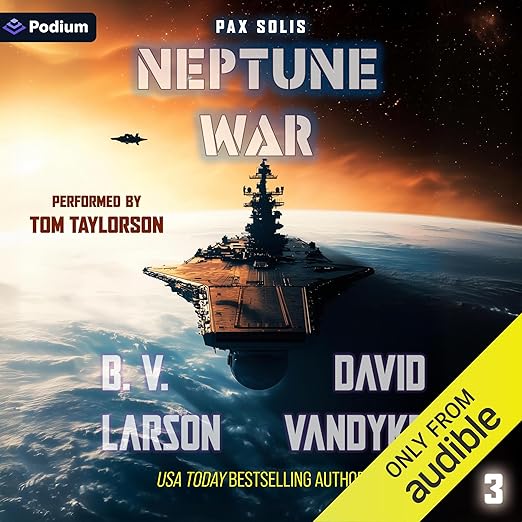
I picked up the Pax Solis series on the recommendation of someone who described it as space opera that does not condescend to its audience. Three books in, that description holds. B.V. Larson has been writing military science fiction long enough to know exactly what this genre’s readers want, and Neptune War delivers the escalation that the first two books have been building toward. The frozen outposts of Neptune going silent one by one is a strong opening image, the kind of sensory detail that immediately communicates scale without requiring exposition.
The setup for Neptune War is dense in the best way. The carrier ECS Vanguard ventures into the darkness beyond the planets to investigate strange signals. There, humanity encounters the Blight, an alien force that has come to exterminate what it believes is a puppet civilization of its ancient enemy. That detail, that the Blight is acting on a false belief about humanity’s nature, is doing interesting thematic work. This is not straightforward conquest. It is a misunderstanding with extinction-level stakes. Meanwhile, Flex continues his investigation into the hyperspace rivers, the mysterious Cure that terrorized Venus, and the specific question of why the Blight thinks humanity is already enslaved.
Our Take on Neptune War
Reviewers describe Flex as a flawed hero who is not overly obnoxious, which is exactly the right calibration for a military SF protagonist. The series’ strength, according to multiple readers, is its plot momentum and character interactions rather than any single revelation or battle sequence. One reviewer notes that moralizing is mixed with pragmatism, which is an interesting observation about the series’ ethical texture. Larson gives Flex a moral code that is legible without being preachy, and Neptune War apparently sustains that balance even as the stakes expand to planetary and civilizational scale. The Blight scenario also gives the series a chance to say something about how civilizations misread each other, and whether Larson takes that opportunity or keeps the focus primarily on military engagement will tell you a great deal about the kind of space opera this series is ultimately trying to be.
Why Listen to Neptune War
Tom Taylorson narrates, and Podium Audio has built a strong reputation for military SF and space opera production. Taylorson handles the technical vocabulary of the setting naturally, which matters in a series with hyperspace rivers, Lizard shock troops, and alien theological warfare. He also brings enough warmth to the character interaction sequences to keep the human stakes readable across what is a substantial nearly sixteen-hour production. The series’ promise that first contact always turns into a fight to the finish is an accurate description of the pacing, and Taylorson sustains that energy throughout.
What to Watch For in Neptune War
The introduction of offworlders who claim their goal is to protect Scadrial at any cost is the most interesting new element in this installment. Any force that defines its mission in terms of acceptable losses, even protective ones, is positioning itself as an ambiguous ally at best. Watch for how Larson handles that ambiguity: does the series commit to moral complexity, or does it resolve into cleaner lines by the finale? The Blight’s mistaken premise about humanity as a puppet civilization also opens up the possibility of a non-military resolution that would be genuinely surprising for the genre. Whether Larson pursues that or opts for the expected confrontation is the book’s most interesting narrative question.
Who Should Listen to Neptune War
Start with book one of the Pax Solis series. This is a serialized space opera with continuous plot threads, and the third book’s emotional weight depends on knowing the history of the ECS Vanguard and Flex’s previous encounters. Fans of military SF who enjoy complex alien threat scenarios and morally textured heroes will find this series a reliable choice. Readers who prefer their space opera lighter on military procedure will find the balance slightly technical, but reviewer consensus suggests the character work is stronger than the genre average.
Frequently Asked Questions
Is Neptune War accessible to new readers of the Pax Solis series?
No. It is the third book in a continuous story. The characters, the political situation between Elendel and the Outer Cities, and the history of the Cure and the Set all require the first two books for context.
What makes the Blight a different kind of antagonist in Neptune War?
The Blight is acting on a false belief that humanity is a puppet of its ancient enemy. That makes this a first contact scenario driven by misunderstanding rather than pure conquest, which adds a layer of tragic inevitability to the conflict.
How does Tom Taylorson handle the technical space opera vocabulary in narration?
Taylorson is an experienced narrator in this genre and handles technical terminology naturally. Reviewers note that the story flows well, which suggests the narration supports rather than interrupts the plot momentum.
Is there a book four planned for the Pax Solis series?
Multiple reviewers express hope for a fourth book, which suggests the series is ongoing. No official announcement is confirmed as of this writing, but the ending structure appears to point toward continuation.