Quick Take
- Narration: Boise Blue handles the isekai premise with energy and keeps the comedic tone consistent, though the performance is more entertaining than nuanced.
- Themes: Overpowered protagonist navigating a familiar world, identity and concealment, the ethics of power when you designed the system
- Mood: Light, comedic, and deliberately low-stakes in a way that reads as intentional rather than thin
- Verdict: A fun entry point for fans of LitRPG isekai who want an overpowered necromancer with personality and snark rather than a power fantasy that takes itself too seriously.
I picked up Necromancer Supreme in Another World on a Friday afternoon, the kind of day when you’ve finished a dense nonfiction read and want something that isn’t going to demand you track competing political factions across three continents. I wanted something with momentum, a little comedy, and a protagonist who wasn’t tediously tortured. I got all three.
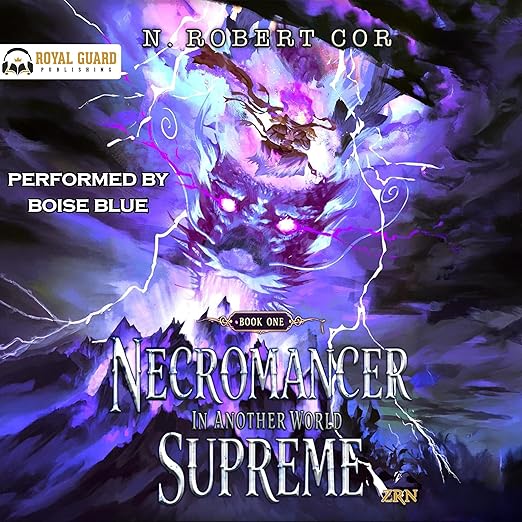
N. Robert Cor, writing here as part of the Royal Guard Publishing lineup, has built a premise that sits comfortably within the isekai LitRPG tradition while finding some room to breathe within those constraints. Jim, the central character, is an extreme case of the devoted gamer archetype: he has spent years inside a single VRMMO, maxing out a Necromancer Supreme character called Vrazher Corour to heights no other player has reached. Then he wakes up inside the game. Not a simulation of it. The game world itself, now somehow real, with the distinction between player character and living person collapsed entirely.
Our Take on Necromancer Supreme in Another World
What Cor does with this setup is smarter than the premise might suggest. Jim is overpowered, genuinely and without apology, but the book works because the author understands that an overpowered protagonist only stays interesting if the character has a head. Jim isn’t a murder machine who carves through everything without reflection. One reviewer specifically noted that he reflected on how his powers could cause more damage than intended if he wasn’t careful, and that thoughtfulness is what keeps the narrative from going flat. He knows the systems of this world better than anyone in it. He built the calamities they’re still recovering from. The central dramatic question isn’t whether he can win any given confrontation. It’s what he’s going to do with that advantage.
The identity concealment element adds genuine texture. Jim must navigate the world as Vrazher Corour while hiding that he is effectively the architect of the modern world’s disasters. That’s a more interesting position than the standard isekai setup, where the protagonist is simply dropped in and expected to muddle through. Here, Jim knows too much. The puzzle is how to exist in a world that would turn on him immediately if it understood what he is.
Why Listen to Necromancer Supreme in Another World
Boise Blue’s narration suits the material well. The comedic beats in Cor’s prose, the snark that multiple reviewers have identified as the author’s signature across series, land effectively in audio. Blue keeps the tone consistent: light without being toothless, playful without undermining the moments when something genuinely matters. It’s a difficult register to hold across nearly fifteen hours and Blue manages it.
The book’s humor is worth flagging explicitly because it shapes the listening experience considerably. This is not a grim dark necromancer fantasy. The comedy is built into the DNA of the setup: a guy who has spent thousands of hours gaming wakes up as the most feared entity in a world he created, and has to pretend he’s just some wandering spellcaster while trying to figure out what era of the game timeline he’s landed in. The Twelve Voidlings, the Twelve Tests, the question of pre- or post-rift timeline: these elements create a mystery structure that gives Jim something to actually investigate rather than simply dominate.
Cor’s worldbuilding benefits from the VRMMO foundation. Because Jim designed or at least deeply inhabited this world as a game, the usual isekai exposition is compressed. He already knows the systems. The book doesn’t need to explain the rules at length because Jim’s knowledge of the rules is itself the dramatic premise. That economy of setup means the story moves quickly, which at nearly fifteen hours is a meaningful quality.
What to Watch For in Necromancer Supreme in Another World
The secondary characters are deliberately light. Elsie is the most fleshed out, described by one reviewer as good but very background. The human side characters and the summons don’t develop much personality beyond their functional roles. This is consistent with a genre that prioritizes protagonist experience over ensemble depth, but listeners who come from literary fiction and want genuine secondary-character texture will notice the thinness. It’s a genre convention, not a flaw exactly, but worth knowing.
The early chapters have been called a relaxed, low-key story in one review, and that framing is accurate. The book is deliberately not a high-tension sprint. If you want relentless escalation and cliffhangers every two chapters, this isn’t that. The pacing is more settled, the comedy more important than the action, and the mystery of what era Jim has arrived in more philosophical than urgent. Readers who enjoy sitting with a world and exploring it at a measured pace will be in their element.
Book one of the series ends with enough resolution to feel complete while clearly leaving room for further adventures. The Twelve Tests and Twelve Voidlings provide a serialization scaffold, and reviewers who have followed Cor’s other series indicate that the author is reliable about continuing them.
Who Should Listen to Necromancer Supreme in Another World
This is a strong choice for LitRPG and isekai listeners who are tired of protagonists who brood relentlessly about their power. Jim is self-aware, occasionally funny, and makes reasonably intelligent decisions. If you’ve read the cultivation series by the same author and enjoyed the snark, reviewers confirm this book delivers more of it in a setting that tilts toward traditional fantasy rather than cultivation mechanics.
Readers who need dense secondary-character development, romantic subplots with significant page time, or narrative stakes built around genuine uncertainty about the protagonist’s survival should look elsewhere. This is fundamentally a comfort read: smart, entertaining, and built around the pleasure of watching a competent person navigate a world they already understand. That’s enough, and it’s executed well.
Frequently Asked Questions
Is this book standalone or do I need to read other series by N. Robert Cor first?
It’s the first book in its own series and works as a standalone entry point. However, readers familiar with Cor’s other work, particularly his cultivation series, will recognize the author’s comedy style and may get additional enjoyment from the tonal similarities.
How overpowered is the main character, and does it make the story feel tension-free?
Jim is genuinely overpowered, but the book generates tension through concealment and mystery rather than combat outcomes. The questions of what era he’s landed in, which of his former summons are now autonomous beings, and how to hide his identity create genuine stakes that don’t depend on whether he can win a fight.
Does the VRMMO-to-real-world premise require familiarity with gaming terminology?
Some genre literacy helps. Terms like VRMMO, max-level character, and in-game systems are used without extensive explanation. Listeners who have no gaming background may find the early chapters slightly opaque, but Cor builds enough world-context that the premise becomes clear within the first hour or two of listening.
How does Boise Blue’s narration handle the tonal shifts between comedy and world-building exposition?
Well. Blue’s strength is in maintaining the comedic register that defines the book’s voice. The exposition is handled at a measured pace that doesn’t drag, and the snark in Jim’s narration comes through clearly. The performance is entertaining and consistent rather than dramatically varied.