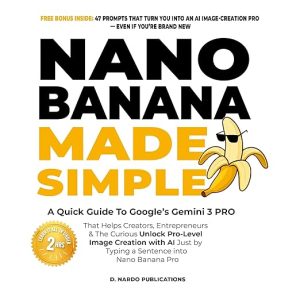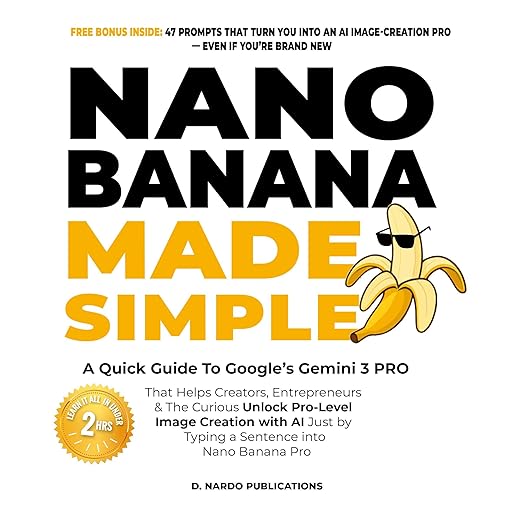
Nano Banana Pro sits in the rapidly expanding field of AI image and video generation tools, and D. Nardo Publications' Nano Banana Made Simple arrives with a promise that cuts against the hype typical of this category: not better AI, but control. The audiobook, narrated by Scott Gillis and running one hour and twenty minutes, is built on a diagnosis that most people generating AI images will recognize intuitively. The results feel random, and when something works, you often cannot reproduce it. Gillis narrates the prompting frameworks and practical techniques that the book offers as solutions to that inconsistency, and his pacing suits the material well for an audiobook format.
The eighty-minute runtime places this title in a specific tier: long enough to deliver substantive content, short enough that a single focused listen covers everything. For a practical guide to prompt engineering for a specific tool, that constraint works in the book's favor. You do not need seventeen hours to understand how to structure prompts for image and video generation. You need a clear mental model and a few reliable structures you can apply immediately afterward.
Gillis Reframes Inconsistent Results as a Communication Gap
The book's framing positions the problem as a communication gap rather than an AI capability gap, which is a genuinely useful reframe for users who have been blaming the tool for inconsistent results that actually stem from inconsistent prompting. Gillis delivers that argument cleanly in the opening sections, and the audiobook builds on it by introducing prompt structures that consistently produce high-quality images and videos across different use cases.
The practical content covers how to control style, lighting, framing, and detail without technical jargon, a claim that the strongest reviewers found credible. One listener described the book as a fantastic place to start for anyone wanting to understand Nano Banana's capabilities, noting that it breaks everything down in simple terms and provides real tips for getting the results you want rather than the results the tool defaults to. Another praised the author's acknowledgment of how fast AI image generation is advancing, situating the guide within an ongoing evolution rather than presenting it as the final word on a settled practice.
Deliberate Pace Comes With a Downloadable Checklist
Scott Gillis's narration is one of the reasons the audiobook format works for this content. Tutorial-style material for software tools often fails on audio because the instructions feel disconnected from the interface they are describing. Gillis mitigates this by maintaining a clear, deliberate pace that lets each prompt structure settle before the next one arrives. The accompanying PDF available in the Audible library is worth downloading for listeners who want to reference specific prompt examples as a written checklist alongside their listening sessions.
The audiobook also covers common failure modes specifically: why most users get disappointing results, and what the mechanics behind those outputs actually are. Understanding what goes wrong and why is often more instructive than learning what to do right, because the failure patterns tend to repeat in predictable ways. The decision to address these explicitly rather than focusing only on ideal use cases gives the book practical durability beyond a first listen and makes it more useful as a reference after the initial run-through.
Notes-Style Bullets Meet Uneven Audio Density
One critical reviewer noted that the source material includes pages dominated by short, spaced-out bullet points that read more as a notes document than a developed book. In audio, that kind of material can produce passages that feel like a list being read aloud rather than ideas being developed and connected. Gillis navigates this as well as any narrator could, but listeners should know that the audiobook's density is uneven: some sections deliver genuine conceptual development, while others are more reference-style in their structure.
The tool specificity is also worth naming clearly. This guide is built around Nano Banana Pro in its current iteration, and AI image generation tools evolve quickly. The prompt logic and structural principles taught here should remain applicable across updates and even across similar tools, since the underlying challenge of communicating intent to generative AI is consistent across platforms. But any platform-specific features or interface details will date as the tool develops. Think of the prompting frameworks as durable and the platform-specific observations as current rather than permanent.
Intermediate Users Are the Real Sweet Spot
This audiobook is well-calibrated for users who have already tried Nano Banana Pro or similar AI image generation tools and feel frustrated by inconsistent results they cannot diagnose or fix. It is not for complete AI novices who want a conceptual introduction to the field, nor for experienced prompt engineers who have already developed sophisticated workflows. The sweet spot is the intermediate user who knows the tool exists and has used it but has not yet developed a reliable method for producing the outputs they are imagining. At eighty minutes with a supplementary PDF, it is a low-friction investment for a potentially significant improvement in output quality and creative control.
The book's title itself merits a brief note. Nano Banana Pro is a specific AI image and video generation tool, and not every listener will arrive knowing the platform by name. The audiobook's value proposition does not depend heavily on deep prior familiarity with this particular tool, but listeners who have been generating AI images through other platforms, whether Midjourney, Adobe Firefly, or others, will find the prompting logic transferable even if some interface-specific details differ. The principles of communicating intent to a generative model are broadly consistent, and the framework Gillis delivers is written for humans who want reliable results, whatever the specific tool they are working with.
At a Glance
- Narrator: Scott Gillis narrates the practical AI prompting guide with clear, tutorial-appropriate pacing that makes the prompt structures easy to follow in audio format, a genuine advantage for step-by-step content.
- Subjects: AI image generation, prompt engineering, creative control and output consistency
- Tone: Practical and demystifying, focused on repeatable results
- Bottom line: A compact, honest introduction to getting consistent results from Nano Banana Pro's AI image and video tools, built for users who are tired of guessing at the tool's behavior.
A Few Questions About Nano Banana Made Simple
Does the Nano Banana Made Simple audiobook teach skills that will work across future updates to the tool?
The prompting frameworks and the underlying logic of communicating intent to AI image generation tools are designed to be durable. Platform-specific features will evolve, but the principles for controlling style, lighting, framing, and consistency should remain applicable through updates to Nano Banana Pro.
Is this audiobook suitable for someone who has never used AI image generation tools before?
The book targets users who have tried the tool and found the results inconsistent rather than complete beginners. That said, the no-coding, no-complicated-workflows positioning makes the foundational content accessible to curious newcomers, and the short runtime makes it a low-risk starting point.
Does the audiobook come with any supplementary materials for referencing prompt structures?
Yes. An accompanying PDF is available in your Audible library with purchase. Given that prompt structures benefit from visual reference when you are actually using the tool, downloading and keeping that PDF open alongside your AI interface is a practical recommendation.
How long is this audiobook and is that runtime sufficient for the content it covers?
At one hour and twenty minutes, the audiobook is designed for a single focused listen covering the complete prompt engineering framework. The short runtime is a deliberate fit for practical tutorial content rather than a limitation, and it pairs well with the supplementary PDF for ongoing reference.