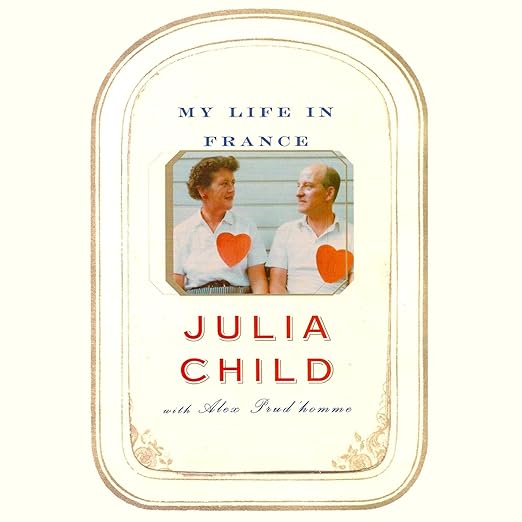
Julia Child's memoir of her years in France arrived to me through an unlikely route: a conversation with a friend who teaches culinary history and who insisted that the book was fundamentally about a marriage rather than a cuisine. She was right, and the audiobook confirms it. Kimberly Farr's narration captures something that reading the page sometimes obscures, which is the way Child's warmth for Paul and her warmth for France operate at the same frequency. The two loves are not separate chapters. They are the same emotion applied in different directions, and heard aloud, that becomes unmistakable.
My Life in France covers the years Child spent in Paris and the French provinces from 1948 onward, following Paul Child's State Department posting and eventually leading to enrollment at the Cordon Bleu, her collaboration with Simone Beck and Louisette Bertholle, and the long road to the publication of Mastering the Art of French Cooking in 1961. It is a memoir structured not around dramatic conflict but around discovery, which is a harder narrative to sustain and which Child and co-author Alex Prud'homme manage with considerable grace. This audiobook renders that grace audible.
Our Take on My Life in France
What Child describes in the opening pages, the meal at La Couronne in Rouen that constituted her first French lunch, has become one of the most quoted passages in food writing. Oysters on the half-shell, sole meuniere, wine, salad, fromage blanc. The precision of her memory for what she ate and felt reading it is pleasurable, but hearing Farr deliver those sentences creates something different, something closer to the experience of being told a story by someone who still cannot believe their luck. Child was a tall, outspoken woman from Pasadena who arrived in France speaking no French and knowing nothing about French cooking and ended up defining American home cooking for a generation. Heard aloud, the gap between who she was on the ship to Le Havre and who she became feels both enormous and completely natural.
Farr does not attempt to replicate Child's distinctive television voice, which was a wise decision. That voice, high and undulating and immediately recognizable, belongs to a performance context. The written Julia is a slightly different person: more reflective, more precise about her feelings, more willing to describe failure without turning it into comedy. Farr finds a register that is warm and specific and slightly formal in the period-appropriate way, and it suits the material well. Reviewers consistently describe the book as charming, and the narration is a significant part of why the audio version earns that word.
The food descriptions are the obvious draw, and they work particularly well in audio. Child's descriptions of markets, ingredients, techniques, and meals are sensory and precise, and Farr's delivery gives them room to register without rushing past them. A Parisian reviewer noted that the book produces the feeling of having strolled the streets of Paris alongside Child, and audio amplifies that quality: the rhythm of spoken prose makes the scenes physical in a way that rapid silent reading sometimes bypasses.
The historical context is also richer than the book's food reputation suggests. Child arrived in France in 1948, three years after the end of the Second World War, during a period of reconstruction and political tension and also of extraordinary culinary vitality. Her observations about French markets, her descriptions of relationships with purveyors and fellow students at the Cordon Bleu, and her account of navigating professional publishing in the 1950s as a woman with an unconventional project all carry genuine documentary value alongside their personal warmth. Paul Child's career in the State Department connects the memoir to a broader postwar American story that the book never lectures about but consistently illuminates.
What Gives Us Pause
The book's structure is looser than a conventional memoir and tighter than a journal. Child moves between Paris, Marseille, Germany, Norway, and Washington DC following Paul's postings, and the sections outside France are sometimes underwritten compared to the rich Parisian episodes. Listeners who want a continuous immersive experience in one place will find the memoir episodic in ways that reflect the reality of a diplomat's life rather than the demands of narrative convenience.
Worth watching for: the extended account of the Cordon Bleu and Child's complicated relationship with its director Max Bugnard and with her French collaborators. This section is where the book's professional dimensions sharpen, and it is considerably more interesting than the simple story of "American woman learns to cook in Paris" that the memoir's popular reputation sometimes reduces to. The negotiations, the friction, the persistence required to bring Mastering the Art of French Cooking into existence are treated with enough specificity that listeners interested in the history of cookbook publishing will find material that goes well beyond the personal.
Who Should Listen to My Life in France
This audiobook rewards food enthusiasts, francophiles, and readers of memoir who respond to voices that are confident without being self-congratulatory. The 11-hour runtime feels generous rather than long because the material sustains it, but listeners who want plot-driven momentum or dramatic tension will find the gentle episodic structure less satisfying. People who loved the memoir format of books like MFK Fisher's collected essays or Elizabeth David's food writing will recognize a kindred spirit in Child's approach. Those coming primarily for cooking instruction will not find recipes here: this is the story of how the cooking was learned, not the technical manual that resulted from it.
Does the audiobook of My Life in France capture the charm of the print edition?
Most listeners find Kimberly Farr's narration enhances the memoir's warmth rather than diminishing it. Her delivery makes the French food descriptions and period scenes feel immediate in a way that suits the conversational, personal tone Child wrote in.
Is this audiobook suitable for listeners who are not especially interested in cooking?
Yes. The memoir is fundamentally about transformation, marriage, and the discovery of a vocation, with food as the medium rather than the subject. Listeners who respond to intelligent, warm personal narrative will find plenty to sustain them even without prior interest in French cuisine.
How does Kimberly Farr handle Julia Child's distinctive voice in the narration?
Farr does not attempt to replicate the famous television persona. She finds a different register for the written Julia: warm, precise, and period-appropriate. This is the right call, since the book reflects a more reflective and less performative version of Child than the television audience knew.
Does this audiobook cover the full arc of Child's career or focus only on her early years in France?
The memoir covers roughly from 1948 through the publication of Mastering the Art of French Cooking in 1961, with some additional reflection on later years. It does not attempt to document her television career or the later decades of her public life.