Quick Take
- Narration: Blair Baker earns the Library Journal’s praise directly, her tonal control keeps this short novella firmly in the cozy register without letting the genuinely sinister stakes slip into camp.
- Themes: Memory as identity, the permanence of death in a world that had made it optional, detective fiction logic applied to SF speculation
- Mood: Cozy and cerebral, Agatha Christie by way of a generation ship
- Verdict: Murder by Memory is a sharply conceived novella that packs more worldbuilding and tonal confidence into two hours than most full novels achieve, though listeners who want room to breathe with the characters will find the brevity a limitation.
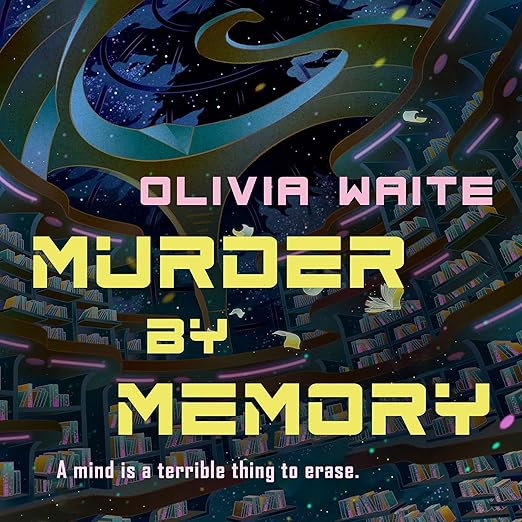
I listened to Murder by Memory on a Tuesday evening during a commute that ran longer than expected, and I was not remotely sorry when the traffic stalled. Olivia Waite has written a novella that gets its worldbuilding, its detective, its crime, and its stakes established in under two and a half hours without the seams showing. The comparison to Becky Chambers on one end and Miss Marple on the other is marketing shorthand, but it is accurate shorthand: this is a cozy mystery with genuine SF architecture underneath it.
The HMS Fairweather is an interstellar generation ship where new bodies are provided upon request and minds are preserved in glass in the Library when their owners want to rest between lifetimes. Murder, in this world, has become essentially impossible, kill a body, the mind continues. Dorothy Gentleman, a retired ship detective whose mind was resting in the Library, wakes up in a body that is not hers. Someone else’s body. Someone else who has just been murdered. And someone is not only killing bodies but purposefully deleting minds from the Library, making death on the Fairweather permanent for the first time in three centuries. The crime is existentially new. Dorothy’s method is old-fashioned and excellent.
Our Take on the Worldbuilding Economy
The generation ship premise is not new, Alastair Reynolds, Becky Chambers, and dozens of others have worked this terrain, but Waite does something specific and clever with it. By making death optional through the Library system, she creates a world where murder has effectively ceased to be a serious crime, which means the detective’s role has atrophied, which means when real murder returns, the detection skills required have become almost antique. Dorothy’s methodology is not an anachronism, it is the only thing that works against a killer who understands the technological systems and has spent three hundred years planning. That irony is what gives the cozy genre framing its teeth.
Why Listen to Blair Baker’s Performance
Blair Baker’s narration is the production’s biggest asset. Dorothy Gentleman is described by the synopsis as a formidable no-nonsense auntie of a detective, and Baker inhabits that description with full commitment: dry, assured, occasionally amused, never flustered. The Library Journal’s note that Baker keeps the novel’s tone firmly cozy is the right observation. There is genuine menace in the premise, mind deletion is a form of murder that removes any possibility of continuation, and Baker’s steadiness as Dorothy is what prevents that menace from destabilizing the cozy atmosphere. The secondary characters, particularly the feckless nephew Ruthie and the sultry yarn store proprietor who may know more than she lets on, are distinct enough in Baker’s hands to be immediately legible.
What to Watch For in the Novella Format
The criticisms this novella has generated are structurally honest: it is short. One reviewer noted the characters do not have room to develop to the point where you care about them deeply before the mystery resolves. Another wanted a full novel in this world and found the novella format insufficient for everything Waite is attempting. Both criticisms are legitimate, and the question of whether the format serves the concept is genuinely interesting. What Waite achieves in two and a half hours is remarkable in execution. What she does not have room for is the slow accumulation of affection that makes a detective series’ recurring cast feel like old friends. This is an opening chapter in a detective’s life, not a complete portrait. Listeners who accept it on those terms will find it rewarding.
Who Should Listen to Murder by Memory
Listen if: you enjoy cozy mysteries that take their SF elements seriously rather than treating them as decorative; you want a detective protagonist with genuine wit and method; or you are looking for an audiobook that delivers a complete and satisfying arc in under three hours without feeling truncated. Skip if: you need room to develop deep attachment to a cast before caring about their fates; you want a novel-length exploration of this world’s premise; or you are not a cozy mystery reader and are coming only for the SF worldbuilding, which exists but is not the primary pleasure.
Frequently Asked Questions
Is Murder by Memory a complete story, or does it end on a cliffhanger requiring the next book?
The central murder mystery resolves within this novella. It is labeled book one in the Dorothy Gentleman series, so it establishes a world and a detective to return to, but it does not leave the primary crime unsolved. A satisfying standalone that functions as a series opener.
How does Blair Baker handle the tonal balance between cozy and genuinely sinister?
Exceptionally well, this is the performance’s chief achievement. Baker’s Dorothy is dry and assured, which keeps the cozy register intact, but she does not paper over the fact that mind deletion is an existentially serious crime. The tone is controlled rather than muddled.
Do you need to be a science fiction reader to appreciate Murder by Memory?
No. The SF elements are present and inventive, but the mystery logic is cozy in structure and Dorothy’s methods are old-fashioned by design. Readers who love Agatha Christie but rarely read SF will find the generation ship setting accessible rather than alienating.
Is the novella length a problem, does the story feel incomplete at under three hours?
Depends on your expectations. The mystery is complete. The characters are sketched rather than fully inhabited. Reviewers who wanted a novel are disappointed; reviewers who accepted the novella as a proof of concept for a series were satisfied. Know which kind of reader you are before purchasing.