Quick Take
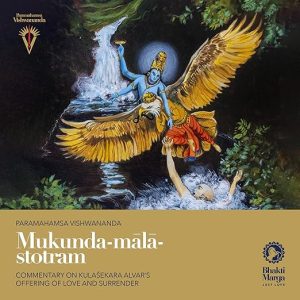
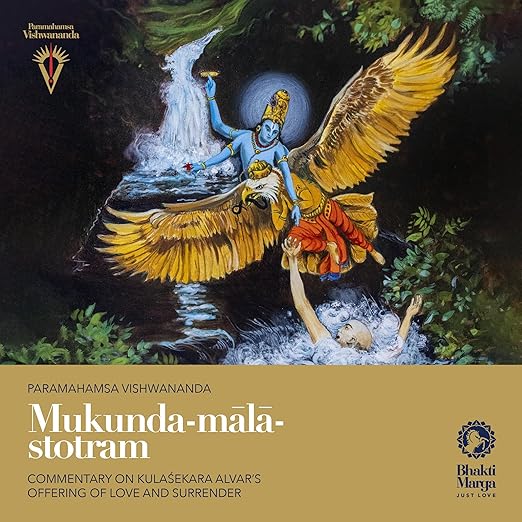
- Narration: Paramahamsa Vishwananda narrates his own commentary with evident devotion, lending the recitation an authenticity that a hired voice would struggle to replicate.
- Themes: Bhakti devotion, surrender and liberation, the soul’s longing for the divine
- Mood: Meditative, reverent, and deeply interior
- Verdict: A specialized listen for those already drawn to Vaishnava practice; it rewards patience and sincerity over casual curiosity.
I came to the Mukunda-mala-stotram on a quiet Saturday morning when I needed something that asked nothing of my analytical mind and everything of my attention. I had been reading around South Indian devotional traditions and kept encountering King Kulasekhara’s name, one of the twelve alvars, the mystic saints whose poetry shaped the bhakti revival and whose influence reached all the way to Sri Ramanujacharya’s Sri Sampradaya. Nine hours felt long for a single devotional text, but by the end of the first hour I had stopped thinking of it as long at all.
What this audiobook offers is not a lecture or a scholarly unpacking but something closer to a guided immersion. Paramahamsa Vishwananda reads the prayers themselves and then opens each one with commentary, connecting the ancient Sanskrit to the lived reality of spiritual practice. The structure means you are never left holding a beautiful but opaque verse without a thread to follow. For listeners with no background in Vaishnavism, that scaffolding is genuinely valuable.
Our Take on Mukunda-mala-stotram
King Kulasekhara wrote this prayer as an act of saranagati, the Sanskrit term for complete surrender to the Lord. The text moves between acknowledging the misery of the soul caught in samsara, the cycle of birth and death, and an urgent, almost tender petition to Mukunda, the Lord as granter of liberation, to free the author despite his self-proclaimed unworthiness. That paradox, the worthless supplicant addressing the infinite divine, is what gives the Mukunda-mala-stotram its emotional texture. It is not triumphant devotion; it is devotion that knows its own smallness.
Paramahamsa Vishwananda’s commentaries draw on the Bhagavad Gita, the Srimad Bhagavatam, and other scriptural sources he has taught extensively. His voice carries the weight of someone who has lived with this material for decades, not someone reading notes from a page. Reviewers across multiple languages, French, Portuguese, German, English, have all responded to this quality. One described feeling a river of bliss within the heart. That is the language of devotional experience, not literary critique, but it points to something real about the recording’s effect on willing listeners.
Why Listen to Mukunda-mala-stotram
The nine-hour runtime is front-loaded with explanatory material that makes the prayers accessible. Vishwananda does not assume the listener has prior Sanskrit literacy or familiarity with Vaishnava theology. He explains saranagati without making the explanation clinical. He contextualizes Kulasekhara’s historical role within the alvar tradition without turning the commentary into an academic lecture. The result is a listening experience that functions simultaneously as devotional practice and as an introduction to a theological framework that many Western listeners will encounter for the first time here.
The format also lends itself well to audio in a way that a dry scriptural commentary would not. Hearing the prayers recited before they are explained creates a rhythm of sound followed by understanding, which mirrors the oral tradition these texts emerged from. There is something appropriate about receiving this material through the ears rather than off a page.
What to Watch For in Mukunda-mala-stotram
This is a devotional work with a specific theological orientation. Listeners who approach it as comparative religion or secular philosophy may find the register confusing. Vishwananda speaks from within the tradition he teaches, not from outside it, and the commentary reflects that position without apology. One reviewer from the United States found the text deeply moving; another from France used the word nectarean. These are not responses you produce by maintaining critical distance.
The audio quality and production are modest, consistent with a release from Bhakti Event GmbH, which publishes Vishwananda’s teachings. Do not expect the polished studio sound of a major publisher. What you get instead is an intimacy that suits the material.
Who Should Listen to Mukunda-mala-stotram
If you are drawn to the devotional traditions of South India, studying the alvar poets, exploring Vaishnava philosophy, or searching for an audio companion to a personal bhakti practice, this recording offers something rare: a living teacher reading and interpreting a medieval devotional classic with obvious sincerity. If you are looking for an entry point into Hinduism without prior grounding, you may want to begin elsewhere and return here once you have a basic orientation in the terminology.
Frequently Asked Questions
Do I need prior knowledge of Sanskrit or Vaishnavism to follow this audiobook?
No prior Sanskrit is required. Paramahamsa Vishwananda explains each verse and its theological context in English before or after the recitation, so the commentary functions as an accessible guide even for complete newcomers to Vaishnava practice.
Is this a traditional recitation or does it include scholarly commentary?
It is both. Vishwananda recites the prayers and then offers his own spiritual commentary rooted in the broader Vaishnava scriptural tradition, including the Bhagavad Gita and Srimad Bhagavatam. It is devotional teaching rather than academic scholarship.
Who was King Kulasekhara and why does it matter for understanding this text?
Kulasekhara was the seventh of the twelve alvars, the mystic bhakti saints of South India, and his poetry helped inspire Sri Ramanujacharya’s Sri Sampradaya. Understanding that he wrote as a king who chose devotion over power adds weight to the text’s theme of surrender and liberation.
At nine hours, does the audiobook sustain its depth throughout or does it become repetitive?
The format of prayer followed by commentary creates natural variation across the running time. Listeners already engaged in devotional practice tend to find it sustaining; those looking for narrative development may find the meditative structure demanding after the first few hours.