Quick Take
- Narration: Sara Wheeler narrating her own travel memoir is exactly right: her voice carries the dry wit and genuine literary passion that give the book its distinctive character.
- Themes: Literary pilgrimage and landscape, Russia's complex present against its artistic past, the act of travel as a form of reading
- Mood: Erudite and warmly observant, with flashes of melancholy and dark humor
- Verdict: Mud and Stars is a rare travel book that earns its literary pretensions, offering listeners both a vivid portrait of contemporary Russia and a generous introduction to the writers who made it.
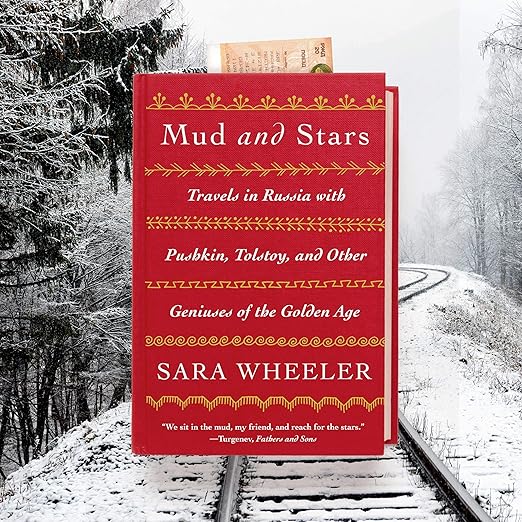
Pushkin, Tolstoy, Gogol, Turgenev, Dostoevsky: Sara Wheeler arrives in Russia with a library rather than a guidebook, and the audiobook she narrates herself, Mud and Stars, across eight hours and thirty-eight minutes, is a literary pilgrimage that refuses the usual routes. She bypasses Moscow and St. Petersburg as much as possible, traveling instead to the places associated with the country's great nineteenth-century writers: the Trigorskoye estate where Pushkin spent his exile, the shores of Lake Ilmen where Dostoevsky owned his only house, the single remaining stone of Tolstoy's birthplace. This is a travel memoir, a work of literary criticism, and a portrait of contemporary Russia assembled simultaneously, and Wheeler holds all three registers with the ease of someone who has been doing this kind of work for a long time and sees no reason to choose between them.
The book is timely in ways Wheeler could not entirely have anticipated when she was traveling. Russia under Vladimir Putin, which she observes with a sharp but unsentimental eye, presents a pattern of outcry and silence that she traces across both the political landscape she encounters and the literary tradition she is following. The writers who guide her journey were not strangers to repression, exile, or the gap between what a country claims to be and what it demonstrably is. That parallel is never heavy-handed in Wheeler's telling; it surfaces naturally from the juxtaposition of what these writers wrote about Russia and what Russia looks like from a borrowed bed in a modest homestay, eating roe and cabbage soup, learning the language from patient and sometimes baffled local hosts.
Wheeler narrating her own work is the correct decision, and not merely because she knows where the emphasis belongs in her own prose. Her voice carries a quality that is difficult to describe but immediately recognizable: the dry intelligence of someone who has read everything and is still genuinely surprised by what she finds. When she describes looking for Dostoevsky along the waters of Lake Ilmen, or paying tribute to what remains of Tolstoy's birthplace, the literary reverence in her voice is real rather than performed, and it communicates itself to the listener even if you have read neither writer and arrive at the audiobook as a traveler rather than a scholar.
Reviewer Jeanne Marie Lambrianou described Wheeler as packing you up and carrying you along through time and place, and that is the precise sensation of listening to this recording. Wheeler has a gift for weaving writers' lives and works around the physical places she visits, so that a chapter about traveling to Trigorskoye becomes simultaneously a portrait of Pushkin's character, a description of the beet fields and architectural follies of northwestern Russia, and a reflection on what it means to preserve a literary legacy in a country with such an ambivalent relationship to its own past. Reviewer Jim Clark praised her ability to handle Tolstoy without soft-pedaling his dreadful and often confused life, and that toughness is present throughout the book.
What Stands Out
The straightforward answer is that this audiobook is one of the more intelligent travel books of recent years, and the self-narration makes the audio format distinctly more satisfying than a print reading would be. Wheeler's prose has a rhythm and a voice that benefit from being heard rather than read silently. The literary references throughout, and there are many, are integrated rather than dropped in for credibility. She genuinely knows these writers and their work, and she conveys that knowledge in a way that makes even listeners unfamiliar with nineteenth-century Russian literature feel oriented rather than excluded from the conversation.
For listeners with an existing interest in Russian literature, the audiobook offers something rarer: a contemporary account of what the places these writers lived in actually look and feel like in the present. Wheeler boards trains, eats with families, navigates the bureaucratic oddities of travel in regions far from Moscow, and brings all of that texture into conversation with what Gogol or Turgenev wrote about the same landscapes. Reviewer John P. Jones III, introduced to Wheeler's work through Travels in a Thin Country, found Mud and Stars underappreciated based on its review count, and that observation points to something genuinely worth correcting by a wider audience.
What to Watch For in Mud and Stars
Listeners who want a fast-moving travel narrative will find Wheeler's pace more contemplative than propulsive. She lingers, which is both her method and her point. A pilgrimage should be deliberate, and the book's rhythm reflects that intention. At eight and a half hours, it asks for attention rather than passive listening, and rewards that investment in proportion to the care the listener brings to it.
Some familiarity with the major nineteenth-century Russian writers enriches the experience significantly. Wheeler introduces each figure as she arrives at the places associated with them, so you are not expected to arrive with a complete literary education, but listeners who have read at least one or two of the writers she covers will find the audiobook resonating at additional frequencies. It is also worth noting that Wheeler's Russia is emphatically not the Russia of diplomatic news cycles or geopolitical analysis, though the political reality of life under Putin surfaces regularly. This is a more intimate, literary, and ultimately more human portrait than either genre typically provides.
Best Suited For
Mud and Stars is the right audiobook for listeners who love literary travel writing, who have an interest in Russia's cultural and literary history, or who want to spend eight hours with a narrator whose intelligence and dry humor make even a muddy estate visit feel worth the journey. It is less suited to listeners who want an active itinerary, practical travel information, or a political analysis of Russia rather than a literary and personal one. Readers who enjoyed Patrick Leigh Fermor, Ryszard Kapuscinski, or Wheeler's own earlier work in Travels in a Thin Country will find this a worthy addition to the tradition of serious literary travel writing.
A Few Questions About Mud and Stars
Do I need to have read Russian literature to appreciate this audiobook?
Not at all, though familiarity with the major writers Wheeler visits enriches the experience. She introduces Pushkin, Tolstoy, Gogol, Turgenev, and Dostoevsky as she arrives at their associated places, so the audiobook functions as an introduction to these writers' lives and landscapes for those who have not read them yet.
How does Sara Wheeler's self-narration affect the audiobook experience?
Wheeler narrating her own memoir is a significant asset. Her voice carries the dry wit and genuine literary passion that define the book's character, and she knows exactly where the emphasis belongs in her own prose. It is a richer listening experience than a third-party narrator would likely provide.
Is this audiobook primarily a travel narrative or a work of literary criticism?
It is genuinely both, and that dual quality is what makes it distinctive. Wheeler weaves the writers' lives and works into her accounts of the physical places she visits, so the book is simultaneously a contemporary portrait of Russia and a warm, rigorous engagement with nineteenth-century Russian literature.
Is this audiobook's portrait of Russia still relevant given how much has changed politically?
Yes. Wheeler was already observing the Putin-era pattern of outcry and silence during her travels, and she draws explicit parallels between the political pressures the nineteenth-century writers faced and the contemporary political climate she encounters. The book's political observations are woven into the literary and personal narrative rather than serving as a separate analytical framework.