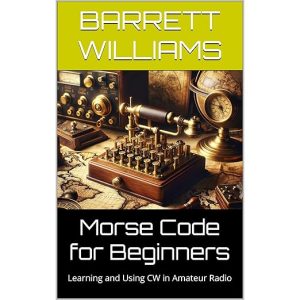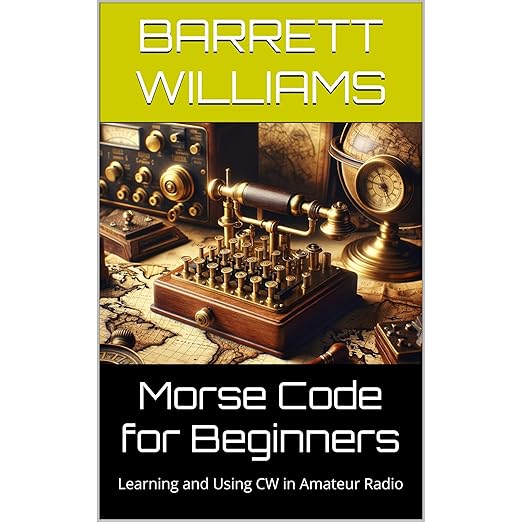
Dots and dashes are a language you learn with your ears rather than your eyes, which ought to make an audiobook the natural home for a beginner's guide to Morse code. Barrett Williams has written a genuinely thorough one, covering the whole path from the invention of the code to a first live contact on the air. What happens to that material in this particular recording is a more complicated question, and it is the reason a buyer should hesitate over this particular entry.
From First Letters to a Stranger's First Contact
Williams covers more ground than the title implies. The book starts with the origins and evolution of the code, moves through the equipment a beginner needs and how to set up an amateur radio station, then works systematically through the alphabet, the numerals and the punctuation. After that come the accelerators: software tools, practice routines, and the surprisingly personal question of which type of key suits your hand and your ambitions.
Everything is built around the progression toward a first contact. Individual symbols become words, words become phrases, phrases become an exchange with a stranger somewhere else in the world, complete with signal reports and the abbreviations that keep an exchange moving when every character has to be sent by hand. Anyone who has taught themselves a skill in isolation knows the value of a book that keeps the first real use of it in view. Nothing sustains practice like a specific event to practice toward, and the first exchange with a stranger is a better goal than any score on a test.
Past that milestone the book turns toward the culture. Continuous wave contests, the communities that organize them, the etiquette that keeps a shared band usable, and a chapter on mental resilience for operators grinding through a long contest. It also covers emergency communications and disaster response, which is the argument radio amateurs make for why any of this still matters when a phone in your pocket can reach the other side of the planet.
Hearing the Code Before Seeing the Chart
Morse is auditory in a way almost no other hobby is. A printed chart of dots and dashes teaches you to translate symbols on a page, which is precisely the habit that has to be unlearned before anyone can copy code at speed. The book understands this and builds toward recognizing whole characters by sound, so the format and the pedagogy are pointed in the same direction, at least on paper.
Practical chapters are the ones a beginner will return to. Choosing between a straight key, a paddle and the alternatives is a decision with real consequences for how your sending is heard, and the material on software tools and structured practice addresses the thing that defeats most learners, which is not difficulty but the absence of a routine. Three and a half hours is about right for this much orientation.
Emergency preparedness gives the book a second audience entirely. Code carries through conditions that defeat voice transmission, needs almost no power, and depends on equipment simple enough to be repaired by hand. Listeners who came from a general interest in preparedness rather than from radio will find that section unexpectedly convincing, and it gives the hobby a justification that has nothing to do with nostalgia.
Barrett Williams writes with obvious enthusiasm for the tradition and none of the gatekeeping that sometimes surrounds it. The framing throughout is that a global community is waiting on the other side of a modest amount of practice, and that the barrier is patience rather than talent. For a subject that could easily be presented as an antiquarian curiosity, treating it as a living skill is the correct editorial decision. The chapters on introducing children to the code make the same case from the other end.
Synthetic Narration for a Listening-Based Skill
Virtual Voice is what the narration credit reads, and on this title of all titles that matters. A synthetic reading is a reasonable compromise on a text you consume for information; it is a much harder proposition on a book whose central lesson is learning to recognize sound patterns by ear. The page also says nothing about whether actual code tones appear in the recording, which is the one thing a buyer needs to know here.
Shelving is wrong in a way that will cost this book readers. This entry sits under home and garden with a crafts and hobbies tag, which is technically defensible and practically useless: nobody browsing gardening titles wants an amateur radio primer, and nobody hunting for an amateur radio primer is looking in that aisle. The series is named as HAM Mastery: Unlocking the Airwaves, book two, and the first volume is never identified.
Four ratings, an average of exactly two stars, and not a word of explanation from anybody. The arithmetic is worth spelling out because it is unusually tight: an average of exactly two across four whole-star votes puts the total at eight, which means at most one person can have gone above three stars, and if anyone awarded a five, the other three raters all gave the lowest grade available.
Aspiring Hams Yes, Speed Trainees Need More
Aspiring radio amateurs who already know they want the license and want the code with it are the intended audience, and the structure serves them properly, from first principles through to contest culture. Preparedness-minded listeners looking for a communication method that survives infrastructure failure are the strong secondary case, and they can stop after the emergency chapters with most of what they came for.
Serious code students need more than this, and should treat it as orientation before the actual training rather than as the training itself. Learning to copy at speed requires timed drills, software feedback and daily repetition that no recording can supervise. Anyone hoping for a history of telegraphy should also look elsewhere, since the origins get a chapter rather than a book, and everything after it is instructional. Listeners with no intention of transmitting anything will find long stretches about equipment they will never buy.
Rhythm and hearing are the entire subject, and it deserves a reading by somebody who can hear. Take this as the map of a hobby, buy the practice tools separately, and treat the low average on the page as an open question rather than as a verdict on the subject itself.
Can you actually learn Morse code from an audiobook?
You can learn what to do and in what order, which is genuinely useful. You cannot build copying speed that way, because that requires timed drills with feedback. Treat this as the orientation that tells you which tools to buy and which habits to avoid, then do the practice with software designed for it.
Is this audiobook part of a series?
Yes, and awkwardly. It is the second entry in HAM Mastery: Unlocking the Airwaves, so a buyer who prefers to start at the beginning has nothing on this page to search for. Nothing in the contents appears to lean on the earlier volume, which means beginning here costs you nothing except tidiness.