Amazon Customer, the handle behind one review here, happened to be listening to this story while actually staying on the Isle of Portland, a few miles down the coast from Chesil Beach, close enough to the book's own setting to hear "the undertow and grinding roar of the pebbles" through the window while reading about smugglers doing exactly that a few coves over. Few audiobooks get to be reviewed in the landscape they're set in, and that context frames everything else worth knowing about this one.
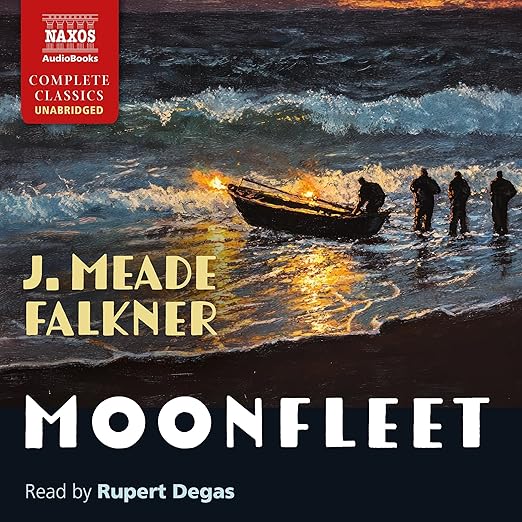
John Meade Falkner's novel follows orphaned John Trenchard, raised by a cold and critical aunt in the smuggling village of Moonfleet, who stumbles into a passageway under the local graveyard one night and ends up entangled with a band of smugglers led by the gruff innkeeper Elzevir Block. When the two are implicated in a magistrate's murder, they flee across the countryside chasing a legend about Blackbeard's lost diamond, eventually working their way to Carisbrooke castle to decode a hidden message in the ghost's own locket. Rupert Degas narrates this Naxos AudioBooks edition, a relatively new release on the catalog for a novel that's been in print since the 1890s. The synopsis frames the book as probing "the value of wealth versus that of true friendship," which is a useful lens for a plot that could otherwise read as a straightforward chase after a legendary diamond; the treasure matters less, by the end, than who John chooses to trust along the way.
Bookwyrm's review frames it well: "Moonfleet is a classic coming of age story that spans John Trenchard's life from childhood through adulthood." That span is part of what distinguishes it from a simple treasure hunt; John's aunt kicks him out of her house for staying out too late, and the consequences of that single decision reshape the rest of his life. csmsinger's review captures the tonal register directly: "Well written, well conceived," and describes the book as "a moral tale of the danger of greed" wrapped inside "the salt spray of the sea, the white foam of the breakers." That same review describes feeling transported to "a part of the world I've never visited," each time picking the book back up, which is a small but telling compliment for historical adventure fiction: the setting has to feel lived-in enough that a listener with no connection to that stretch of English coastline still comes away with a sense of having been there.
Falkner Wrote Three Novels and Ran an Arms Firm
Dan Pinkston's review makes the strongest case for this one, supplying context you won't find in the marketing copy. Falkner "wrote only three novels, Moonfleet, The Nebuly Coat, and The Lost Stradivarius," all published in the 1890s and the first decade of the 1900s, and according to that same review, Falkner worked as an expert on English churches and as chief executive of one of the largest arms manufacturers in Great Britain. Pinkston discovered the book through a review by Michael Dirda in the Washington Post, which is its own small piece of literary trivia: a writer who published almost nothing, working an entirely unrelated day job, wrote a novel still being freshly recorded well over a century later.
M Carley's review adds the human stakes plainly: John "lives in Moonfleet, where one of the main occupations is smuggling goods," wants to make something of himself, and "also has feelings for a young woman named Grace, who is the daughter of an important man in town." That romantic thread runs alongside the treasure plot without overtaking it, giving the adventure a second engine once the smuggling and the manhunt eventually resolve. Bookwyrm's review adds one more useful piece of texture: John's aunt throws him out of the house specifically for being caught outside at night, a punishment that reads as harsh by modern standards but sets the entire plot in motion, since it's that expulsion that pushes him toward Elzevir Block and the smugglers in the first place.
Its Slow Opening Doesn't Sour the Ratings
M Carley is also the one dissenting voice on pacing, noting plainly that "the story started out a little slow" before the plot proper kicks in. It's a fair warning for anyone expecting the treasure hunt to begin immediately; the setup takes real time to establish John's home life and his aunt's coldness before the smuggling plot arrives. Every other review in the column rates the book four or five stars regardless, so the slow opening doesn't appear to have soured anyone's overall impression once the story picked up speed.
On the numbers: the 4.3 rating rests on just 2 counted votes, thin enough on its own that I'd treat it as a placeholder rather than a verdict, regardless of how it was calculated. Take the displayed score as an approximation rather than a number you could rebuild yourself from what's shown. The February 2026 release date on this Naxos edition is also worth flagging simply because it's recent; you're getting a freshly produced recording of very old source material rather than a decades-old digital transfer. The listing currently prices the audiobook at $8.95, worth checking against whatever storefront you're buying from.
Seven Hours and Fifty Minutes of Coastal Adventure
This suits listeners drawn to classic English adventure fiction with real moral weight underneath the plot mechanics, especially anyone who enjoys coming-of-age stories that let their protagonist actually change across the runtime rather than simply survive an ordeal. Fans of buried-treasure plots with a genuine sense of place, coastal caves, smuggling runs, decoded ciphers, will find plenty to like, and Dan Pinkston's biographical detour into Falkner's strange, book-adjacent life adds unexpected texture for anyone who enjoys knowing the author behind the story. Skip it if a slow, atmosphere-building opening chapter tests your patience, since at least one reviewer found the early pacing sluggish before the plot found its footing. Patient listeners get a genuine adventure classic with more moral seriousness than its treasure-map premise suggests, and one that earns the coming-of-age label Bookwyrm gives it rather than just wearing it as marketing shorthand.
The Short Version
- Voice: Rupert Degas narrates this recent Naxos AudioBooks production of a novel first published in the 1890s.
- Big ideas: coming of age, smuggling and buried treasure, the cost of a single reckless decision
- Atmosphere: Atmospheric and morally serious beneath its adventure-story surface
- Worth it?: Patient listeners willing to sit through a slow opening chapter get a genuinely worthwhile classic adventure.
A Few Questions About Moonfleet
Should listeners expect a slow start to this audiobook?
Somewhat. One reviewer, M Carley, describes the opening as starting out a little slow before the smuggling plot takes hold. Every other review in the column still rates the book highly, suggesting the slower setup pays off once John Trenchard's story gets moving in earnest.
What's the total length of the Moonfleet audiobook?
Rupert Degas narrates this Naxos AudioBooks edition across 7 hours and 50 minutes. That runtime covers John Trenchard's childhood through his adult adventures chasing Blackbeard's legendary diamond alongside the gruff smuggler Elzevir Block, from the graveyard passageway to the eventual reckoning at Carisbrooke castle.
Is this audiobook appropriate for kids interested in classic adventure stories?
Yes, it's cataloged as a children's title, though the story includes real violence, a murder accusation, and morally serious themes about greed. It suits older kids and family listening sessions more than very young children looking for a gentler, lighter adventure story overall.