Quick Take
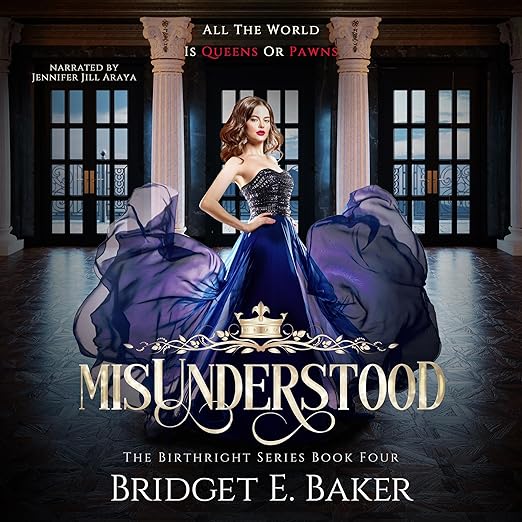
- Narration: Jennifer Jill Araya handles the emotional complexity of Melina’s internal conflict with conviction, her performance gives weight to the identity revelation that drives the book.
- Themes: Identity and self-knowledge, perfectionism and parental expectation, the cost of long-term self-denial
- Mood: Tense and emotionally layered, with a darker undertone than earlier books in the series
- Verdict: The strongest entry in The Birthright Series for character depth, though it works best read in sequence from book one.
I finished Misunderstood on a weeknight, later than I planned to stay up, which tells you something useful about how this book operates. I had come in with some familiarity with Bridget E. Baker’s Birthright Series, enough to understand that each installment rotates perspective among the sisters, but this one, the fourth book, surprised me with how much it changes the texture of the series.
Where the earlier books in the sequence move at the pace of plot, Misunderstood slows down to excavate character. Melina is not a new figure, readers of the earlier books have seen her as Chancery’s older sister, a force of competence and certainty. Hearing the story from inside her head reframes everything that came before, and Baker handles that dual function well: the book works as a standalone emotional narrative and as a retroactive explanation of events the reader has already lived through.
Our Take on Misunderstood
The central tension is deceptively simple: Melina’s parents cannot agree on anything except that she must win the Centennial Games. One parent’s idea of success embarrasses the other. Every choice Melina makes is evaluated against two incompatible standards, and she has spent her entire life threading that impossible needle. What Baker is really writing about, underneath the fantasy combat and the world-fate stakes, is the psychological cost of building your identity around other people’s expectations. Melina is extraordinarily good at reading others, her ability to analyze and predict people is her primary weapon. But that skill is precisely what has allowed her to avoid ever turning the same analytical lens on herself. The book’s emotional core is the moment that avoidance collapses.
Why Listen to Misunderstood
Jennifer Jill Araya’s narration is a significant part of why this book works on audio. The internal monologue is sustained and sometimes relentless, Melina reasons, second-guesses, and corrects herself constantly, and Araya manages that texture without making it feel like a performance. The voice stays in character without becoming theatrical. Reviewers describe being unable to stop listening even while occupied with other tasks, which is a specific quality of effective narration. The series has earned loyalty across four books, and the audio version of this installment is a worthy continuation.
What to Watch For in Misunderstood
One reviewer notes that the book pushes its thematic statement harder than the earlier installments, there is a point in the middle section where Baker’s handling of identity and self-acceptance tips into explicit statement rather than dramatized revelation. Readers who prefer themes embedded in action may find those passages heavy-handed. That said, the majority of reviewers describe this as the best book in the series precisely because it goes deeper and darker. The twist involving the twins’ birth and father lands differently depending on how much you have pieced together from earlier books, so reading in sequence is genuinely worth the effort.
It is also worth acknowledging that the Birthright Series sits at an interesting crossroads of genre: it has the competitive structure and political intrigue of high fantasy, the psychological texture of literary fiction, and an identity arc that feels genuinely contemporary. Baker does not flatten any of these dimensions in service of the others. Misunderstood is a difficult book to categorize neatly, which is one of the markers of something worth your time.
Baker also handles the world of the Birthright Series with the ease of someone deep in her own creation, the Centennial Games, the melodics discipline, the political structure of a world where a single flaw renders you useless. These details feel lived-in rather than explained, which rewards listeners who arrive with series context and does not punish those who do not with heavy exposition.
Who Should Listen to Misunderstood
Listeners who have read at least the first two books in The Birthright Series will get the most from this one, the emotional payoff depends on having an existing relationship with Melina as a secondary character before she becomes the protagonist. New listeners can technically start here, but the retroactive revelation structure will be largely lost on them. The book is also worth seeking out for readers interested in LGBTQ+ fantasy that treats identity as something discovered rather than declared, Baker handles the self-knowledge arc with care and without reducing it to a position statement.
Frequently Asked Questions
Can I listen to Misunderstood without reading the earlier books in The Birthright Series?
Technically yes, but you will lose most of what makes it satisfying. The book functions as both a standalone story about Melina and a retroactive explanation of events from earlier installments. Starting from book one gives you the context that makes the revelations land properly.
How does Jennifer Jill Araya handle Melina’s sustained internal monologue?
Very well. Melina’s narration involves constant reasoning and self-correction, which could become exhausting in the wrong hands. Araya keeps it grounded, the performance feels inhabited rather than performed, which is what the material requires.
Is the LGBTQ+ content central to the plot or more background?
It is central to the emotional core of the book. Melina’s self-knowledge arc is the main story, and her identity is what she has spent her life refusing to accept. Baker handles this without reducing it to a message, it is a character story first.
Reviewers mention the book goes deep and dark, how dark does it get?
The darkness is emotional rather than graphic. The book deals with the psychological weight of perfectionism, parental conflict, and long-suppressed self-knowledge. There is combat as part of the Centennial Games storyline, but the heaviest material is internal.