
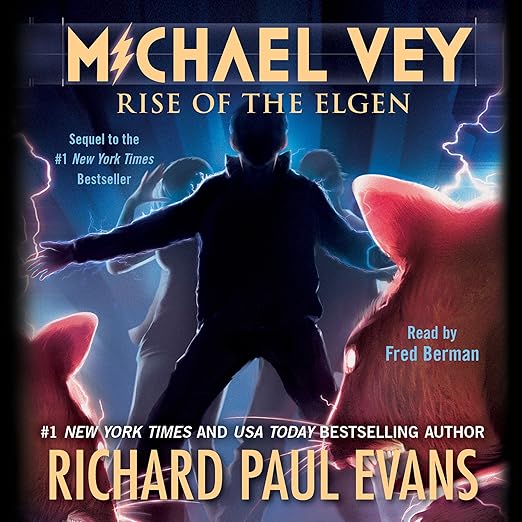
Michael Vey has a secret his classmates would kill to expose, and by the time this audiobook picks up, half the adults in his life are just as dangerous as any classmate could be. His electrical powers are no longer his alone either; his friend Taylor has them too, and so do other kids scattered around the world, which is exactly what draws the attention of a group calling itself the Order of Elgen. Nrhaller's review fills in an origin detail the synopsis only implies: seventeen young people, all between fifteen and seventeen years old, gained their powers because of a mistake made at the hospital where they were born, a shared backstory that gives the whole premise a concrete, almost medical explanation rather than vague genre magic.
Nrhaller's review captures the fan reaction this sequel was clearly built to produce: a preorder placed months ahead, a full reread of the first book while waiting, and the new one finished the same day it arrived. That kind of momentum matters for a story built around Michael, his tech-genius friend Ostin, and their self-styled Electroclan racing to save Michael's mother from Dr. Hatch before time runs out.
How Michael Vey 2 Holds Up
Cathy Pearce Anderegg calls this "the best book of the 3 Michael Vey books so far," specifically crediting more developed plotting and better-drawn secondary characters, including the non-electric teens around Michael who let ordinary readers see themselves in a story otherwise built around superpowers. That kind of grounding detail is easy to skip in a high-concept series, and its presence here is a real point in the book's favor. That same reviewer highlights a specific pleasure many series miss: feeling "proud" when ordinary, non-electric characters step up and make a real difference against the Elgen, rather than leaving every meaningful action to the superpowered leads.
Fred Berman brings a genuinely rare asset to this specific review: a confirmed, direct history narrating this exact series for this exact author, rather than an unproven pairing. That matters specifically during the action sequences a series like this depends on, where a narrator has to keep several teenagers with overlapping electrical powers distinct from each other in the middle of a fight, without the visual cues a printed page would offer. That is a genuinely different challenge than most solo-cast narration jobs, since the whole premise depends on listeners being able to tell several characters apart purely by the sound of powers being used against each other.
Woodsman's review surfaces a genuinely confusing wrinkle worth flagging directly: it refers to the two books in this series by the names "The Rise of the Elgen" and "The Prisoner of Cell 25" rather than by their numbered titles, and nothing on this listing explains whether those are alternate marketing titles, foreign editions, or simply personal shorthand. Either way, a shopper who encounters those names elsewhere should know they likely point back to this same series. That reviewer's account also doubles as a real-world data point on the book's pull: the son-in-law in question, described as an avid reader of fantasy and adventure despite working as a chemistry researcher, had never heard of the series before, yet finished the opening volume in five hours and immediately asked how many more books were coming.
Why Michael Vey 2 Works as an Audiobook
Lisa Tobleman's review makes the appeal concrete: "one huge action packed rollercoaster and fun to read," built around a jungle chase in Peru after Ostin uncovers strange "rat fires" tied to the Elgen's larger plan. That plan, described in the synopsis as an intent to "restructure" the world, gives the sequel higher stakes than a typical hidden-power school drama, closer to a global conspiracy thriller aimed at a teen audience. This release, running nine hours and forty minutes through Simon and Schuster Audio and Mercury Ink, keeps that plot moving briskly enough that Cathy Pearce Anderegg singles out one specific scene as the strongest moment across all three entries so far, even though that review is cut short before naming exactly what happens in it.
Stacy's review, short as it is, makes a specific and useful point: an eleven-year-old in the household genuinely loves these books, a real data point about the age range this material actually lands with in practice, separate from whatever age range the publisher might target on paper.
Weak Spots in Michael Vey 2
Younger listeners or their parents should know the tone gets more intense here than the premise alone suggests. Lisa Tobleman specifically compares the Elgen's compound to "a little German SS trooper forced" atmosphere, an unusually direct historical comparison for a middle-grade action series, and calls the result "chilling" rather than merely tense. That same reviewer stops short of spoiling one specific twist involving the rats visible on the book's own cover art, choosing to protect the reveal rather than explain it, which suggests the moment lands as a genuine surprise even for someone who already knew a rat-related plot point was coming.
Multiple reviews on this listing stop mid-sentence, a formatting quirk of how excerpts get pulled here rather than anything about the book itself, so treat a truncated line as incomplete rather than as the reviewer's actual final word. Woodsman's account of a son-in-law's reading order mix-up is a good example: it stays genuinely useful context even with its last sentence missing.
The Right Listener for Michael Vey 2
Fans who devoured the first Michael Vey book, per Nrhaller's account of rereading it while waiting for this one, are the obvious next audience, and hearing Fred Berman return to narrate should make this a comfortable, familiar-sounding continuation rather than a jarring handoff. Families with younger listeners should preview the Elgen compound material first, given how directly at least one reviewer compares it to real historical atrocity, before assuming this reads as pure adventure fiction all the way through. Woodsman's review even offers a real test case for reading order: the son-in-law mentioned earlier was accidentally handed this second book before the first, and by Woodsman's account found it "so thrilling" that the missing setup barely registered, a reassuring anecdote for anyone who lands here out of sequence.
Key Details
- Narration: Fred Berman has a confirmed history with this exact series and author, a genuine known quantity for returning listeners.
- Themes: hidden electrical powers, a found alliance under threat, a global conspiracy plot
- Mood: Fast-paced action with a surprisingly dark undercurrent
- Verdict: A strong sequel for existing fans, though the Elgen material runs more intense than the premise suggests.
Does narrator Fred Berman have prior experience with the Michael Vey audiobook series?
Yes. Berman turns up elsewhere in the catalog narrating this same series for this same author, so listeners are hearing a familiar voice return rather than gambling on a stranger. That familiarity carries real weight for a story with a large, returning cast of electrically gifted characters to keep straight.
Is the Michael Vey 2 audiobook appropriate for the same age range as the first book?
It runs more intense in places. One reviewer directly compares the Elgen compound to a Nazi-era atmosphere and calls it chilling, a heavier reference point than a typical middle-grade adventure reaches for. Parents of younger listeners, even fans of the first book, should know the second entry escalates in tone.
Why does the Michael Vey 2 audiobook rating look inconsistent with its five written reviews?
Five different people left written reviews for this title, yet the vote counter recognizes only three of them, and no combination of three whole-star grades reaches 4.8 by ordinary averaging. The mismatch sits with the listing's bookkeeping rather than anything a listener would notice in the story itself.







