Quick Take
- Narration: Marin Ireland’s multi-perspective performance is the audiobook’s defining achievement, she gives each Newman a distinct interior life, with Dinah in particular rendered as a fully inhabited human being.
- Themes: Performed identity versus private truth, 1960s social upheaval, the cost of secrecy in families
- Mood: Rich and layered, with dark comedy giving way to something genuinely moving
- Verdict: A historical family drama that earns its emotional ambitions largely through Ireland’s extraordinary narration and Niven’s ear for what the sixties actually cracked open.
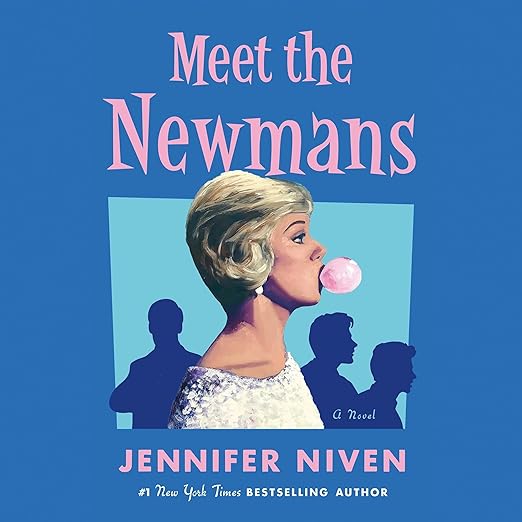
I came to Meet the Newmans on a gray January evening, which turned out to be exactly the right atmospheric pairing. Jennifer Niven’s novel about America’s favorite TV family, Del and Dinah Newman, their sons Guy and Shep, playing idealized versions of themselves on a weekly black-and-white program, has a particular quality of melancholy that suits gray evenings. It is a book about the gap between the performed self and the actual self, and it knows that the gap is rarely funny even when the surface of the story is.
The year is 1964, and the gap between the Newman family’s televised perfection and the reality of their lives has become unsustainable. Del is keeping a secret that will detonate everything. Dinah has been going physically numb, which is not metaphorical but a genuine medical symptom that the novel handles with more seriousness than you might expect. Gay son Guy is hiding his love life in the closet that 1964 provides very little alternative to. Rock-and-roll idol Shep is watching his luck run out in ways that are more of his own making than he can admit. Then Del has a car accident, and Dinah, forced to function without her husband’s direction for the first time in their marriage, hires journalist Juliet Dunne to help write the show’s final episode. The collision between Dinah’s 1950s sensibility and Juliet’s 1964 consciousness becomes the novel’s engine.
What Marin Ireland Does in Twelve Hours
Let me be direct: Marin Ireland’s narration is the reason this audiobook works as well as it does. Kirkus was right to call it a standout performance. Library Journal, in a starred review, highlighted her ability to give each point of view its own interior logic, and the specific note about the zing she brings to Dinah’s voice is exactly right. Dinah Newman is the character the novel loves most, the woman who has spent decades performing selflessness and domesticity so thoroughly that she has nearly lost track of what she herself might want. Ireland finds the wry, watchful intelligence beneath the performance, and it makes Dinah’s arc feel genuinely earned.
The multiple point-of-view structure is handled with real skill. Niven shifts between family members and Juliet without losing the novel’s tonal coherence, and Ireland tracks those shifts without letting any one voice collapse into another. At twelve hours and thirty minutes, this is a substantial listen. Ireland makes it feel shorter than it is.
1964 and the Cracks It Opens
The specific year is not arbitrary. 1964 is the year after Kennedy’s assassination, the year of Beatlemania’s American arrival, the year before the Voting Rights Act. The Newmans’ television show, the kind of scrubbed apple-pie fiction that defined American broadcast culture in the 1950s, is already an anachronism. The show’s declining ratings are a measure of how much the country has changed around it. Niven is interested in what happens to people who were built for a world that is dissolving, and the novel’s most perceptive passages are the ones where characters encounter the new reality and have no language for it.
One reviewer flagged anachronisms in the period detail, noting that as someone who was nine years old in 1964 certain elements felt wrong. This is a real issue for readers committed to historical precision. Niven is not writing documentary realism but a kind of heightened historical fiction more interested in emotional truth than period accuracy. The comparison to Lessons in Chemistry in the marketing is instructive, both books use their historical settings more for mood and theme than for strict fidelity to how the era actually worked.
What the Family Structure Carries
Meet the Newmans is ultimately a book about secrets and the particular damage they do when they are held in families. Del’s secret is the most dramatically consequential, but Guy’s hidden love life and Shep’s relationship with his own failures carry the novel’s more nuanced emotional work. Niven avoids the easy resolution where revelation leads directly to healing. What happens when the Newmans can no longer be the Newmans is more complicated than that, and the novel earns the complexity.
Judy Blume’s endorsement and Cynthia D’Aprix Sweeney’s warm, witty, and wise comment in the marketing copy both suggest the audience this book is reaching for. It shares something with domestic fiction that wants to be funny about painful things without becoming flippant, and it largely succeeds. The gay storyline is handled with period specificity rather than anachronistic comfort, which is the right choice and one that a less careful writer might have avoided.
Who This Audiobook Rewards
Listeners who responded to Lessons in Chemistry or The Seven Husbands of Evelyn Hugo will find the tonal register familiar and the historical setting similarly deployed. It works particularly well in audio because Ireland’s multi-character performance adds a dimension the page cannot provide. Listeners looking for strictly accurate 1964 historical fiction may surface frustrated. Anyone who found the Newmans’ specific form of family dysfunction, the performance of perfection as a full-time job, recognizable in their own experience will find this one lingers.
Frequently Asked Questions
How historically accurate is Meet the Newmans’ portrayal of 1964 America?
The period detail is evocative rather than rigorously accurate. At least one reviewer who was a child in 1964 noted specific anachronisms. Niven uses the era for its emotional and thematic resonances rather than as a documentary backdrop. Readers who prioritize strict period accuracy should adjust expectations accordingly.
Is the gay storyline in Meet the Newmans handled with period specificity or given a more contemporary framing?
The novel handles it with period specificity, which means Guy’s situation is presented with the constraints and silences that 1964 actually imposed rather than with the vocabulary or emotional frameworks of contemporary LGBTQ+ narratives. Several reviewers found this one of the book’s stronger choices.
Does Marin Ireland perform all character voices or does the audiobook use a cast?
Ireland performs the full audiobook alone, voicing all characters. Her ability to differentiate the Newman family members and Juliet Dunne has been specifically praised in professional reviews. The Macmillan Audio production supports a single-narrator format throughout.
How closely does Meet the Newmans resemble real 1950s and 1960s family television programs like Leave It to Beaver?
The Newman family show is clearly modeled on the conventions of those programs, and Niven draws on that cultural familiarity to create the gap between image and reality that drives the plot. Readers with a knowledge of those shows will recognize the specific performance of family happiness Niven is deconstructing.