Before You Press Play
- Read by: An author-branded guide handed to a different reader, with no note anywhere about why or whether she appears.
- At its heart: Car buying and maintenance, mechanic relationships, economic access
- Vibe: Patient, plainspoken and quietly angry
- Short version: The best general car guide for the people the industry ignores, though print serves the emergencies better.
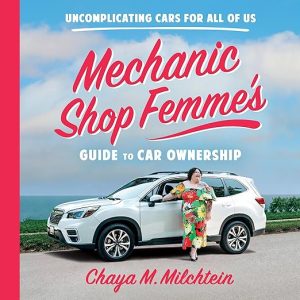
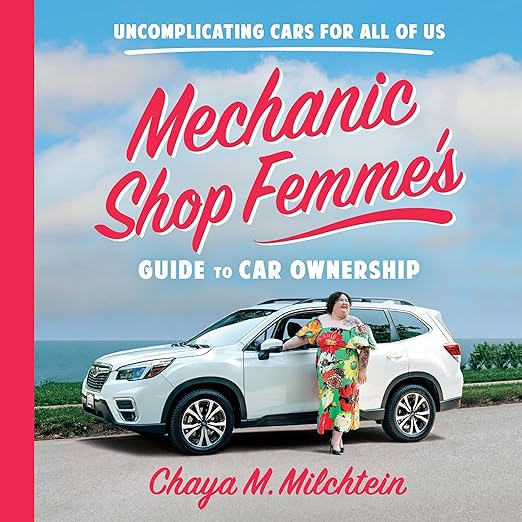
When did you last buy a book about cars? The description opens with that question and then answers it honestly: most car books are written for enthusiasts and mechanics, and the everyday owner who simply wants to stop being taken for a ride was never the intended reader. Chaya M. Milchtein's audiobook is the corrective, six hours and forty-three minutes covering buying, insuring, maintaining and rescuing a vehicle, written by an automotive educator and journalist who has spent a decade inside the industry. The one thing the page never explains is why the person who built that reputation on her own voice is not the person reading it to you.
Milchtein orders the book around a car's actual life rather than a mechanic's mental model. Buying comes first, then insurance, then the search for a shop you can trust, then emergencies. That ordering matters more than it sounds, because most automotive writing starts under the hood and assumes you already own the thing. This one starts at the point of sale, which is where the money gets lost and where the intimidation begins. One buyer at five stars calls it a book that organizes the chaos of car ownership ideas, doubts and worries that live in your head, which summarizes the method better than the marketing copy manages.
Underneath it sits an economic argument stated outright, and it is not decorative. A reliable car and a good relationship with a mechanic, the description says, are what let people climb out of poverty in a country where economic injustice falls hardest on marginalized communities. That reframing changes what the book is: not a hobbyist's manual but a financial survival guide that happens to be about cars. It also explains the tone the reviews keep circling, which is patient rather than enthusiastic. Nobody here is trying to make you love driving, and I found that restraint the most persuasive thing about it.
Decade in the Trade That Anticipates the Conversation
The credential is unusual, and it is the reason to listen. A decade inside the trade, spent writing and teaching explicitly for the people that trade has treated worst, produces advice that anticipates the conversation rather than just the repair. One buyer puts the payoff bluntly: the parts counter gets annoyed now, because they cannot mansplain much anymore. Another says the book would make a great gift for anyone who knows absolutely nothing about their car. A third recommends it to any woman buying a car for herself. Three responses, three social positions, one benefit described the same way each time, which is a reasonable proxy for how broadly this lands. Nothing in the pool contradicts any of it.
The second reason is subtler and it comes from the longest account here. That buyer credits the book with three separate things: telling you what you wish you had known, explaining where to go for more information, and preparing you to make sense of that information when it arrives. Only the first is what a manual normally does. The other two are what a teacher does, and they are what makes a six-hour recording worth more than the sum of its chapters, because a car problem you meet in three years will not be one of the problems described here. Milchtein's years on the inside show up as a habit of explaining the shape of an answer rather than only the answer.
Parenteau Reads a Book Built on One Brand
Casting is the most interesting thing on this listing and the least explained. Mechanic Shop Femme is a personal brand built on short video, and one buyer of the five mentions following those videos before mentioning the book at all. That listener knows exactly what the author sounds like. The recording is read by Tanis Parenteau instead, which is an ordinary publishing decision and an odd one for a title whose authority ties this closely to a specific person talking straight to camera. Nothing on the page indicates whether the author appears in the recording at all.
Second, this is a reference book and the buyers keep saying so. One calls it a handy book to have and a quick reference. Another describes something that will last through a lifetime of ownership. Both descriptions assume an object you return to, and a linear six-hour-and-forty-three-minute file is not that object. The emergency chapters in particular are the ones you want at the roadside, which is precisely where scrubbing through audio is least practical, and precisely where a printed index earns its keep. Emergencies are among the four areas the description promises to cover, which makes the format mismatch a design problem rather than an oversight.
Third, the shelf it landed on. The listing files this under LGBTQ+ studies, following the author's identity rather than the book's subject, while the description says in its opening sentence that the guide is intended for anyone regardless of age, gender or experience. That mismatch cuts both ways. Readers browsing queer nonfiction will find a book about buying, insuring and repairing a car, and the car owner who genuinely needs it may never see the listing at all. Categories are supposed to route people toward books, and this one routes them away.
First-Time Owners Who Dread the Shop
This is for anyone who owns a car and dreads the shop, which is most people who own a car. First-time buyers get the most from it, and the five accounts bracket the range neatly: somebody who knew absolutely nothing, somebody whose existing knowledge got confirmed, and somebody who had been waiting a whole lifetime for a book that organizes the subject. It also works as a gift, and one buyer recommends it as exactly that. Households where one person handles the car and everybody else stays out of it are the clearest case, because this is the book that ends that arrangement.
Owners who already service their own vehicles will find nothing aimed at them, since a torque wrench is not the tool this book assumes. The audio edition specifically is the wrong choice if you want a roadside reference rather than an education, because on that job print wins and it is not close. Arriving through the LGBTQ+ category expecting memoir or cultural criticism means adjusting your expectations sharply. The queer framing shapes who the book is written for and how it treats you, rather than what it is about.