Quick Take
- Narration: R.C. Bray’s performance as Skippy and Joe remains the anchor of this series, and his work on Mavericks is as assured as in any previous installment.
- Themes: Proving worth under impossible conditions, the tension between individual action and collective survival, competence earned rather than assigned
- Mood: Fast-moving and propulsive, with more genuine emotional stakes than the series has attempted before
- Verdict: Mavericks splits the Expeditionary Force narrative in two, which divides readers, but R.C. Bray makes both threads work, and the character investment here is the series at its deepest.
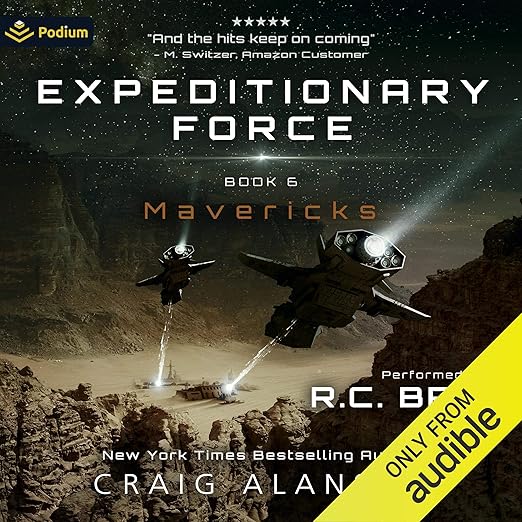
I was well into the Expeditionary Force series when I came to Mavericks, and I had developed the specific listening habit this series rewards: half-attention during the larger combat sequences, full focus whenever Skippy the AI and Joe Bishop start talking to each other. R.C. Bray’s performance of that dynamic is one of the more successful comedy-within-military-science-fiction achievements in the audiobook space, and Mavericks is where that dynamic gets tested by an extended separation between the two characters.
Book six takes a structural risk that Alanson had been building toward. Rather than following Joe and Skippy through a single escalating crisis as the previous installments had done, Mavericks splits the narrative: one thread follows the familiar crew on a larger strategic mission while a second tracks Emily Perkins and a small unit of human soldiers, the Mavericks of the title, as they attempt to prove themselves to the skeptical alien Ruhar in a training exercise that becomes catastrophically complicated. The two threads are designed to run parallel and eventually converge, but they create distinctly different listening experiences and the contrast is deliberate.
Our Take on Mavericks
The split narrative divides readers in ways that reveal something real about what different people want from this series. Critics feel the Mavericks section runs too long in its early stages before the Joe and Skippy thread reasserts itself to provide ballast. Defenders argue, with real conviction, that the character development delivered in the Mavericks storyline, which introduces Emily Perkins with genuine depth and gives her genuine stakes of her own, is exactly the kind of thing the series has needed. One reviewer described it as the best book in the series so far specifically because it delivered on depth and character motivation in ways previous volumes had not fully attempted. That opinion is credible: this is the installment where the Expeditionary Force series starts caring as much about who these people are as what they can do under pressure.
Why Listen to Mavericks
R.C. Bray is the primary reason to choose audio over ebook for this entire series, and that remains fully true here. His comic timing for Skippy’s AI personality, which mixes genuine intelligence with performative petulance, has been one of the defining pleasures of the Expeditionary Force audio run. The Mavericks material gives him a different set of voices to inhabit and different emotional registers to sustain, and he handles the transition without apparent effort. At seventeen-plus hours, the runtime is substantial, but Bray maintains consistent energy across both narrative threads throughout. Alanson’s improvement in prose quality from the earlier volumes, noted specifically by one reviewer who tracked it carefully across the series, is evident here and makes the listening experience smoother.
What to Watch For in Mavericks
This is book six in an ongoing series, and all the implications of that apply: do not start here, the character context accumulated across five prior volumes is genuinely essential, and the narrative will not resolve the series’s larger strategic arcs. Some reviewers flagged continuity errors in the text, including a geographical misidentification involving Gingerbread and Paradise that Bray reads faithfully but that pulls attentive listeners out of the story. The Mavericks section specifically runs long before its payoff arrives, which is the most legitimate structural criticism of this installment. Listeners who found previous books too slow in their setup phases may find this one similarly tested their patience in its first third.
Who Should Listen to Mavericks
Series readers who are current through book five will find this a meaningful step forward in character development and ambition, with Emily Perkins and the Mavericks unit providing a fresh perspective on a universe that could otherwise have started feeling familiar. New listeners should start with book one, without exception. If R.C. Bray’s performance of Skippy has been the primary draw for you throughout the series, he is fully present here. If you have been hoping the series would invest more meaningfully in human characters beyond Joe and Skippy, Mavericks is the specific installment where that investment finally begins in earnest.
Frequently Asked Questions
Is Mavericks an appropriate entry point for listeners new to the Expeditionary Force series?
No. The series has a continuous storyline with character relationships and plot threads that begin in book one. The alien politics, the Joe-Skippy dynamic, and the ongoing strategic situation that Mavericks depends on are developed across five prior volumes. Starting here removes most of the context that makes the character choices meaningful.
How does the split narrative between the Joe and Skippy thread and the Mavericks thread affect pacing?
The split is the central structural debate among series readers. Some find the Mavericks thread runs long before it connects with the main storyline; others find it the most welcome development in the series because it builds genuine depth for new characters. Both reactions are defensible, and Bray’s narration serves both threads professionally throughout.
Does R.C. Bray’s performance change significantly when the story shifts away from Joe and Skippy?
Bray adjusts register effectively across the two threads. The Joe-Skippy comedy depends on a specific comedic dynamic that the Mavericks section does not replicate, so listeners who came primarily for that energy will notice its reduced presence in the second thread. Bray handles the more serious, ensemble-driven Mavericks material with the same technical proficiency.
One reviewer mentioned the Rindhalu appear briefly in Mavericks. Are they significant going forward?
Alanson has been building toward a fuller reveal of the Rindhalu across the series, and Mavericks offers a glimpse of their behavioral patterns without resolving the mystery. This is deliberate narrative architecture; the payoff comes in later volumes of the series.