Quick Take
- Narration: R.C. Bray is Skippy, and fourteen books in, that partnership remains one of genre audio’s most durable pleasures, the character would not survive a different voice.
- Themes: Humility confronting an equal, human ingenuity as supplement rather than substitute, the cost of exceptionalism
- Mood: Comic and relentlessly kinetic, with an unusually structured finale that rewards patience with the banter
- Verdict: Book fourteen of Expeditionary Force delivers exactly what the series promises and introduces a structural twist that justifies returning for another round.
Twenty hours on a road trip is either too much or exactly right for Expeditionary Force. I have done several of these drives with Craig Alanson and R.C. Bray in my ears, and there is a particular rhythm to listening to a Skippy book that rewards exactly the kind of sustained, semi-distracted attention that long drives provide. You cannot take notes. You cannot stop to think carefully about the science. You can only be carried along by the momentum of Bray’s performance and the peculiar pleasure of watching a superintelligent AI discover that it is not, as it turns out, uniquely supreme.
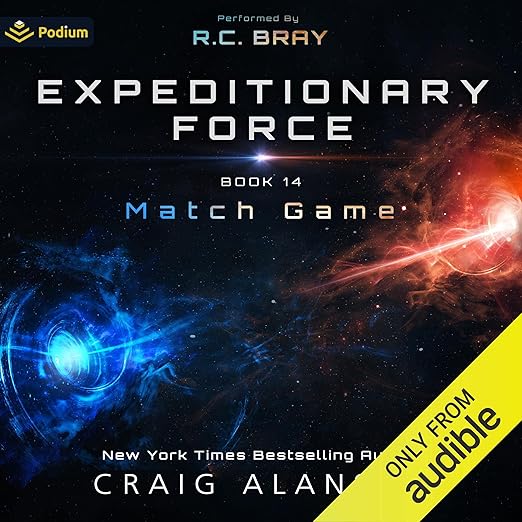
Match Game is the fourteenth entry in the Expeditionary Force series. If you are arriving here without the previous thirteen books, this is genuinely not the place to start. But for readers who have been following Joe Bishop, Skippy, and the Merry Band of Pirates across fourteen volumes, this is an entry that does something the series has been building toward for some time: it gives Skippy an opponent of equal power. That premise alone is reason enough to keep reading.
Our Take on Match Game
Alanson’s genius with Skippy, which sounds like a strange phrase to type but is genuinely accurate, is that the AI’s arrogance has always been the series’ comic engine and its emotional core simultaneously. Skippy is insufferable and irreplaceable. His relationship with Joe is built on a kind of affectionate exasperation that functions as genuine camaraderie, and the series has never let you forget that Skippy’s extraordinary capabilities are the primary reason humanity has survived this long. Match Game complicates that by introducing an opponent who can actually challenge him, which requires Skippy to do something he has spent thirteen books avoiding: ask for help from the filthy monkeys.
That dynamic shift is handled with the series’ characteristic wit. Reviewer Lou in Jax notes the twist ending coalesces like a movie plot, which captures it well, Alanson structures this volume around a revelation that recontextualizes the preceding action in a way that rewards the listener’s patience with the banter. The banter is significant, as always, and reviewer Lou’s observation that it sometimes runs longer than necessary is fair. But the extended Skippy-Joe exchanges are also the series’ texture, and excising them would produce a tighter but less distinctive book.
Why Listen to Match Game
R.C. Bray is the irreplaceable element. Fourteen books in, his Skippy has a settled, internally consistent characterization that feels less like performance than inhabitation. The vocal flourishes that might have seemed mannered in book one are now simply how Skippy sounds, and Bray has developed enough range within that characterization to keep the character fresh across twenty hours. His Joe Bishop carries the appropriate weight of someone who has been doing the impossible for fourteen books and is genuinely tired of it, which gives the human side of the partnership an emotional honesty that balances Skippy’s perpetual self-delight.
The series’ genre positioning, reviewer Steven Kellar describes it as improbable but just believable enough to be Hard Science Fiction, is accurate. Alanson is not writing hard SF in any technical sense, but the physics and alien cultures are internally consistent enough that the improbabilities feel earned rather than arbitrary. Bray’s performance respects that consistency; he does not play the science for laughs when Alanson is playing it straight.
What to Watch For in Match Game
The banter. Not as something to endure, but as something to track. The Skippy-Joe exchanges are where the series does its actual character work, disguised as comic padding. When Joe’s exasperation tips into something more like genuine worry in this volume, because Skippy has finally met something he cannot simply outthink, the emotional register shifts in ways that pay off the accumulated investment of the earlier books.
The surprise this entry offers long-time series readers is a finale structured to catch you off guard in a series where you might reasonably think you know what to expect. That structural surprise is the book’s primary recommendation for readers who have stayed with the series across fourteen volumes and want confirmation that Alanson still has new moves.
Who Should Listen to Match Game
Book fourteen is for committed Expeditionary Force readers only. The emotional resonance of Skippy being genuinely challenged depends entirely on knowing what Skippy’s capabilities are and why they matter. For those readers, this is one of the series’ stronger entries, structured around a premise that the earlier books were building toward and delivered with Bray’s most assured series performance. Not an entry point under any circumstances, start with Columbus Day and work your way through.
Frequently Asked Questions
Can I start the Expeditionary Force series at Match Game (book 14)?
No. The emotional stakes of Skippy facing an equal opponent depend entirely on fourteen books of established characterization. Match Game would be comprehensible but almost meaningless without that context. Start with Columbus Day.
How does the banter between Skippy and Joe in Match Game compare to earlier entries?
The banter is as extensive as ever, which some readers find charming and others find excessive. This volume adds a layer of genuine tension beneath the comedy, Skippy is actually worried for the first time, which gives the exchanges more emotional weight than some of the middle-series entries.
What kind of structural twist does Match Game deliver at its conclusion?
Without spoilers: it recontextualizes the primary conflict through a reveal that reviewer Lou in Jax compared to a movie plot twist. Several readers found it one of the series’ more satisfying finales, particularly given the setup that precedes it.
Is R.C. Bray’s Skippy voice consistent across fourteen books, or has the characterization drifted?
Remarkably consistent. Bray established Skippy’s vocal signature early and has maintained it with only natural deepening over time. Long-time series listeners will find the performance as settled and internally coherent as it has ever been.