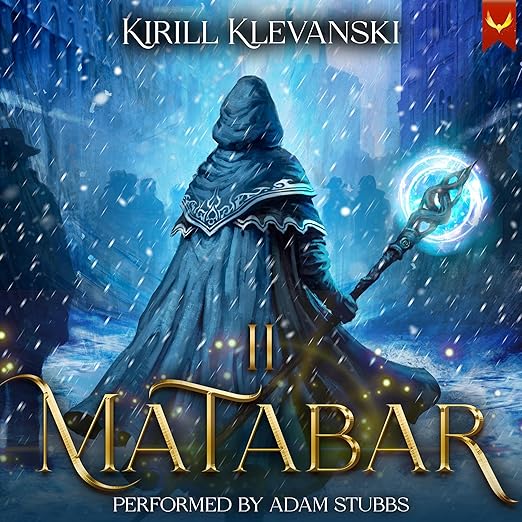
Quick Take
- Narration: Adam Stubbs brings consistent energy across thirty-two-plus hours, a demanding performance that holds attention well through the intrigue-heavy capital city sequences.
- Themes: Power and its price, conspiracy and divided loyalty, the isolation that unchecked ambition produces
- Mood: Dense and immersive, with a steampunk-fantasy texture that rewards patient investment in the world
- Verdict: Klevanski’s second Matabar volume builds substantially on book one, more complex, more demanding, and more rewarding for readers already invested in Ardan’s progression.
I finished Matabar 2 on a Sunday when I had planned to spend the morning doing other things entirely. By midday I was still listening, which is the most honest account I can give of how effectively the book holds attention across its considerable runtime. Kirill Klevanski’s Dragon Heart series made him one of the more interesting voices in translated progression fantasy reaching English-speaking audiences, and Matabar, his second series to reach English audio through Aethon Audio, demonstrates why that reputation has proven durable. The second volume moves Ardan Egobar from the rural mountain origins of the first book into Metropolis itself, the beating heart of the Empire of the New Monarchy, and the shift in setting brings a corresponding and necessary shift in tone. Where the first book established character and magic in a simpler environment, the second book tests both against a capital city that has its own deeply established agenda and its own power structures that predate Ardan entirely and have no interest in accommodating him.
Ardan is now simultaneously a student of the Imperial Magical University and an operative of the Emperor’s Second Chancery, the last of the Matabar. Those two identities sit in genuine and productive tension throughout the novel, because what each institution wants from him does not always align, and Metropolis is a city where every alliance can be a trap and every patron may be serving competing interests that Ardan cannot yet see clearly. The conspiracies that emerge in book two have been established carefully enough in the first volume that their arrival here feels earned rather than arbitrary, and the returning enemies who appear carry the weight of accumulated history rather than the flatness of antagonists introduced purely to generate new conflict.
What Changes Between Book One and Book Two
The shift from rural origins to capital city politics changes the register of the storytelling in ways that readers of the first book should understand and prepare for before starting. The first Matabar volume has the clarity of a simpler world: Ardan learning, Ardan proving himself, Ardan discovering the scope of his abilities against relatively straightforward and externally identifiable opposition. Book two introduces the ambiguity of institutional politics, the layered loyalties of a complex and stratified society, and the specific challenges of being a powerful outsider in a city built around existing hierarchies that have centuries of inertia behind them. One reviewer noted the prose is becoming something artful in its own right, with a rhythm to the writing that makes scenes feel vivid without becoming heavy or overwrought with unnecessary detail. The supporting characters each have goals and ideals that exist independently of Ardan’s arc and trajectory, and that independence is a reliable sign of a maturing series: supporting characters who are not simply in service to the protagonist’s needs make for a substantially richer world to spend extended time in.
The Magic-Meets-Progress World and Why It Works
Klevanski’s world is one of the more interesting settings in current progression fantasy precisely because it blends magical tradition with something approaching early industrialization and bureaucratic modernity. Reviewers have called it a wonderful blend of fantasy and steampunk, and that description captures the texture accurately without overpromising. The Imperial Magical University is not simply a Hogwarts analogue transplanted to a different setting; it is an institution with its own political alliances, active research agendas, and the full bureaucratic weight of a state apparatus that has been operating for centuries. The Second Chancery is a different kind of power entirely, older and more opaque in its methods and its loyalties. Ardan operating across both institutional structures gives the book a sustained tension that goes beyond simple power-level progression, which is what prevents Matabar from feeling like a standard cultivation narrative dressed in European clothes and given a new name for a new market.
Length, Pacing, and What to Expect from Thirty-Two Hours
At thirty-two hours and thirty-nine minutes, Matabar 2 is a substantial listening commitment, and I want to be honest that it is not an efficient narrative in the thriller sense of that term. One reviewer noted finding themselves skimming through sections where the wordiness exceeded what the scene actually required to accomplish its purpose, and that is a fair and specific observation. Klevanski is building a world with considerable density and historical depth, and he does not always resist the temptation to provide more detail than the immediate story demands in the moment. For readers who value immersion and find extended capital city sequences rewarding and atmospheric, this is a feature rather than a flaw and should be anticipated as part of the experience. For readers who want tighter pacing and leaner prose throughout, the bloat is real and should be factored into the decision to start. Adam Stubbs’s narration sustains energy across the full runtime with impressive and consistent quality. Thirty-two hours of single-narrator performance is a genuine endurance test that many audiobook readers do not pass cleanly, and Stubbs handles it throughout.
Who Should Start This Series and Who Should Wait for More Volumes
Matabar as a series is best approached by readers who have a genuine appetite for progression fantasy with literary ambitions beyond the standard template, who are comfortable with substantial runtime investments in a single story, and who find world-building density rewarding rather than taxing. Readers who want to begin the series should start with the first Matabar volume before touching book two, and should come in knowing that Klevanski is building something patient and layered rather than delivering quick narrative satisfactions at regular intervals. The comparison reviewers keep making to Dragon Heart is useful context: if you enjoyed Klevanski’s earlier work in English translation and wanted it to be more polished and more politically complex, Matabar is that version. If you have not read Dragon Heart and are entirely new to Klevanski, starting with Matabar book one is still the better introduction to his style and world-building approach.
Frequently Asked Questions
Is Matabar 2 accessible without having listened to Matabar 1, or is book one essential context?
Book one is essential. Matabar 2 opens in medias res with a protagonist whose relationships, abilities, and institutional allegiances were all established in the first volume. Listeners who start here will miss the character foundation that makes the capital city politics legible and emotionally meaningful throughout.
How does Klevanski’s writing style in translation compare to Dragon Heart, is the prose quality similar across both series?
Several reviewers who know both series note that Matabar feels more polished in translation than the early Dragon Heart volumes, with prose developing an individual rhythm rather than simply serving the plot efficiently. Readers who found Dragon Heart compelling but stylistically uneven may find Matabar the stronger listening experience.
Does Adam Stubbs’s narration hold up across thirty-two-plus hours, and is his voice well suited to the genre?
Stubbs is an experienced audiobook narrator for progression fantasy and epic fantasy, and the performance here is consistent without the energy decline that long recordings sometimes show in their final hours. His voice suits the serious, world-building-heavy register of Klevanski’s approach throughout.
Is Matabar 2 available as a free audiobook, and how many volumes are currently planned for the series?
Yes, it is available as a free audiobook through Audible membership. The Matabar series is ongoing, and given Klevanski’s prolific output and the strong reader response to this second volume, further entries are expected. Check the series page on Audible for the current volume count and release schedule.