Quick Take
- Narration: Rajiv Dadia brings authority and fluency to Nitin Seth’s material, navigating between global business context and technical data concepts without losing momentum.
- Themes: Data strategy, AI convergence, organizational transformation
- Mood: Expansive and optimistic, with genuine intellectual ambition
- Verdict: A broad, well-researched map of the data-AI moment that works best for leaders trying to make sense of the terrain rather than engineers looking for implementation detail.
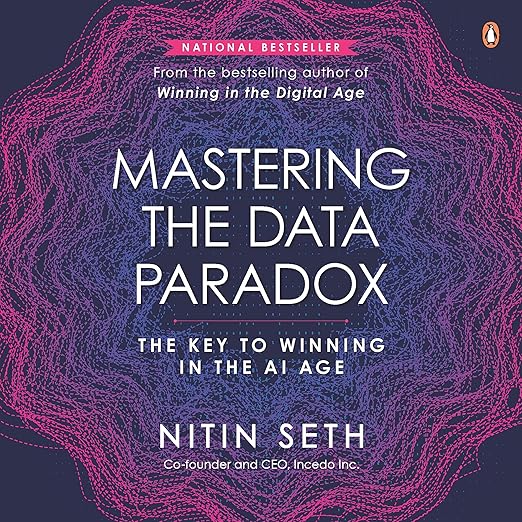
Eighteen hours is a long investment for a business book, and the question worth asking upfront about Mastering the Data Paradox is whether Nitin Seth earns that runtime. I came to this one after a period of reading shorter, more urgent takes on the AI moment, books that felt like memos written in a hurry. What Seth offers is something more patient and more ambitious: a genuine attempt to understand the data-first world and the AI age as a convergence, not as separate phenomena.
The central premise is straightforward but well-constructed. Seth argues that two massive shifts are unfolding simultaneously: the emergence of data as the central driving force in industries worldwide, and the dawn of generative AI as a mechanism for leveraging that data at unprecedented scale. The convergence of these two forces, he writes, creates opportunities that are, in his words, boundless. It’s a claim that could tip into boosterism, and Seth is not entirely immune to that tendency, but he grounds it in enough structural analysis to stay credible.
The Paradox at the Center of the Argument
The title’s paradox, which Seth takes some time to articulate precisely, is the gap between how much data organizations now possess and how little of it they actually use to generate value. Most enterprises are data-rich and insight-poor. The mechanisms of that failure, cultural, structural, and technical, form the intellectual spine of the book. Seth draws on his experience across consulting, technology, and enterprise leadership, and that breadth shows in how he frames organizational failures without caricaturing the people inside them. One reviewer, a young data scientist, described the book as the guide they’d been missing for navigating the complexities of data in business settings, which captures its register well. This is not a book written for engineers; it’s written for the people who need to commission, direct, and evaluate data work.
Where Individual, Enterprise, and Global Perspectives Intersect
One of Seth’s structural choices is to move between three scales: individual careers and capabilities, enterprise strategy, and global economic transformation. This creates a book with unusually wide reach, though it also means the argument can feel diffuse when you’re in the middle of it. The global sections are the most interesting intellectually, because Seth takes seriously the possibility that the data-AI convergence will redraw competitive maps across entire industries rather than simply accelerating existing trends. Rajiv Dadia handles this breadth capably in the narration. His delivery has the kind of measured confidence that suits boardroom-adjacent material, and he doesn’t collapse the 18-hour runtime into monotony. The book’s longer reflective passages, which could easily become tedious in a less attentive reading, hold their shape under his narration.
The Generative AI Section and Its Limitations
The generative AI material, which Seth positions as the second great inflection point in the book’s central argument, is where attentive listeners will want to apply some critical distance. Seth is genuinely knowledgeable, but the speed at which this landscape is moving means some of his framing will age faster than the rest of the book. The structural analysis of why data governance and data quality remain the bottleneck even in an AI-accelerated world is more durable, and that section reads as the most rigorous part of the text. Reviewers with data science backgrounds found the book illuminating precisely because it bridges technical understanding with business context. That bridging function is where Seth adds the most distinct value.
I listened to significant stretches of this during a week of long drives, and the book’s ambition suited that format. It’s the kind of material that rewards being heard in uninterrupted stretches rather than in ten-minute clips. By the final chapters, Seth’s cumulative argument has real weight, even if individual sections sometimes prioritize breadth over depth.
Frequently Asked Questions
Is this book technical enough for practicing data engineers or data scientists?
Not primarily. Seth writes for leaders and strategists who need to understand the data-AI landscape, not for practitioners implementing systems. Data engineers will find the strategic framing useful for understanding business context, but they won’t find implementation guidance or architectural depth here.
How does Rajiv Dadia handle the technical content in the narration?
Smoothly. Dadia has a fluency with business and technology terminology that prevents the denser sections from feeling labored. He maintains consistent energy across a long runtime without monotony, which matters considerably for an 18-hour listen.
Does the generative AI material feel current given how fast this field moves?
Seth’s structural arguments about data strategy, governance, and organizational readiness have durability. The specific generative AI framing will feel more time-stamped as the field continues to develop. Treat the AI sections as context rather than final word.
Is this more useful for someone at a large enterprise or a smaller organization?
Seth draws most of his examples from enterprise contexts, but his arguments about data culture and governance apply at smaller scale too. The global economic framing is less immediately actionable for smaller organizations, but the individual and team-level sections translate well.