Quick Take
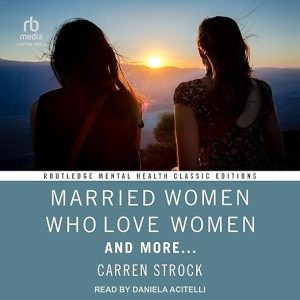
- Narration: Daniela Acitelli reads Carren Strock’s extensively revised classic with measured care, the narration suits the book’s dual function as personal testimony and professional resource.
- Themes: Late-life identity discovery, the intersection of marriage and same-sex attraction, family restructuring
- Mood: Compassionate and unflinching, grounded in personal narrative and clinical awareness
- Verdict: Twenty-five years after first publication and still the most thorough resource for women in heterosexual marriages navigating the discovery of same-sex attraction, the updated edition earns its longevity.
I have known at least three women, personally, who fit the demographic Carren Strock is writing for: women who married in good faith, built lives, and discovered, whether gradually or suddenly, that they were gay or bisexual. In each case, the experience was marked by a particular kind of isolation. Not the isolation of being alone, but the isolation of an experience so specific and so little-discussed that finding language for it, let alone community, felt nearly impossible. Strock’s book has been filling that gap since its first publication in the 1990s, and the twenty-fifth anniversary edition suggests that the gap is still real.
What makes Married Women Who Love Women unusual in its genre is that it operates on multiple levels simultaneously: personal memoir, oral history of other women’s experiences, practical guide, and academic resource. Strock shares her own story while weaving in the accounts of many others, which creates a scope that no single narrative could achieve. The result is a book that can serve a newly discovering woman needing validation, a therapist seeking clinical understanding, and a researcher or student approaching the subject academically, and it manages all three without compromising any of them.
The Discovery Questions No One Answers
The book’s organizational structure around core questions, how women make this discovery, how they respond, how loved ones react, what happens to marriages and families, is one of its greatest strengths. These are the exact questions that women in this situation typically carry alone, sometimes for years, before finding any resource that addresses them honestly. Strock provides answers drawn from the women she interviewed: not prescriptive answers, not universal ones, but the full range of how women have navigated these questions in practice.
The chapter on discovery is particularly valuable. Strock charts the varied paths by which women arrive at self-recognition: some through a specific relationship, some through gradual awareness, some through a single moment of recognition, some through years of vague dissatisfaction that eventually resolves into clarity. The validation this provides, the simple message that there is no single or correct timeline or trigger, is genuinely difficult to find elsewhere in accessible popular form.
What Twenty-Five Years of Updates Carry
The updated edition incorporates contemporary understandings of sexuality and gender that were not available to the first edition’s framework. This matters because the language and conceptual vocabulary of sexual identity has shifted significantly since the 1990s, terms like bisexuality, fluidity, and the spectrum of gender identity carry different meanings and more nuanced frameworks now than they did when Strock first published. One reviewer noted that the book covers transgender experience and bisexuality with genuine depth beyond what the title suggests, which reflects the expanded scope of the revision.
The updated language is handled with care rather than forced retrofitting, Strock is clearly not simply replacing old terminology but genuinely engaging with how the understanding of these experiences has evolved. This is not a common quality in updated editions of older books in this space, and it is worth noting.
For the Woman Holding This Book Alone
The heart of this book is the testimony of women who have lived this experience. Their stories are not uniformly triumphant, Strock does not present a single ideal outcome, nor does she suggest that coming out to a spouse or restructuring a family is always the right decision. The book holds the full complexity of what these women navigated: loss alongside liberation, grief alongside relief, damaged relationships alongside rebuilt ones. One reviewer, a lesbian loving a woman who identified as straight, described reading it to better understand a partner’s experience, which speaks to how usefully the book functions for people adjacent to this experience as well as at its center.
Daniela Acitelli’s narration is controlled and empathetic without being demonstratively emotional, which is the right register for material this personal. She does not editorialize through the personal testimonies, which allows the women’s voices, mediated through Strock’s framing, to carry their own weight.
Who Should Listen and Who Should Skip
Women in heterosexual marriages who are questioning their sexual identity will find this the most comprehensive and validation-first resource available in audio form. Partners of such women, and therapists working with this population, will find it clinically and humanly informative. Students of gender studies, sexuality studies, or LGBTQ studies programs will find a rich primary source document. Listeners who are not personally connected to these experiences but are curious about the social and psychological dimensions may find the 13-hour length requires genuine interest to sustain.
Frequently Asked Questions
Does the book address women who identify as bisexual as well as those who identify as lesbian?
Yes. One reviewer specifically noted that the book’s coverage extends well beyond the binary implied by the title, bisexuality, the fluidity of sexual attraction, and the contemporary understanding of sexuality as a spectrum are all addressed, particularly in the updated edition.
Is this book useful for the husbands of women going through this discovery, or is it written exclusively from the wife’s perspective?
The primary perspective is that of the women themselves, but husbands and partners are addressed throughout, their responses, their grief, and their own navigation of the situation appear in the testimony sections. Partners reading to understand rather than to be understood will find useful material here.
The original publication was in the 1990s, how significantly has the content been updated?
The updated edition incorporates contemporary language around sexuality and gender identity, fresh narratives from women across the country, and revised framing that reflects how understanding in this area has evolved over twenty-five years. It is a genuine revision rather than a surface-level update.
Is this book affiliated with any therapeutic approach or advocacy organization?
The book is published under the Routledge Mental Health Classic Editions series, which situates it in an academic and clinical context. Strock does not advocate for any specific outcome, coming out, staying in the marriage, disclosure, or any other choice, and the book is explicitly framed as a resource for informed self-determination.