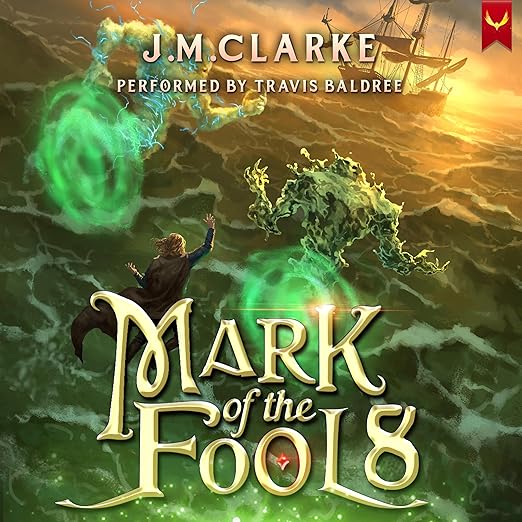
Alex Roth cannot keep his identity hidden any longer, and book eight opens with that fact already loose in the world. What makes this audiobook worth talking about is not the plot turn, though. It is a sentence in the one written response filed after the recording arrived: "I think it is important to sing the praises of Travis Baldree." That notice is dated January 2026, ten months after release, and it comes from the only person on this page writing at a point when the recording actually existed.
The Review
Revelation drives the plot this time. Something has come out, and Alex has to unlearn what he knew about Thameland and the cycle of the Ravener while hunting for the hidden priests of Uldar's Rise. Meanwhile the First Apostle prepares to destroy the Fool and picks up an unexpected ally, and Alex has learned something about his Mark that the description says could change his life-path entirely.
Sixteen hours and fourteen minutes is a great deal of room for that, and the most substantive response on the page argues the room goes unused. A four-star notice from October 2024, written in pages rather than hours, describes the volume as five hundred pages of everyone telling Alex how wonderful he is, Alex included, and reads the whole book as preparation for a character it calls the General. It still credits the series with never having released a bad book.
That complaint has a specific audio dimension. A stretch of praise-heaping you can skim in print at three times reading speed has to be sat through at narration speed, and a listener gets no warning about whether the next twenty minutes are plot or reassurance. Progression fantasy runs on the pleasure of a protagonist getting stronger; once the getting-stronger turns into a chorus about how strong he already is, length stops being generosity and starts being a bill.
A December 2024 response supplies the counterweight, crediting the series with developing its story line well, fleshing out the side characters and only getting better as it goes. Eight books in, that is the assessment that carries weight, because a series this long survives on whether the supporting cast has become worth spending time with rather than on whatever the protagonist is currently unlocking.
Why Mark of the Fool 8 Works as an Audiobook
One response makes the format case by accident and it is the best argument on the page. Writing in February 2025, six weeks before this recording existed, a reader explains that they had listened to books one through seven and read book eight only because they could not find it in audio. Reading was just as good, the notice concedes, "only you couldn't ride and listen."
That clause contains the entire value proposition for a sixteen-hour progression fantasy. This is series-length comfort listening, the kind you consume while doing something else, and a printed copy costs you the something else. Anyone who got through seven volumes on foot, on a bike or behind the wheel and then hit a wall at the eighth now has the wall taken away.
Travis Baldree carries the credit, and what the material demands of whoever reads it is clear enough: a magic-academy ensemble to keep distinct, a comic register the description advertises alongside action and slice-of-life, and enough spoken system terminology to hold a listener oriented with no page to glance at.
Length also stops being a liability once you accept what the series is for. Eight books of accumulating magical theory, academy politics and a slowly widening cast is not a story you consume so much as one you live alongside, and four of the five responses here talk about the series as a whole rather than about this volume in particular. A file this size delivered into your ears is the natural shape of that relationship. The same book on paper demands a chair and a lamp, which is a considerably larger ask.
The Caveats
Read the counter carefully. It shows three ratings behind a 4.7 average while five people have written full responses on the same page. Those five carry visible star grades of five, five, four, five and five, which average 4.8. Three is a sample size rather than a readership, and it is plainly counting a different population from the one that wrote.
Dates matter more than usual here. Only the January 2026 notice was written by somebody who could have heard this edition; the other four arrived in October, November and December of 2024 and then February 2025, all of them ahead of the March 2025 release. Two of the five are also filed under the same generic retail account name, so the pool is narrower than five voices even before the timing is taken into account.
Genre labeling deserves a look too. The description advertises coming-of-age magic academy fantasy, weak-to-strong progression into power, a setting inspired by tabletop roleplaying, detailed worldbuilding and magical science, action, comedy, slice-of-life and GameLit elements. That is a lot of promises stacked into one paragraph, and by volume eight a series has usually settled on which of them it is actually delivering.
Who Should Pick Up Mark of the Fool 8
Anyone already seven books deep is the audience, and every written response on this page comes from somebody already inside the series. The most unqualified recommendation, filed in November 2024, comes from a reader who had gone through to the eighth book and describes it simply as a fun story that leads you into an adventure without demanding you lose yourself in it. That is a fair account of what keeps people here.
GameLit and progression readers who like their systems explained will find the fit good as well, provided they are patient about it. The description advertises magical science and detailed worldbuilding as selling points rather than as background, which means real stretches of the book go to mechanism instead of incident. Some listeners find that the most satisfying part of the genre. Others find it the reason they gave up on it. Eight volumes in, this series has plainly chosen, and nobody arriving now should expect it to reconsider.
Starting here is the single thing not to do. The opening revelation only lands if you already know what it overturns, and every proper noun in the description assumes seven volumes of history behind it. Anybody who wants a self-contained fantasy, or who resents long series where each installment advances a fraction of a larger arc, should recognize that this is the eighth of exactly that and will not convert them.
Quick Take
- Read by: Travis Baldree holds the credit, and the only listener to write since release leads with that name before the notice cuts off mid-sentence.
- At its heart: progression fantasy, magic academy, hidden identity, GameLit systems
- Vibe: Long, companionable, comic underneath the stakes
- Short version: Essential once you have the previous seven behind you, and impenetrable if you do not.