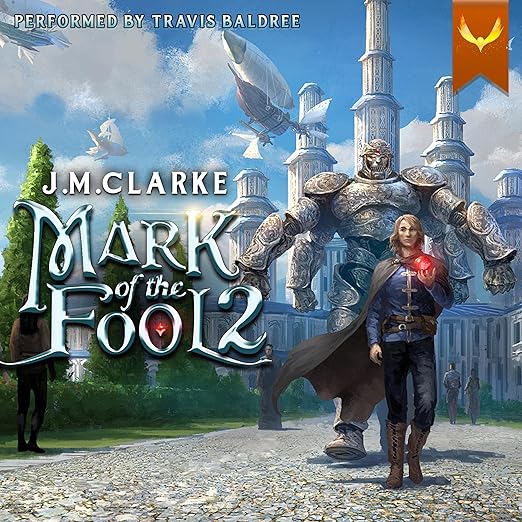
Quick Take
- Narration: Travis Baldree is one of the best voices in fantasy audiobook production, and his work here on Alex Roth’s progression through the University of Generasi is exceptional, character-distinct, paced for a 21-hour listen.
- Themes: Academic life as adventure, the slow accumulation of power through unconventional means, friendship under impossible pressure
- Mood: Expansive and propulsive, with genuine warmth alongside the action
- Verdict: Listeners who completed book one of Mark of the Fool and wanted more of everything will find the second volume delivers on every front, especially in worldbuilding and character development.
Twenty-one hours and fifty-one minutes. That is the runtime of Mark of the Fool 2, and I want to address it directly because it is the first thing experienced audiobook listeners will notice and the first question they will ask themselves: does this deserve that much time? Having spent a considerable stretch of a long week with it, my answer is yes, conditional on having read the first book, which you absolutely need to have done.
J.M. Clarke’s progression fantasy series centers on Alex Roth, who escaped his home country of Thameland carrying the Mark of the Fool, a magical designation that was supposed to condemn him to being the weakest participant in his kingdom’s fight against a recurring supernatural threat. Instead, he has found ways to exploit its unusual properties and arrived at the University of Generasi, where the second book opens with him apparently adjusting to student life: making friends, studying alchemy, navigating the social dynamics of a complex magical institution. Readers of progression fantasy know this calm is temporary, and Clarke does not make the audience wait long before the shadows start moving again.
Our Take on Mark of the Fool 2
What Clarke does particularly well in this volume is broaden the threat landscape without losing the intimacy that made the first book work. The murders that begin partway through the book, the ancient enemy tracking Alex, and the revelation about his sister Selina, who discovers she is something she hates, in terms the book handles more carefully than most, all emerge from the established world rather than arriving as imported complications. One reviewer praised how Alex handles Selina’s situation, with maturity and patience, giving her space to work through her own crisis rather than solving it for her. That choice elevates the book above the genre’s typical approach to secondary characters in distress.
The University of Generasi setting continues to reward attention. Clarke has built an institution that draws on D&D-adjacent fantasy traditions but develops its own logic and culture in ways that feel genuinely inhabited rather than decorative. The alchemy classes, the social hierarchies, the faculty politics, these exist as texture that becomes plot rather than worldbuilding that exists for its own sake. Reviewers have noted consuming the first two books in four days, which for 40-plus combined hours is a meaningful description of how these books function on the attention.
Why Listen to Mark of the Fool 2
Travis Baldree’s narration is a significant part of why this series works in audio. Baldree, who is also a novelist (Legends and Lattes), brings an author’s understanding of how fantasy worlds need to be communicated through voice, he handles the multiple species with personality and distinctiveness, manages Alex’s internal monologue without making it feel like running commentary, and sustains the tonal variety across a 21-hour runtime without losing consistency. A lesser narrator would flatten a book this long. Baldree makes it feel episodic in the best sense, each section distinct, the whole accumulated into something that earns its length.
What to Watch For in Mark of the Fool 2
The book is not accessible without book one. The worldbuilding, character relationships, and narrative stakes depend heavily on context that the second volume does not re-establish for new arrivals. Additionally, one reviewer noted that Selina and Theresa, two significant female characters, receive less viewpoint time than they merit, which is a recurring observation about the series. The primary perspective stays close to Alex, and the richness of the supporting cast occasionally suffers for it. This does not derail the book, but readers who want more balanced ensemble treatment will notice the constraint.
Who Should Listen to Mark of the Fool 2
Essential listening for anyone who completed the first book and found themselves wanting more of Alex’s unconventional approach to power, more of the University of Generasi’s world, and more of the political and supernatural threats accumulating around Thameland. The book rewards patience with its quieter student-life sequences, which function as both genuine character development and as structural contrast for the violent and dangerous passages that follow them. Listeners new to the series must start at the beginning; those already invested will find book two the expansion the first volume promised.
Frequently Asked Questions
Can Mark of the Fool 2 be listened to without reading the first book?
No. The worldbuilding, character relationships, and narrative stakes are built directly on book one’s foundation. Arriving at book two without that context would make the story significantly harder to follow and would eliminate most of the emotional payoff.
Is Travis Baldree’s narration a good fit for a 21-hour progression fantasy audiobook?
Excellent fit. Baldree is among the best narrators working in fantasy audio, and his ability to maintain character distinction and tonal consistency across a very long runtime is exactly what this book requires. His performance is one of the primary reasons to choose the audiobook format over print.
How does the University of Generasi setting compare to other magic academy settings in the genre?
Reviewers note that the D&D-inspired setting develops its own logic and culture beyond its genre antecedents. The institution feels inhabited rather than borrowed, with faculty politics, social hierarchies, and class content that integrate into plot rather than serving purely as atmosphere.
Does the series address the dark secrets of Thameland in this volume or does that remain mostly background?
Book two keeps the Thameland threat present through Alex’s awareness of it and through Selina’s storyline, while the primary setting remains the University. The Ravener and the kingdom’s ongoing conflict serve as stakes and context rather than as the immediate front-line action, which shifts closer by the end of the volume.