Quick Take
- Narration: Sarah Beth Goer handles the introspective, lore-heavy material with care, giving Marin and Emonael distinct presences without overplaying the emotional weight of their bond.
- Themes: The origins of magical knowledge, master-student devotion, suppressed truth in a world built on power
- Mood: Contemplative and myth-like, with the slow-burning gravity of a story told from great historical distance
- Verdict: A genuinely impressive fourth book that adds real depth to the Ancient Dreams universe by reaching back to its origins, best experienced after the trilogy rather than before it.
There is a particular satisfaction to a prequel that earns its existence. Too often, prequel fiction extends a franchise rather than illuminating the original, filling in backstory that was more powerful when it remained suggestive. Marin’s Codex is the exception. By the time I reached it, I had spent time with the Ancient Dreams trilogy, and coming back to a world I knew in order to understand how it began, to meet the woman whose research shaped everything that followed, felt like exactly the kind of narrative enrichment a prequel is supposed to provide but rarely does.
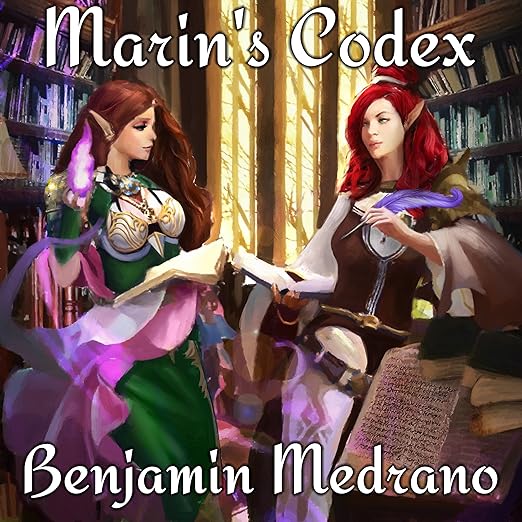
Benjamin Medrano published this independently in 2018, and the production reflects that origin: this is author-funded audio, built with the same care as the rest of the series rather than the resources of a major publisher. What it lacks in production gloss it makes up for in the specificity of its world-building and the quality of its central relationship. Marin and her student Emonael are the heart of the book, and Medrano takes his time with their bond in a way that feels earned rather than declared.
Our Take on Marin’s Codex
The central conceit is beautifully constructed: we are reading the history of how the first serious treatise on high magic came to be written. The High Mage Marin’s codex, the document that ushered in a new era of magical understanding in this world, exists in the trilogy as a foundational text. Here, Medrano dramatizes the process of its creation: the research, the trials, the forces that sought to silence the threat Marin’s knowledge posed to established power. That framing gives the book a sense of stakes that pure origin-story fiction often lacks. We know the codex survives. What we do not know is what it cost.
One reviewer describes this as Medrano hitting a home run with a fourth book added to a completed trilogy, high praise that reflects how unusual the achievement is. Another notes that the writing is excellent, the story fascinating, and the characters engaging in a way that explains much of the motivations that reverberate through the trilogy. Sarah Beth Goer, who also narrates the earlier volumes, carries the performance with the same attentiveness that distinguishes her work throughout the series.
Why Listen to Marin’s Codex
The book also contains a novella, Into the Eternal Wood, which follows Sistina Constella of the Kingdom of Everium. That second piece functions as a bonus for readers already invested in the world rather than as a continuation of the main narrative. Goer’s narration handles both stories with the same care, maintaining the contemplative register that suits the Ancient Dreams universe without letting the longer pacing become inert. For a twelve-hour listen that is functioning partly as supplementary lore, that steadiness of tone is what keeps the audio from feeling like it is asking too much.
What to Watch For in Marin’s Codex
The note from Medrano and in multiple reviews that this is best read after the trilogy, not before, reflects something real about how the book works. If you have not spent time with the Ancient Dreams trilogy, you will be meeting Marin as a historical figure without the context of what her work eventually produced. The emotional resonance of watching her create the codex that you have already seen referenced and revered across three volumes is a specific kind of literary pleasure that simply is not available to a first-time reader entering through this door. The book can be followed as a prequel in the conventional sense; it cannot provide the same experience.
Who Should Listen to Marin’s Codex
Readers who have completed the Ancient Dreams trilogy and want to understand its origins more fully. Fans of secondary-world fantasy that prioritizes the history and mythology of its magic systems over action set-pieces. Listeners drawn to stories about the preservation of knowledge against suppression. Those new to Medrano’s work should begin with the first volume of the trilogy; arriving here first is technically possible but misses the central pleasure of what Medrano has built across this series.
Frequently Asked Questions
Should Marin’s Codex be read before or after the Ancient Dreams trilogy?
After. Both Medrano’s own framing and virtually every reviewer make this clear. The book is technically a prequel covering events thousands of years before the trilogy, but the emotional and thematic resonance depends on knowing what Marin’s codex eventually became. Reading it first removes the central source of that resonance.
What is the Into the Eternal Wood novella, and how does it fit with the main Marin’s Codex story?
It is a separate novella featuring Sistina Constella of the Kingdom of Everium, set in the same world but following a different story. It is included in this volume as a second piece rather than as a continuation. Reviewers who describe the book as two excellent prequels to the Ancient Dreams series are referring to both works.
How does Sarah Beth Goer’s narration compare to the rest of the Ancient Dreams series?
Goer narrates consistently across the series, and reviewers who have followed the entire run describe her performance as one of the elements that makes the series work as audio specifically. Her handling of Marin and Emonael is noted as particularly well-calibrated to the slower, more reflective pace of this volume.
Is the LGBTQ+ classification of this book reflected in the narrative content of Marin’s Codex?
Yes. The relationship between Marin and Emonael and the broader world-building of the Ancient Dreams universe includes queer characters and relationships as a natural part of the narrative rather than as a special category or subplot. This is consistent with the series as a whole.