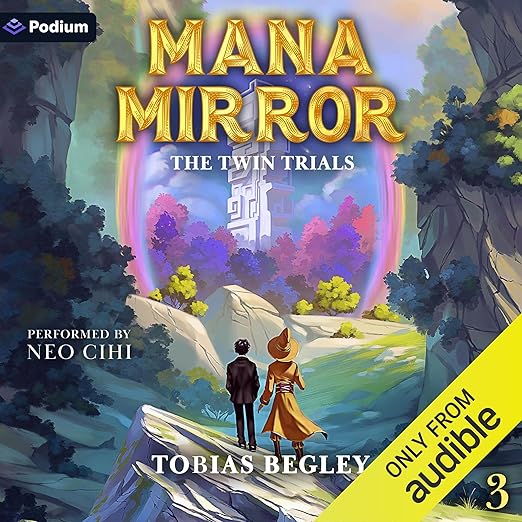
Quick Take
- Narration: Neo Cihi continues his work with the Mana Mirror series and delivers Malachi’s internal stakes convincingly, the right combination of studious intensity and physical vulnerability.
- Themes: Cultivation and power, identity and transformation, found family under pressure
- Mood: Dense and propulsive, with the satisfaction of systematic magical progression
- Verdict: Book three of the Mana Mirror series delivers what fans of the earlier entries came for, expanded world-building, clear character growth, and trial-structure pacing that keeps the tension high.
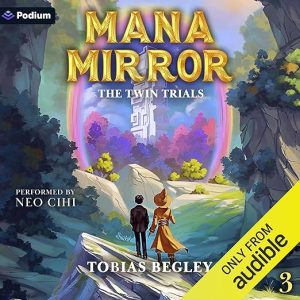
I came to Mana Mirror: The Twin Trials having listened to the first two books in the series back to back during a week of travel, Tobias Begley’s cultivation fantasy scratches a particular itch that I don’t encounter as reliably in the Western fantasy tradition. The magic system, the trial structure, and above all Malachi’s specific combination of studiousness and stubbornness make this one of the more interesting protagonists currently running in the LitRPG-adjacent space. By book three, the investment is significant, and Begley knows it, the Twin Trials delivers on accumulated expectations while opening enough new threads to justify a fourth book.
The setup involves two concurrent trial structures: the Idyll-Flume, an eight-story vertical realm created by a long-dead sage and now open for the first time, and the Beastgate trial trail, a test of magecraft and survival watched over by a powerful hudau tortoise. Both operate as crucibles for Malachi and his companions, with competitors pushing simultaneously from multiple directions. That parallel structure is more ambitious than a single-trial format and pays off in pacing, the book never stays in one arena long enough to lose momentum.
Our Take on Mana Mirror: The Twin Trials
One reviewer describes this as their favorite book in the series so far, citing background things going on, little reveals, and tons of upgrades for Malachi. That’s a useful summary of what the book does well: it advances the surface narrative while deepening the world’s mechanics. Another reviewer notes that the character development has been astounding across the series and that Malachi’s growth has been breathtaking. That’s earned rather than hyperbolic, Begley has been patient with Malachi’s arc in a way that cultivation fiction doesn’t always allow itself. One reviewer calls out Malachi as a studious, smart, strong, stubborn, honorable young trans man who is in love with a character with nonbinary identity. That representation is woven into the narrative rather than foregrounded didactically, which is exactly how it should work.
Why Listen to Mana Mirror: The Twin Trials
The cultivation fantasy genre, largely imported from Chinese web fiction’s xianxia and xuanhuan traditions, has found a committed Western audience, and Begley is one of the more accomplished practitioners writing originally in English. The twin trial structure gives book three more variety than a single dungeon crawl would offer, and the twenty-hour runtime provides room to develop both the competitive dynamics between Malachi’s group and the antagonists and the quieter character work between trials. Neo Cihi’s narration, consistent across the series, helps maintain the continuity of voice that multi-book series require. At 4.8 stars from over a hundred ratings, this is a series that has found its audience and is delivering for them.
What to Watch For in Mana Mirror: The Twin Trials
This is book three of an ongoing series. New listeners who start here without the context of books one and two will find the world-building inaccessible, Begley doesn’t re-explain established mechanics, relationships, or history for late arrivals. The trial structure that works as a pacing engine in the first two books becomes slightly more complex to navigate here, with two simultaneous arenas and more characters in play. One reviewer notes that the book is dense with competing threads, which is accurate and is a feature for dedicated readers and potentially an obstacle for casual listeners. The LitRPG-adjacent elements, systematic magical progression, stat-like power development, are not foregrounded but are present for readers who track that framework.
Who Should Listen to Mana Mirror: The Twin Trials
Fans of books one and two in the Mana Mirror series should listen to this immediately; it’s where the series arguably hits its stride. Readers who enjoy cultivation fantasy in the tradition of Cradle or He Who Fights with Monsters but want a Western author’s perspective and LGBTQ+ representation will find Begley’s series a natural fit. Fantasy listeners who prioritize systematic magic systems, ensemble casts, and protagonists who think as well as fight will be comfortable here. Anyone new to the series should start with book one, this is not a standalone entry.
Frequently Asked Questions
Can The Twin Trials be listened to as a standalone entry in the Mana Mirror series?
No. This is book three of an ongoing series, and Begley does not re-explain established world-building or character history. New listeners should start with book one before approaching this entry.
How does Tobias Begley handle the LGBTQ+ representation in the Mana Mirror series?
Malachi is a trans man and is in a relationship with a nonbinary character. Both are established characterization elements woven into the narrative naturally rather than highlighted as plot-driving issues. Reviews describe the representation as integrated rather than performative.
How does the twin trial structure in this book differ from the single-trial format of earlier entries?
The Idyll-Flume and the Beastgate run concurrently in book three, giving Begley two arenas to work with simultaneously. This increases complexity and provides more variety in setting and challenge type, but also requires tracking more competing threads than earlier books demanded.
Is Neo Cihi’s narration consistent with the earlier books in the series?
Yes, Cihi has narrated the Mana Mirror series consistently, which is important for a multi-book story with established character voices. Listeners who found his performance satisfying in earlier entries will find the same register here.