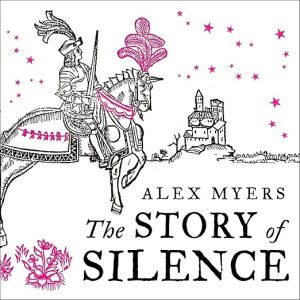
Alex Myers built this audiobook from a twelfth-century Old French poem called Le Roman de Silence, a work that has fascinated gender scholars for decades precisely because its medieval author seemed to understand something about the constructedness of gender long before the concept had a vocabulary. The Story of Silence, narrated by James Macnaughton, remakes that source material as contemporary literary fantasy, keeping the bones of the original (the foolish king's edict, the Cornish earl's secret daughter, the child named Silence who must navigate a world that insists on categories they were never allowed to choose) while expanding the emotional architecture considerably. The audiobook runs 14 hours and 21 minutes and earns most of that time.
The craft question at the heart of this book is a real one: how do you write a protagonist whose gender identity is neither fixed nor performed, set in a medieval world where the stakes of that ambiguity are legally and physically mortal? Myers' solution is to give Silence a rich interior life and a narrative voice that never resolves the tension artificially. Publishers Weekly called it utterly enchanting, and that reads as understatement. The narrative takes on genuine weight because Myers refuses to make Silence's journey a simple allegory. The world of dragons, minstrels, and courtly intrigue is not a backdrop; it is the actual medium through which Silence works out who they are.
What We Made of It
What strikes me most about The Story of Silence as an audiobook is how well the medieval adventure scaffolding serves the more interior story. This is not a book where the quest plot feels like a concession to genre readability, and it is not a book where the gender themes feel bolted on for contemporary relevance. The two layers are genuinely fused. When Silence rides out to prove themselves as a knight, the physical danger is real and the prose moves with appropriate speed. When Silence sits with the question of who they might have been (and who they are choosing to become), Myers gives that equal weight without slowing the story to a philosophical crawl.
Macnaughton's narration is a significant part of why this works. Reviewer Kevin Held noted that Myers writes clearly and descriptively, with wit and wisdom in equal balance, and Macnaughton catches both registers. He does not sentimentalize Silence's more vulnerable moments, and he does not play the adventure sequences for pure entertainment value at the expense of the emotional undercurrent. It is controlled, intelligent narration of the kind that literary fantasy requires and does not always receive.
Why The Story of Silence Works as an Audiobook
The audiobook comparison that matters here is to Naomi Novik's Uprooted and Katherine Arden's The Bear and the Nightingale, both cited by the publisher as likely touchstones for the target reader. That is fair company. All three books share a serious engagement with folklore and medieval source material, a strong-willed protagonist navigating a world structured against them, and prose that takes its language seriously rather than treating it as a delivery mechanism for plot. If you have read either of those books and found them rewarding, The Story of Silence belongs in the same listening queue.
What Myers adds that neither Novik nor Arden quite attempts is the specific question of gender as constructed category. This is not a fantasy about a girl who disguises herself as a boy for tactical reasons and returns to her assigned identity at the end. Silence is genuinely uncertain about who they are, and the novel does not resolve that uncertainty with a tidy revelation. One reader described being taken inside the life and thoughts of a woman who has to pretend to be a man and finding their perspective on differently-gendered persons permanently altered. That is a significant effect for a work of fantasy to produce, and it speaks to how carefully Myers handled the source material.
What Might Not Land
Merlin's presence in the narrative is both a plot element and a structural device worth tracking. In the original Roman de Silence, allegorical figures named Nature and Nurture literally debate Silence's identity. Myers translates this into Merlin's more ambiguous role, and the way he handles the enchantment subplot without reducing it to simple cause and effect is one of the book's quieter achievements. Also watch for the minstrel subplot, which functions as a kind of mirror to Silence's own situation: performance, disguise, and identity are all in play, and the parallels are not labored but they are there to be found by a reader paying attention.
Who Should Pick Up The Story of Silence
Readers who loved the literary fantasy of Uprooted, The Bear and the Nightingale, or Circe will find strong common ground here. Listeners interested in medieval history who also have patience for interior emotional complexity will get more from this than from straight historical fiction. Anyone who has appreciated Myers' earlier work will find this his most ambitious and fully realized project to date. The 14-hour runtime demands investment, and the book rewards it. Listeners who prefer plot-driven fantasy with minimal interior reflection may find the pace contemplative at times, but the adventure elements are substantial enough that this does not read as purely character-driven literary fiction. For anyone who has ever wished that a fantasy novel would take its gender and identity themes as seriously as its sword fights, The Story of Silence is the rare audiobook that actually delivers on that promise without sacrificing either half of the bargain.
- Read by: James Macnaughton handles Silence's shifting interiority with real skill, calibrating his voice to a protagonist who moves fluidly between the register of knightly adventure and quiet self-examination.
- At its heart: gender identity and self-determination, medieval inheritance law, found identity versus assigned role
- Vibe: Lyrical and layered, adventure-paced but emotionally interior
- Short version: Alex Myers' reworking of the Old French Roman de Silence is a remarkably thoughtful piece of literary fantasy that earns its comparisons to Naomi Novik and Katherine Arden.