The Short Version
- Performance: Egenes reads his own crossing, which buys authenticity and puts the burden of varying twelve hours of open country on a non-professional voice.
- What it covers: A transcontinental horseback ride, self-reconstruction, animal partnership, vanished mid-seventies America.
- Feel: Unhurried, weathered, quietly funny.
- Our call: A genuinely useful trail memoir for riders and a slow, rewarding road book for everyone else, buried under the wrong genre tags.
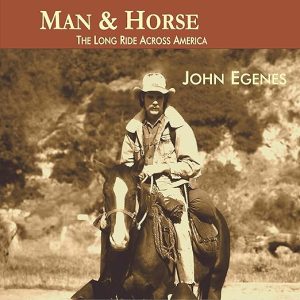
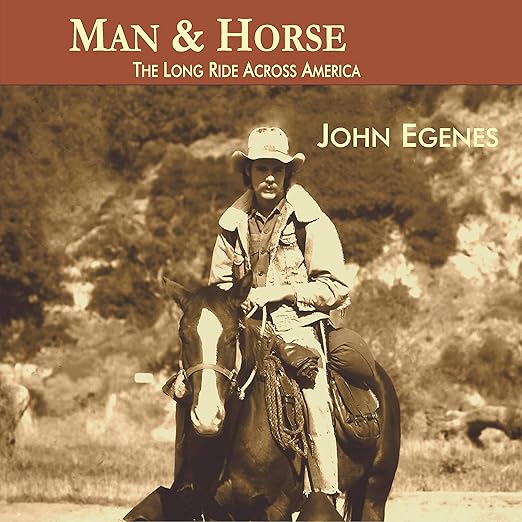
In 1974 a hundred dollars, a beat-up cavalry saddle and a horse named Gizmo were the entire outfit, and the audiobook John Egenes eventually made of that ride runs eleven hours and fifty-one minutes, read by the man who did it. Seven months, eleven states, California to Virginia, ocean to ocean. The arithmetic alone is worth pausing on: a young man with no money and no plan put himself on a young horse and pointed east, and the crossing took most of a year at the speed a horse can safely be asked to travel.
Egenes Narrates His Own Slow Crossing
What lifts this above the endurance-feat shelf is that the journey is not the achievement. The description frames Egenes as disenfranchised, from a broken home, carrying a faraway look rather than a goal, and the transformation it tracks is slower and less flattering than a record attempt: two inexperienced animals, one of them human, becoming competent over months of desert, prairie and roadside. A June 2019 entry sorts the mixture accurately, calling it part travelogue, part self-discovery, part philosophical treatise on internal struggle, and part account of sheer practical survival.
Nearly half a century separates the 1974 ride from this 2020 recording, and that distance changes how you hear the whole thing. Memoir written at such a remove usually smooths itself into anecdote. What survives here instead is the texture of the daily problem, where the water is, what the horse ate, which town has a farrier, and the retrospective distance does useful work rather than sentimental work, because the older writer can see what the younger rider was actually doing out there.
Egenes reads it himself, which for this material is close to the right decision. A trail memoir is largely one voice describing landscape with long stretches and no dialogue at all, and the risk over nearly twelve hours is that deserts and prairie start to sound identical. He has the specific advantage of remembering the places, and the specific disadvantage that no professional is standing by to vary the pace. Test a stretch of open-country description against one of the reflective passages: if both land at the same tempo, the empty miles will feel emptier than they read.
An Unusual Clock Speed for Everyone Else
Practical readers get more from this than the premise suggests. A January 2021 entry describes conditioning an eighteen-year-old stallion for a first overnight trek of more than twenty-five miles and reports that the book made a longer project feel genuinely achievable, which is not a literary compliment at all, and it is the kind of endorsement a trail memoir should want. Anyone planning distance riding will find real information here about daily mileage, what breaks down first and how a horse and rider adapt over weeks rather than days.
Everyone else gets a road book with an unusual clock speed. A car crossing is a week of highway. A horse crossing is seven months of arriving in places at walking pace, sleeping among coyotes and wild horses under open sky, camping alone in graveyards and abandoned shacks when the country turned urban. That pace is what the copy means by an America that no longer exists, and it is the reason a nearly twelve-hour recording suits the material better than a tighter edit would.
Disclosed Friendship, Flagged Contradiction, Impossible Rating
Pets and Animal Care is the tag this record carries, alongside a filing under home and garden. A buyer browsing for animal husbandry will meet a coast-to-coast memoir about a man reckoning with his own life, and a buyer looking for travel writing may never reach the shelf it was put on. The genre fields are actively misleading rather than merely vague, and since browsing is how books like this get found, the misfiling costs the record more than a self-published title can easily afford.
A rating count of one sits under a displayed 4.6, and a single voter has exactly five options available, one star through five, none of which is 4.6. Whatever produced that figure, it did not come from one person choosing a value. Underneath it sit five written responses, which means the number a buyer sees first and the writing a buyer can actually read are not measuring the same thing at all.
Weigh the responses with their disclosures in view. One opens by stating outright that the author is a friend, which is the honest thing to do and still shapes the assessment that follows. A March 2019 four-star raises a substantive objection instead, unhappy with a passage where Egenes dismisses people who carry guns for self-defense shortly after doing so himself, and that contradiction is a fair thing to flag in a memoir that trades on candor. One further entry signs itself with the name of a rival format's storefront, so even the small pool is not entirely about this recording.
Long-Distance Riders Over Plot-Driven Listeners
Long-distance riders and anyone who keeps horses have the most to gain here, particularly people contemplating a multi-day ride and wondering what the second week feels like. Travel-memoir readers who like slow crossings and unglamorous logistics are the second audience, and listeners drawn to mid-seventies America as a place rather than a decade will find a version of it recorded at walking pace, which very little else preserves.
Anyone wanting narrative tension should give it a pass, since the outcome is announced in the first paragraph and the interest lies entirely in the texture between coasts. Listeners who need a polished studio performance may struggle with an author reading his own work across twelve hours, and readers who want an animal story rather than a man's story should know the balance tips toward the rider. Gizmo earns his place, though, and the closing image of a country seen from between a horse's ears is the honest summary of what this is.