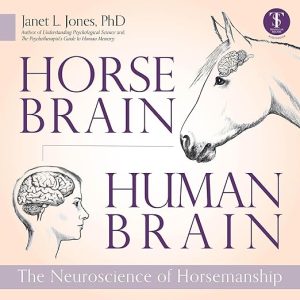
Somebody filed a neuroscience book under home and garden. Janet L. Jones spent a career studying brains and a life around horses, and this audiobook is what came out of both: eight hours and twenty-one minutes on how a horse sees, learns, fears, trusts and focuses, and on what a human brain is doing while it tries to negotiate with all of that from the saddle. The listing shelves it beside gardening and sports, with a rating count of one sitting underneath.
Two Nervous Systems, Compared Side by Side
Jones puts the two nervous systems side by side and refuses to let either one be the default. Seeing, learning, fearing, trusting, focusing: each capacity gets described from the human end and then from the equine end, and the gap between the two descriptions is the whole book. What follows from it is practical rather than philosophical. Performance improves, training time shortens, misbehavior becomes legible instead of infuriating, and handling shifts from force toward something closer to translation. Every principle gets applied to ordinary problems in the arena or out on the trail, and the true stories that carry them come from Jones's own training years rather than from a literature review.
Nothing on the page states the argument better than its lowest grade does. Four stars in August 2025 came away with a single sentence: my horse is never wrong or bad, she is reacting as a horse to keep herself alive. The same entry does the anatomy in plain terms, setting brains wired to react and flee against humans equipped with forethought and judgment, and noting how goal-driven and task-oriented we are by comparison. If that trade already sounds obvious, the book will still surprise you with how far the consequences run, right down to what a horse is physically able to see while you are asking it to do something.
Harris Switches Between Science and Barn Stories
Comparison is where this earns its place, and one reader did the comparison for us. Somebody who had already worked through several books on horse behavior and psychology, and who found this one referenced in an article, filed five stars in August 2021 calling it the best of that lot and crediting a writing style engaging enough to make the science go down easily. That is the specific compliment worth having here. The horsemanship shelf is crowded with training systems and thin on explanations, and a system tells you what to do while an explanation tells you why the same cue works one day and fails the next.
Helena Harris carries the file, and the assignment alternates between two registers that do not sound alike. One is expository neuroscience, careful and sequential, where a listener needs to hold a chain of causes together. The other is barn narrative, built on particular horses and particular handlers getting it wrong. Those stories only work as illustrations if the switch between the two is audible, otherwise the anecdotes flatten into filler between the science. Take a stretch of the explanatory material and a stretch of the stories before you commit, because they are not the same assignment and a reader can be good at one and stiff at the other.
Rating Math That Fails, Exercises That Pause You
Numbers on this page repay a second look. It advertises 4.8 above a rating count of one, and a single person voting has exactly five values to choose from, one star through five, with 4.8 not among them. Beneath that same counter, five people have written at length, several of them at real length. So the two fields are not tallying the same thing, and the figure at the top tells a buyer nothing. Read the written entries instead, which is where the useful information lives on a record like this.
One entry from November 2020 stops halfway through the book and explains why. The section asking you to work out your own posture and proprioception by experiment is, in that reader's words, pretty tricky, and doing it properly meant recruiting somebody to take photographs and assembling equipment first. That is an exercise you cannot perform while a file plays, and it is not the only place the book reaches for something you are meant to look at or physically try. The accompanying reference material sits in your library rather than inside the audio, so download it before you start and expect to be pausing.
Shelving is the last problem and the one with real consequences. This record carries a Pets and Animal Care tag, which is right, attached to genre placements in home and garden and in sports and outdoors, which are not. A book about visual processing, fear responses and cross-species communication is not a lifestyle purchase, and the people most likely to want it, working riders and popular-science readers, are browsing neither of those aisles. Nobody is harmed by the misfiling here in the way a mislabeled memoir can harm somebody, but a book this specialized survives on being findable.
Groundwork Riders Get the Most from This
Riders who already do groundwork will get the most from it, particularly the ones who have noticed that their horse behaves like a different animal in the arena and on the trail and want to know what changed. Trainers will find language for things they already do by instinct. It also works, unexpectedly well, for the non-riding listener who likes comparative cognition, since half of what is here is really about how much of your own perception you never notice.
Hands-on drill work is the one thing this format cannot supervise. Listeners hoping for a step-by-step program will find principles and worked examples rather than a schedule, and the exercises that do appear assume hands, space and something to work with. Anybody who wants a straight training manual should look for one and use this alongside it. Understanding why the animal shied at the same corner twice is worth eight hours by itself, and the explanation most horse books skip comes with it.
Can this audiobook be used while actually working with a horse?
Only in part. The explanatory chapters are ideal for a drive to the barn, and the worked examples stick in the memory. Several passages ask you to test something about your own posture or perception, which needs space and a free pair of hands, so plan on pausing rather than listening straight through.
Does the audiobook come with supporting material?
Yes. The listing notes that accompanying reference material lands in your library alongside the audio, which matters on a book whose explanations keep reaching for something to point at. Download it before the first session rather than hunting for it halfway through a chapter on visual fields.