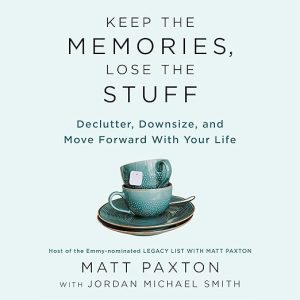
Quick Take
- Narration: Matt Paxton narrates his own book with the warmth and directness that defines his television presence, the self-narration is a significant advantage.
- Themes: Downsizing and memory, emotional attachment to objects, psychological readiness for change
- Mood: Compassionate and unhurried, with a focus on emotion over instruction
- Verdict: The most emotionally intelligent book in the decluttering space, Paxton addresses why people hold on, not just how to let go.
I started this one on a Sunday morning after spending the previous day helping a family member sort through forty years of accumulated belongings. The timing was not planned but it was apt. Matt Paxton opens Keep the Memories, Lose the Stuff with the premise that most decluttering advice misses the point entirely: it tells you how to get rid of things without addressing why it is so hard to begin. That framing landed with particular force after an afternoon of watching someone freeze in front of a box of old birthday cards and be unable to move for twenty minutes.
Paxton is the host of Legacy List with Matt Paxton on PBS, Emmy-nominated, and previously a featured cleaner on Hoarders. His two decades of work with people across a wide range of life situations, downsizing for retirement, clearing a home after a death, moving into assisted living, preparing an estate, inform every story in the book. This is not advice written from the outside of the problem. Paxton has sat in those rooms, with those boxes, and with the people who cannot open them.
Our Take on Keep the Memories, Lose the Stuff
The psychological distinction Paxton draws is the core of the book: physical objects are not the same as the memories attached to them, and letting go of one does not require surrendering the other. That sounds simple. The book earns the insight by walking through specific categories where people consistently get stuck, family china, children’s artwork, decades of photographs, inherited furniture from people who are no longer living, and demonstrating through real stories how identifying a single meaningful object can unlock the release of dozens of others. One reviewer describes the book as eye-opening in how it shows people what they hope to leave behind, as well as what they carry forward. That bilateral quality, what we keep from the past, what we pass on to the future, gives Paxton’s framework a depth that distinguishes it from organizing books focused purely on the mechanics of sorting.
Why Listen to Keep the Memories, Lose the Stuff
The self-narration by Paxton is the production’s defining feature and its greatest strength. His television presence, warm, direct, emotionally attentive without being sentimental, translates fully to audio. This does not sound like a clinical how-to read by a professional voice actor. It sounds like a conversation with someone who has spent twenty years sitting with people in difficult rooms, and that quality of presence is very difficult to replicate. Reviewers consistently mention the emotional resonance of the stories throughout. At five hours and twelve minutes, the runtime is generous enough to develop ideas without overstaying its welcome. The downloadable PDF of resources adds practical tools without interrupting the listening flow.
What to Watch For in Keep the Memories, Lose the Stuff
The book is oriented primarily toward people navigating major life transitions, retirees downsizing, those clearing a parent’s estate, people preparing for a move to a smaller home or care facility. One reviewer notes that it is especially effective for people who have been in the same home for twenty or more years. Younger listeners facing a more ordinary decluttering project will find the emotional framework useful but may find some of the specific scenarios less immediately applicable to their situation. The book is also less technique-focused than something like Dana K. White’s systematic approach, Paxton’s primary tools are narrative, empathy, and the slow work of reframing what an object actually means, rather than a step-by-step method with clear metrics.
Who Should Listen to Keep the Memories, Lose the Stuff
Anyone facing a downsizing project, their own or a family member’s. People who have tried other decluttering systems and found the emotional resistance too strong to work through alone. Listeners who have experienced the death of a parent or spouse and are confronting an estate. Those who want to understand their own relationship to objects before they start sorting through them. Less suited for listeners primarily seeking a step-by-step system with clear categories and measurable outcomes, Paxton’s approach is more therapeutic and narrative than methodological.
Frequently Asked Questions
How does Keep the Memories, Lose the Stuff differ from other decluttering audiobooks like Dana K. White’s work?
Paxton focuses primarily on the emotional psychology behind attachment to objects, particularly around life transitions and loss. White’s approach centers on practical systems for daily disorganization. The two books address different problems and complement rather than compete with each other.
Is this book appropriate for someone helping a parent or elderly family member downsize?
Yes, it is particularly well-suited for this situation. Paxton draws extensively on his experience working with seniors and families navigating estate clearances, and the book addresses the interpersonal dynamics of helping others let go, not just the individual internal process.
Does Matt Paxton’s self-narration reference his PBS show Legacy List?
He draws on his television and professional experience throughout the book, using real stories from his years of work with families. The narration is intimate and personal rather than promotional.
What is the practical takeaway from the book’s approach to photographs and family heirlooms?
Paxton advocates identifying one or two objects from each category that genuinely represent a memory or a person, and releasing the rest without guilt. He provides frameworks for photographing items before letting them go and passing meaningful objects to family members who will actually use and value them.