Quick Take
- Narrator: Adam Sims speaks a monk's first person on Penguin's behalf, so what a buyer registers immediately is whether instruction sounds offered or handed down.
- Subjects: cleaning as contemplative practice, Zen training from the inside, simplicity as argument rather than aesthetic
- Tone: Quiet and unhurried, nearer to devotional than instructional
- Bottom line: Two hours that genuinely change how you think about a mop, as long as you keep the principle and drop the temple logistics.
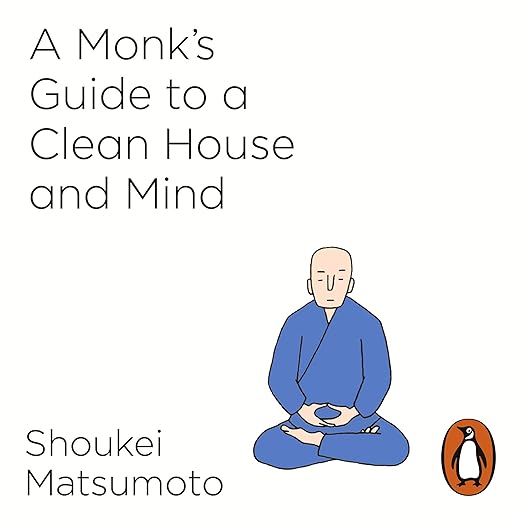
Sweeping, scrubbing and laundry are the subject matter here, and the argument is that not one of them is a chore. Two hours and four minutes of audiobook, written by a monk in training, proposing that you remove dust to sweep away worldly desires and scrub dirt to loosen attachments. It is the shortest book in most people's self-improvement stack and probably the least self-improving, in the sense that it wants to change what you think cleaning is rather than how efficiently you get it done.
One Rating Can't Explain a 4.4 Average
Five people have written about this book at length, several of them at considerable length. The counter beside the average says one person has rated it. Those two columns are not tallying the same room, and the average attached to them reads 4.4, which a single voter cannot produce, because a single voter picks a whole number of stars and nothing between. What makes it stranger is the arithmetic underneath: the five visible grades, three fives, a four and a three, average out to exactly 4.4. The figure is right. The population that produced it has gone missing, and anyone reading meaning into a score here should know that first.
Written in the first person throughout, the book never hides its position. A monk in training introduces the cleaning methods used in temples, describes what the training involves, and asks the reader to treat cleanliness as an occasion for contemplating the self. That framing does an enormous amount of work in a small space. Two hours leaves no room for case studies, for before-and-after photographs, or for a method with a brand name attached, and the absence of all three is the point rather than a shortfall. This is closer to a devotional text with practical applications than to a household manual carrying a spiritual gloss.
Adam Sims Steps Into a Monk's Voice
Somebody grading it five stars in January 2019 offers the clearest evidence that the argument survives contact with an ordinary house. That reader reports having started cleaning in the mornings, and finding the rest of the day more productive as a result, with a clearer head attached to it, which is a modest and specific claim of a sort this genre almost never produces. The same response calls the writing simple and the book quick. At two hours, a listener can absorb the whole argument across an afternoon and start testing it that evening, which is the correct relationship between a book this short and the behavior it is asking for.
Adam Sims reads it, and the description places that credit in the same sentence as the author's name, which is a small courtesy worth noting. The assignment carries a seam that a listener will hear inside the first minute. The text is a monk's own first person, describing a training and a temple from the inside, and the voice delivering it belongs to somebody else entirely, performing instruction rather than issuing it. Get that register wrong in either direction and the book turns preachy or turns into a lecture on a religion. Play a passage of practical instruction rather than the opening, because the opening is philosophy and the instructions are where the tone has to hold steady.
No Translator Named for a Translated Text
Transferability is the recurring objection, and it arrives from readers who liked the book. The four-star grade on the record is the most practically minded of the five. It calls the book concise and informative, then explains that a number of the ideas will not survive contact with a Western household, using laundry as the illustration, since washing clothes daily makes no sense to someone who does a weekly wash, irons it and puts it away. That reader keeps the spirit and discards the practice, which is very likely the right approach. The three-star pushes further, admiring the opening chapter and then finding much of what follows impractical, singling out Buddhist temple garb as improbable daily wear for cleaning an American home.
Two field-level oddities deserve a flag. The record names an author, a publisher and a reader, and no translator anywhere, on a book that introduces cleaning methods used in Japanese Buddhist temples and is written from inside that tradition. If a translation stands between the original text and this English recording, the page does not say so, and whoever made it does not appear. The second oddity sits at the foot of the description, a line reporting that the audio was updated as of February 2018, roughly a month after the release date printed on this record, with no indication of what changed or why a two-hour file needed revising within weeks of arriving.
Zen Practice Grounded in Dust and Dirt
People who dread housework and would rather change their relationship to it than optimize it are exactly the readers this was written for. So is anyone drawn to Zen practice who wants it grounded in something concrete instead of delivered as aphorism, since dust and dirt turn out to be unusually good teaching material. Two hours is short enough to try on a hunch and short enough to revisit every year, which is how this kind of book actually gets used rather than how it gets sold. Households containing one person who cleans resentfully may find it works better as a shared listen than a private one.
Give it a pass if you want a system, because nothing here numbers your steps, sorts your possessions or tells you what to throw away, and the copy makes no pretense otherwise. Give it a pass too if temple-specific practice reads to you as an obstacle rather than as context, since a meaningful share of the instruction assumes a building and a daily routine you do not have. Anyone hoping to lean on the score should remember that the average here is attached to a population the counter cannot account for. Readers who want the argument rather than the method will have the whole of it inside a single afternoon.
Does the audiobook give practical instructions or only philosophy?
Both, deliberately mixed. The copy promises the everyday cleaning methods typically used in temples alongside an account of what monastic training is like, so technique and reasoning arrive together rather than in separate halves. What it does not offer is a sequenced program with steps to follow in order.
Is the audiobook short enough to work as something you return to?
Comfortably. At two hours and four minutes it is closer to a long essay than to a full nonfiction title, and its structure is thematic rather than cumulative. That makes it an easy annual re-listen, which suits a book asking you to change a habit rather than absorb information once.