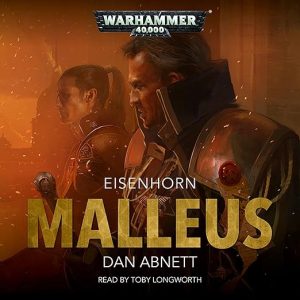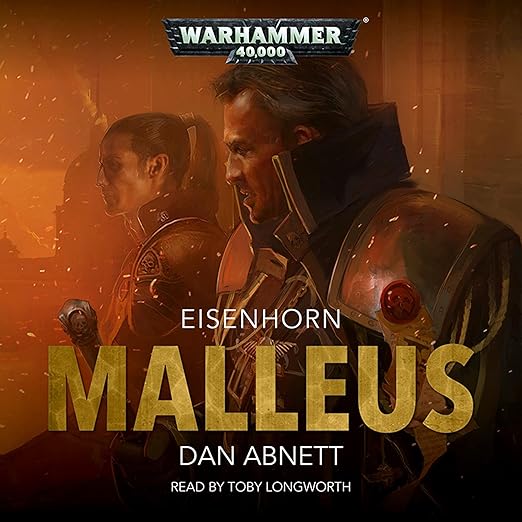
Book two is where a series either deepens or repeats itself, and Dan Abnett's answer is to take everything Gregor Eisenhorn had earned and put it on the table. A century after recovering the alien Necroteuch, he is one of the Imperial Inquisition's most celebrated agents; then a face from his past returns, a tragedy devastates the world of Thracian Primaris, and the celebrated agent is implicated in it. This audiobook is the sound of an institution turning on one of its own, and the pleasure of it is watching a man whose entire authority came from that institution discover how little of it was ever his.
Abnett's premise for this volume is the cleanest inversion the material allows: the inquisitor becomes the hunted. Eisenhorn is on the run for a crime he did not commit, which means every tool he has, informants, authority, the ability to requisition help, becomes a liability the moment it identifies him. The daemon Cherubael returns to make it worse, working not for his death but for his conversion, which is a far more interesting threat and gives the book its central question. How much can a man compromise himself, and how many friends can he risk, before clearing his name costs more than the name was worth?
Five stars in August 2025 sum up the appeal without fuss, calling it an entertaining 40K book that delivers everything you would expect from the setting, battles, one-on-one fights, mystery and adventure, all of it thoroughly enjoyed. That mixture is the actual achievement. The book moves between investigation, chase and set-piece violence without the register lurching, and Abnett's prose stays functional in a subgenre that constantly tempts writers into ornament. The invented vocabulary is heavy, but it arrives attached to things that are happening rather than in blocks of explanation.
Why Listen to Malleus
Eisenhorn has a reputation inside its own shelf, and one five-star response from April 2023 explains what earns it: this reader rates it among the best Warhammer 40K stories available and describes having had to wait for the sequels the first time through, then being able to run straight from one to the next, with plenty of story still ahead. That is the honest pitch for continuing here. A separate five-star account, filed in January 2021, calls the book a strong addition to the series, engrossing, paced just right and hard to put down, which is the more useful verdict for anyone deciding whether the second volume holds the level of the first.
Toby Longworth voices it, and the assignment is harder than a ten-hour thriller sounds. Ten hours of invented nomenclature, Thracian Primaris, the Ordo Malleus, the Necroteuch, have to be delivered as ordinary furniture rather than as exotica, and one of the principal characters is a daemon who needs to sound like something that is not a person without tipping into pantomime. None of the five responses on this record discusses the recording at all, which is worth knowing before you treat those five-star grades as verdicts on this edition. Spend the sample on a passage with Cherubael in it rather than on the opening chapter.
What to Watch For in Malleus
The rating badge cannot be correct. A 4.6 average sits above a rating count of one, and a single vote has only five values available to it: one star, two, three, four or five. No lone rater produces 4.6. Beneath that number sit five signed written responses, which is four more people than the counter admits to. The failure is in the aggregation rather than in the book, but the practical effect is that the badge carries no information, and anyone deciding on the strength of that number is deciding on nothing.
Two responses land on the same flaw, and it is worth taking seriously because they liked the book. A five-star account from September 2024 stays enthralled throughout, praises the tension and the developments, and then notes that the ending felt somewhat abrupt even while wrapping things up well. A four-star response from February 2023, titled as a verdict on the sequel to Xenos, is blunter: fast-paced and fun, but the close came too quickly against the rhythm of everything before it, and the book probably needed another chapter or two. When the enthusiast and the moderate agree on where a book stumbles, the stumble is real. Note as well that the description on this listing still carries its publisher template headings, so the copy you read before buying includes a promotional block rather than a straight summary.
Recommended For
Warhammer readers who want the setting used for something other than warfare should be here already. This is a thriller before it is a battle novel: surveillance, interrogation, forged loyalties, an investigator picking apart a case that has been built against him. It also rewards listeners who like institutional fiction generally, the kind where the bureaucracy is more frightening than the monsters, and Abnett writes that better than the shelf this sits on would lead you to expect. Ten hours is a comfortable length for it, long enough to build the paranoia and short enough to keep the chase moving.
Newcomers should not start here, and the listing does very little to warn them. The title carries no series marker, and only the first line of the description mentions that this is the second Eisenhorn book, while the plot leans on events from the first, a recovered artifact and a debt that is a century old. Anyone allergic to invented proper nouns should also stay away, since the density does not let up. Take the first book first, and the century of backstory this one leans on will already be yours.
In Brief
- Narration: Toby Longworth carries ten hours of invented nomenclature and one recurring daemon, so the sample question is whether Cherubael sounds like something other than a man.
- Themes: An investigator investigated, corruption by degrees, loyalty against institution, daemonic temptation, the cost of clearing your name
- Mood: Baroque, paranoid, propulsive
- Verdict: The Eisenhorn sequel that turns the inquisitor into the suspect, and the middle book most series would be glad to have.
Good to Know
Can I start the Eisenhorn series with this audiobook?
Better not to. The description labels it Book 2 and opens on events from the first volume, including the recovery of the alien Necroteuch a century earlier and a figure returning from Eisenhorn's past. The plot is followable cold, but the weight of it depends on knowing what he already gave up.
Is this audiobook a thriller or a military science fiction novel?
A thriller, by the publisher's own framing, in which the investigator becomes the fugitive. Combat is present and frequent, but the spine of it is investigation and pursuit, and the second half is driven by the threat of conversion rather than by the threat of defeat.