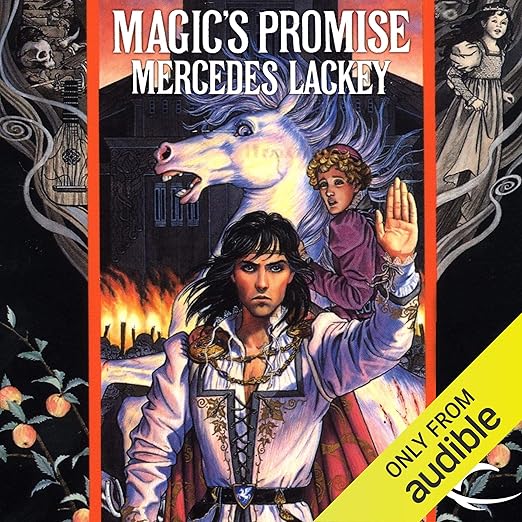
Quick Take
- Narration: Gregory St. John handles Vanyel’s exhausted, grief-saturated emotional register with real sensitivity, conveying the weight of twelve years of duty without letting the performance become monotonous.
- Themes: duty versus desire, the loneliness of exceptional power, self-acceptance and found family
- Mood: Melancholic and deeply character-driven, with moments of genuine tenderness and moral complexity
- Verdict: The middle book in the Last Herald-Mage trilogy earns its reputation as the emotional core of Mercedes Lackey’s Valdemar series, Vanyel in this volume is one of fantasy’s most carefully rendered portraits of endurance.
I first read Mercedes Lackey’s Last Herald-Mage trilogy when I was much younger, and I came back to it through this audiobook specifically because I wanted to know how it held up. The answer, with Magic’s Promise, is: better than most fantasy from that era, and better in ways that surprised me. What I remembered as a tragedy about a gay herald-mage in a magical kingdom turned out to be something more complex than memory had preserved, a study of what happens to a person when exceptional power is combined with profound grief and the relentless demands of duty over time.
The novel picks up twelve years after the events of Magic’s Pawn. Vanyel Ashkevron is now the most powerful Herald-Mage Valdemar has ever produced, and he is utterly hollowed out by it. The wild magic he channels constantly is taking its physical toll; the deaths and losses he has accumulated over a decade of service have taken a psychological toll that nothing has addressed. He is not quite broken, but he is close. Lackey does not soften this. The Vanyel of Magic’s Promise is a different person from the angry teenager of the first book, and the difference is not just maturity, it’s attrition.
What Changes Across Twelve Years and What Doesn’t
A reviewer who returned to the book after decades described loving Vanyel more in this volume than in the first, which seems counterintuitive given how much darker his situation has become. But I think I understand the response. The Vanyel of Magic’s Pawn is a character you want to protect. The Vanyel of Magic’s Promise is a character you want to understand. He has become who he was always going to become, a hero of Valdemar, respected and relied on by everyone, genuinely isolated in the way that exceptional people often are, and Lackey is honest that being necessary to everyone is not the same as being connected to anyone.
The family dynamic is one of the book’s most emotionally precise elements. Twelve years have not changed the Ashkevron household’s difficulty with what Vanyel is, his sexuality, his power, the way both set him apart from the family’s expectations. A reader who noted that when it comes to his family, nothing really changes, sounds like most families, identified something real about how Lackey uses the family home as a site of stasis within a story about growth. Vanyel has changed enormously. His family’s capacity to see that change is limited by everything they were before he left.
The Lineas Crisis and What It Demands
The plot mechanism that drives Magic’s Promise, the call for help from neighboring Lineas that draws Vanyel and his Companion Yfandes into a holocaust of dark magic, is classic Lackey: an impossible situation that tests not just power but judgment and moral clarity. But the Lineas plot is also more psychologically interesting than a standard quest because of what it asks Vanyel to witness and absorb. The dark magic he encounters there is not an external threat to be defeated cleanly. It has costs, and Vanyel has to reckon with those costs in ways that the first book’s more straightforward trauma didn’t require.
Gregory St. John’s narration is particularly effective in these sequences. A character who is near his limits physically and emotionally, still functioning, still making the right choices, but clearly running on something close to empty, that’s a delicate register to sustain over an eleven-hour audiobook. St. John manages it without allowing the performance to become a single sustained note of misery. There is wry humor in Vanyel when the situation permits it, and St. John doesn’t leave that on the table.
The “Mary Sue” Critique and Why It Matters Here
One long-time reader offered a criticism worth addressing directly: Vanyel is potentially too perfect, the world depending too heavily on his continued existence, everything he touches going right even in crisis. This is a genuine tension in Lackey’s writing across much of her Valdemar work, her protagonists often carry world-historical weight in ways that can make their struggles feel calibrated rather than organic.
I think Magic’s Promise partly earns its way around this criticism precisely because Vanyel’s competence is so visibly costing him. He succeeds because he is exceptional, yes. But the book is honest that exceptionalism is not a gift received for free. The foreshadowing for the trilogy’s conclusion that readers familiar with the final volume will recognize here operates as a constant undertone, and Lackey’s willingness to telegraph that Vanyel’s story will not end happily gives the character’s persistence a quality that transcends competence fantasy.
Who Should Listen and Who Should Skip
Listen if you’ve read Magic’s Pawn or plan to. The Last Herald-Mage trilogy is tightly sequential, and the emotional payoffs of Magic’s Promise depend on knowing who Vanyel was before he became who he is here. Listen if you want fantasy that takes its LGBTQ+ protagonist’s inner life as seriously as his external conflicts, Lackey was writing this kind of character decades before it was common, and the care still shows.
Skip if you haven’t read the first book. Also skip if you find protagonists who are exceptionally powerful frustrating rather than interesting, Vanyel’s power is not in question, and the book is not interested in pretending otherwise. The drama is psychological and moral, not whether he can win.
Frequently Asked Questions
Does Magic’s Promise work as a standalone audiobook, or do you need to start with Magic’s Pawn?
You genuinely need to start with Magic’s Pawn. The emotional weight of this book, Vanyel’s exhaustion, his losses, his complicated relationship with his identity and his family, depends entirely on knowing his history. Starting here would mean encountering a character at the end of a long arc without understanding what shaped him.
How does the book handle Vanyel’s sexuality, and does it feel dated given when Lackey wrote the series?
Lackey writes Vanyel’s identity with genuine care that holds up well. His sexuality is central to his character and his relationships rather than a plot device, and the prejudice he faces within Valdemar is treated seriously rather than as background color. Some of the period’s vocabulary and framing shows its age in small ways, but the fundamental respect for the character’s inner life does not.
Is Gregory St. John’s narration consistent across the Last Herald-Mage trilogy?
St. John narrates the trilogy consistently, which helps significantly in an audiobook series where the same character is followed across three volumes. His familiarity with Vanyel’s voice and emotional register deepens across the books, and listeners who begin with Magic’s Pawn will find his performance in Magic’s Promise builds naturally on what came before.
Who is Yfandes, and how central is the Herald-Companion bond to understanding the story?
In Lackey’s Valdemar universe, Companions are mystical horse-like beings who choose and bond with Herald-Mages, forming a deep telepathic connection. Yfandes is Vanyel’s Companion and one of his most important relationships, arguably the most stable connection in his life. Understanding the Herald-Companion bond is important context for this book, and it’s established in Magic’s Pawn.