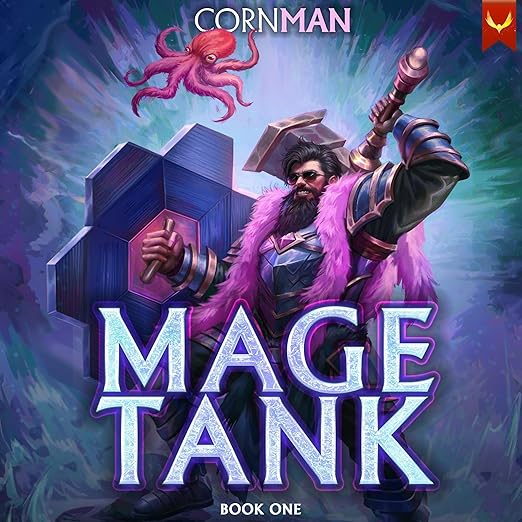
Key Details
- Narrator: Daniel Wisniewski captures Arlo's self-deprecating humor and the cosmic absurdity of a System that treats its newest arrival as its best running joke.
- Subjects: Isekai adventure, LitRPG progression, consequences and intentional build design
- Tone: Comic and kinetic, with surprising moments of genuine weight
- Bottom line: Fans of Dungeon Crawler Carl who want something with similar humor but a more deliberate approach to character building will find Mage Tank satisfying despite its rough edges.
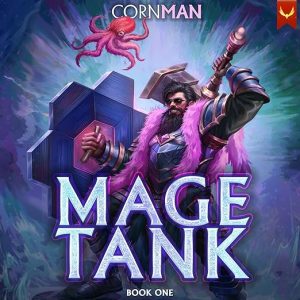
Cornman's Isekai LitRPG debut opens with a character death by high-velocity tree collision, which sets the tonal register accurately: Mage Tank is funny, self-aware about being funny, and genuinely interested in the question of what happens when a protagonist refuses to play the game the obvious way. Narrated by Daniel Wisniewski across twenty hours and thirty-seven minutes, this audiobook has the structural bones of a genre exercise, but the specific choices Cornman makes about intelligence, fortitude, and the relationship between power and survival give it more texture than the standard isekai setup delivers. Listeners who have grown comfortable with the conventions of LitRPG fiction will find familiar landmarks here, but the worldbuilding and character work distinguish it from the more formulaic entries in its crowded genre space.
What Stands Out
Arlo's central decision, to dump all his stat points into Fortitude rather than Intelligence despite Intelligence being his highest natural attribute, is the kind of build choice that LitRPG fiction usually reserves for the climax of the third book after the protagonist has exhausted every other option. Cornman makes it the opening premise and then spends twenty hours exploring what it actually means to be unkillable but not particularly formidable in any conventional sense. The answer involves absorbing punishment that would destroy anyone else, operating in a world that has no tutorial, and steadily convincing a party of strangers who are deeply suspicious of this unprepared newcomer that his approach, while bizarre, might not be as worthless as it appears.
The party dynamic is the audiobook's strongest structural element. Arlo arrives without armor, without weapons, and without a plausible explanation for how he got there, and the people he is immediately forced to Delve with know something is wrong. Cornman does not shortcut this tension by making the party instantly sympathetic or easily deceived. The growing trust, such as it develops, is earned through shared danger and Arlo's demonstrated willingness to absorb consequences on behalf of people who have given him no particular reason for loyalty. Daniel Wisniewski's narration handles the character differentiation within that party with clean specificity, tracking who holds what position in the group's evolving hierarchy without requiring the listener to do constant mental bookkeeping.
The humor is worth discussing in practical terms, because LitRPG comedy varies enormously in density and execution. Cornman's jokes live in the specific details of the System's behavior toward Arlo. The System, which governs how the world functions and distributes rewards for completing Delves, seems aware that Arlo's situation is absurd, and its interface responses read like messages from an entity that finds the whole arrangement thoroughly entertaining. One reviewer titled their assessment with the observation that they would not put too much faith in the words of a malevolent mind-controlling murder-sphere, which gives you an accurate sense of both the book's comedic register and the kind of obstacle Arlo eventually confronts.
One critical reviewer noted that the book could have used more editing, and that the author is perhaps overly attached to the concept of trauma as a character motivation in ways that reflect a younger author's tendencies. That observation is fair. Some of the emotional interiority is handled more schematically than the comedy deserves, and the sequel has reportedly disappointed at least some readers who were enthusiastic about the first volume. For this audiobook specifically, those imbalances are manageable and the genre satisfactions are genuine. Wisniewski finds the right balance between deadpan delivery and vocal engagement, which is harder to execute consistently across twenty hours than it sounds.
The worldbuilding deserves specific mention because Cornman is more rigorous about internal consistency than the genre average. The rules of the Delve system are introduced without exhaustive exposition dumps and then applied consistently, which means Arlo's build choices have real consequences that the narrative honors rather than conveniently sidesteps when they become inconvenient. Intelligent build choices with actual consequences is how the book describes itself, and that self-description is accurate.
Before You Commit to Mage Tank
At over twenty hours, this is a long first volume. Cornman establishes the world's rules, Arlo's relationship with the System, the party dynamics, and the specific mechanics of Delve progression simultaneously, which means the early hours require patience with setup that pays off later but can feel slow in the moment. Listeners who want wall-to-wall action will find the pacing uneven; those who appreciate character-building and intentional progression will find the investment worthwhile.
The series status is worth noting explicitly. This is Book 1, and the ending is appropriately open-ended. One review flagged that the sequel does not maintain the quality of the original, which may affect how listeners want to approach their investment in the world. If you treat each book on its own merits and make continuation decisions as you go, the first volume stands without needing the series arc to justify it.
Is This One for You?
Listeners who already enjoy LitRPG and Isekai fiction, particularly those who appreciated the humor and consequences-matter philosophy of Dungeon Crawler Carl or Full Murderhobo, will find this audiobook directly in their territory. Readers curious about the genre who want a friendlier entry point than some of the more mechanically dense LitRPG titles will find Cornman's emphasis on character and comedy accessible. Those who prefer fantasy without game-system mechanics, stat blocks, or deliberate build discussions should look elsewhere. The twenty-plus-hour runtime is a real commitment, and listeners who find LitRPG progression systems tedious rather than satisfying will not be converted by this title regardless of the quality of the humor.
Good to Know
Do I need to be familiar with LitRPG or Isekai conventions to enjoy the Mage Tank audiobook?
Prior familiarity helps but is not required. The book introduces its world's rules through Arlo's own disorientation, which provides natural exposition for newcomers. The genre conventions, including stat systems, progression mechanics, and Delve dungeons, are explained as Arlo encounters them. Readers who find those conventions tedious rather than satisfying should know the book leans into them throughout its twenty-plus hours.
How does Daniel Wisniewski's narration handle the humor and the multiple party members in this audiobook?
Wisniewski is well-cast for the comedic register. He distinguishes party members through vocal adjustments without overdoing the characterization, and he handles the System's interface text, which reads like messages from a mildly malevolent entity, with the right mix of deadpan and genuine bemusement.
Is Mage Tank a complete story in this audiobook, or does it end on an unresolved cliffhanger requiring the next book?
The central narrative questions introduced in the first volume receive meaningful resolution, though the world and its possibilities are open for continuation. This is Book 1 of a series, and the ending is designed to invite a sequel rather than to close the story entirely.
How does Mage Tank compare to Dungeon Crawler Carl in terms of tone and overall approach to the genre?
Both lean into dark comedy and a protagonist who survives through unconventional means, but Mage Tank is somewhat more deliberate in its progression mechanics and less relentlessly chaotic in its pacing. Fans of Dungeon Crawler Carl will find recognizable satisfactions alongside a different authorial sensibility that prioritizes intentional build logic over escalating absurdity.