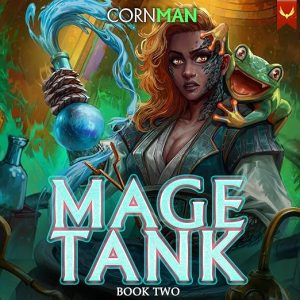
Mage Tank 2: A LitRPG Adventure audiobook picks up precisely where the first volume left off, which means new listeners who start here will be immediately lost, and returning readers of Book 1 will feel immediately at home. The author Cornman has built a LitRPG series around a specific promise: intelligent characters who make intentional build choices, consequences that carry across books, and a System whose rules are not just window dressing but a genuine source of mystery. The second volume keeps that promise across nearly twenty hours of narration from Daniel Wisniewski, which is a significant investment and, for the right reader, a worthwhile one.
How Mage Tank 2: A LitRPG Adventure Holds Up
The central tension in this volume is a System that is keeping secrets. Arlo and Fortune's Folly have defeated the avatar's soul fragment, but the victory has consequences they cannot yet measure, because the System itself is not transparent about what the phases of its operation mean. Not even the most seasoned Delvers know. Grotto refuses to elaborate. The party's response to this information gap is to do what any sensible LitRPG protagonist would do: run more Delves, talk to more Cores, and ask impolite questions until something breaks. What breaks, eventually, is a path to a foreign nation on the brink of war.
Reviewers have called it fun and ridiculous in the best sense, and fun and quirky, and those descriptions capture something real about Cornman's tonal balance. The book is not action all the time, as the synopsis itself acknowledges. It is a game-world fiction in which the characters feel the weight of their choices, joke about their situation with genuine comedic chemistry, and still manage to convey real stakes when the dangerous moments arrive. That balance is harder to achieve than the genre often makes it look, and Book 2 achieves it with the consistency that Book 1 established.
Why Mage Tank 2: A LitRPG Adventure Works as an Audiobook
Daniel Wisniewski's narration is a significant asset here. LitRPG audiobooks carry particular challenges for narrators because the genre requires alternating registers: system notifications, combat sequences, dialogue-driven comedic scenes, and occasional genuine emotional weight. Wisniewski handles all of these without the tonal whiplash that can plague the format. Fortune's Folly is an ensemble, and keeping the group's individual voices recognizable across nearly twenty hours requires real craft. The party's chemistry is one of the book's strengths, and a narrator who could not maintain that chemistry would undermine what Cornman has built.
Weak Spots in Mage Tank 2: A LitRPG Adventure
This is explicitly Book 2 in a series, and the synopsis's description of Orexis, the Get Out of Cage Free Card, and the System phases assumes reader familiarity with the events of Book 1. New listeners who have not read or listened to the first Mage Tank volume will spend a substantial amount of time confused by references that the narrative does not re-explain. The series does not front-load extensive recapping, which is a feature for returning readers and a barrier for newcomers. If you are curious about the series, start at the beginning.
The war-zone sequences in the foreign nation Arlo and company must navigate represent the book's most ambitious new setting, and they are where the consequences motif Cornman is committed to becomes most visible. The party cannot simply cut a bloody path through without cost, and the negotiations and political dynamics they encounter feel grounded in the world's internal logic rather than convenient plot devices. Readers who have grown frustrated with LitRPG series that abandon consequence in favor of escalating power fantasies will find Mage Tank 2 notably disciplined on this point.
The specific promise Cornman makes in the Mage Tank series, and keeps in Book 2, is that consequences matter. LitRPG as a genre has a significant escalation problem: series that begin with tight, meaningful progression often drift into power fantasies where the protagonist's build choices become formalities on the way to inevitable victory. Mage Tank resists this. The Get Out of Cage Free Card that Fortune's Folly receives from the System is powerful precisely because it is singular and uncertain; its effectiveness depends on conditions no one fully understands. The party treats this uncertainty seriously, which means the reader does too. Arlo's approach to the war-zone nation is similarly disciplined: the party genuinely considers whether violence or negotiation serves their goals better, and the answer is not always combat. For readers who value intelligent characters in the literal sense of characters who reason about their situation, rather than the genre shorthand of merely being told a character is smart, Cornman delivers on that promise across the full runtime of the second volume.
The Right Listener for Mage Tank 2: A LitRPG Adventure
LitRPG readers who have completed Book 1 and want to continue Arlo's story will find exactly what they are looking for: more Delves, more System mystery, ensemble comedic chemistry, and genuine consequence. Listeners who prefer their progression fantasy with intelligent characters making real decisions rather than plot-convenienced victories will find Cornman's series one of the stronger recent entries in the subgenre.
Skip and return to Book 1 if you have not read the first volume. Skip altogether if you are new to LitRPG and unsure about the genre conventions. The book assumes familiarity with progression fantasy mechanics, Isekai structure, and system-based world-building. General fantasy listeners without that background will find the terminology and structure more alienating than engaging.