Quick Take
- Narration: Greg Tremblay is the ideal fit for Kai Gracen’s sardonic internal monologue; he captures both the grit and the dark humor without tipping into parody.
- Themes: Identity under violence, trust in a post-merge world, chosen vs. biological belonging
- Mood: Propulsive and sharp-edged, with moments of genuine emotional weight amid the action
- Verdict: A stronger sophomore entry than the first book, and Tremblay’s narration makes Kai’s voice one of the most distinctive in LGBTQ urban fantasy audio.
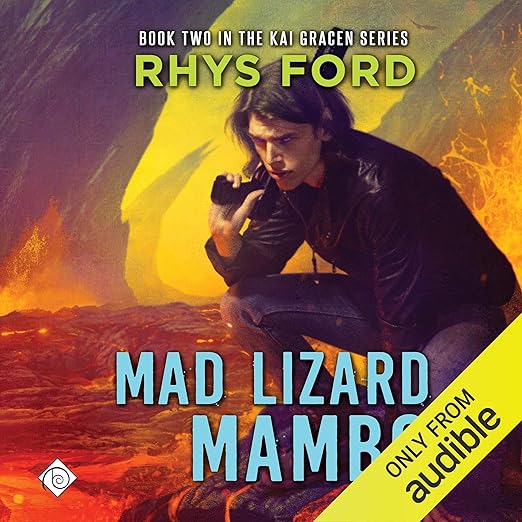
I was halfway through my Saturday morning when I realized I had been listening to Mad Lizard Mambo for nearly three hours without registering the time passing. That is not a compliment I hand out to action-heavy urban fantasy without thinking about it. Rhys Ford’s Kai Gracen series occupies a specific niche: post-apocalyptic urban fantasy with a queer protagonist, a dark sense of humor, and enough worldbuilding density that the first book can feel like a demanding orientation. The second book, which is what we have here, is where Ford’s investment in that world starts to pay off properly.
The premise involves a merged world where human and elfin populations coexist in a California that has been transformed by some unspecified catastrophic convergence. Kai Gracen is a Licensed Stalker, which is essentially a bounty hunter who deals with monsters and dangerous criminals, and he is also elfin, which in this world’s hierarchy carries specific social complications. The central mission in this installment takes him into the Nevada desert in search of a lost elfin Court that may hold the key to his people’s survival. What sounds straightforwardly quest-like turns into something more layered, because Kai’s past arrives alongside the plot.
Our Take on Mad Lizard Mambo
Several reviewers who found the first book hard to penetrate describe this one as the moment the series clicks. That tracks with how series worldbuilding tends to work: Ford spent the first novel building the infrastructure of this merged reality, and the second can use that foundation to run faster and dig deeper simultaneously. The exploration of Kai’s origins, which multiple reviewers flag as a highlight, earns its emotional weight because we have already spent enough time in Kai’s head to understand what being without those origins means to him. Ford is genuinely good at holding that kind of character-level consequence alongside the genre-level action.
One aspect of the series that is worth naming directly: this is gay-themed fiction where, as one reviewer put it bluntly, there is no explicit sex. The slow-burn dynamic between Kai and Ryder develops with real tension and growing intimacy, but Ford is clearly more interested in emotional proximity and complicated trust than in graphic physical content. Readers who came from explicit M-M romance may find this surprising; readers who prefer character development as the primary vehicle for romantic tension will find the approach satisfying.
Why Listen to Mad Lizard Mambo
Greg Tremblay is the specific reason this works as audio. Kai narrates in first person, and his voice is distinctive: sardonic, quick, capable of dark humor while processing genuinely traumatic information. Tremblay has an ability to hold all of those registers at once without making the performance feel schizophrenic. The comedy and the horror exist in the same breath for Kai, and Tremblay finds the exact timing that makes that work. He is the kind of narrator who makes you forget you are listening to a performance because he has fully inhabited the perspective rather than just reading it aloud.
The urban fantasy genre has specific audiobook challenges: world names, magical systems, and species terminology need to feel natural in a narrator’s mouth rather than stumbled over. Tremblay clearly knows this world well enough that the vocabulary never interrupts the flow. At eight hours and forty-nine minutes, this is a comfortable weekend listen that moves at a pace that earns its length.
What to Watch For in Mad Lizard Mambo
This is a series entry, not a standalone. Starting here without reading or listening to book one will mean meeting a world mid-stride, and the backstory essential to understanding Kai’s psychological architecture is distributed throughout the first book rather than efficiently summarized here. Ford does not spend much time catching up new readers. The reward for having done the groundwork, however, is that Mad Lizard Mambo can commit fully to developing its characters and expanding its world without the setup tax.
The action sequences are frequent and occasionally relentless, which one reviewer described as the series’s characteristic intensity rather than a flaw. If you prefer urban fantasy that operates at a more meditative pace, Kai’s world may exhaust rather than excite you. The gory moments that arrive in the Nevada desert sections are not softened, and Ford treats violence in this merged world with a matter-of-factness that is part of the genre’s appeal for its readership.
Who Should Listen to Mad Lizard Mambo
Ideal for listeners who have already encountered book one and want to know whether the series deepens. It does. Also genuinely suited to LGBTQ urban fantasy readers who have been frustrated by genre entries that sacrifice character complexity for either explicit content or sanitized adventure. The Kai Gracen series occupies a space between those poles with real conviction. Less suitable for listeners new to Ford’s world or to urban fantasy as a genre, who should start at book one regardless of how tempting this entry’s reviews may be.
Frequently Asked Questions
Do I need to have listened to book one before starting Mad Lizard Mambo?
Yes, very much so. This is a series entry that assumes familiarity with Kai’s world, the Sidhe Court structure, and the established dynamic between Kai and Ryder. Starting here will mean missing the context that makes the character development meaningful.
How explicit is the romantic content between Kai and Ryder in this installment?
The relationship develops with tension and emotional intimacy but without explicit sexual content. One reviewer specifically noted this as a surprise. The series is categorized as LGBTQ but operates more as slow-burn romantic urban fantasy than M-M romance with explicit scenes.
Is Greg Tremblay’s narration consistent with his performance in book one of the Kai Gracen series?
Tremblay narrates the full series, and his performance here is widely praised for capturing Kai’s sardonic, emotionally layered first-person voice. Reviewers describe this as one of the series’s consistent strengths across books.
How much of Kai’s backstory gets revealed in this book, and does it require prior knowledge to land emotionally?
Significant backstory about Kai’s origins is revealed here, and it is more emotionally effective if you have spent time with book one first. Ford does not recap extensively, so the revelations carry weight proportional to how invested the listener already is in the character.